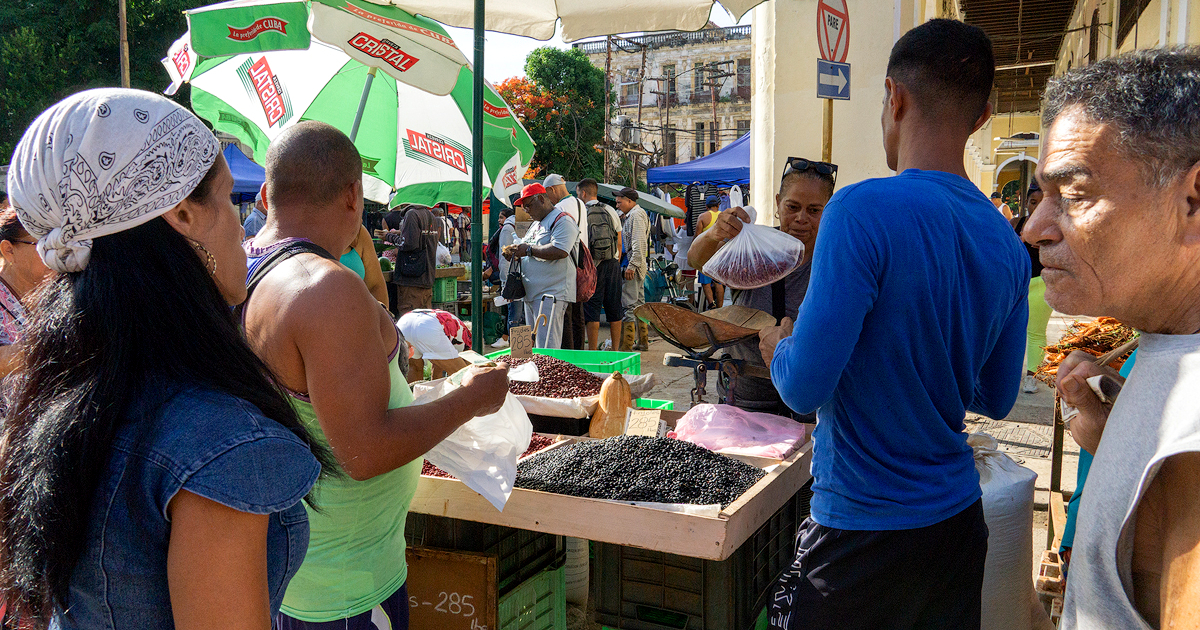
Inflation in Cuba shows no signs of letting up. According to the Report on the Cuban Economy from the Center for Cuban Economic Studies (CEEC) at the University of Havana, covering the first half of 2026, the spiral of prices has become one of the most devastating features of the current crisis.
The accumulated inflation reached 12.24% during the first half of the year, compared to 8.26% in the same period of 2025. The trend is unmistakable: official inflation started the year at 12.52% in January, climbed to 14.73% in April, to 18.27% in June, and to 20.70% in July, before reaching 25.19% year-on-year in August, with a monthly change of 4.92%, the highest of the year.
The main driver of the increase is food and non-alcoholic beverages, which saw a year-on-year price rise of 36.01% in August and accounted for 63.18% of the total increase in the consumer price index in July.
The numbers translate into a harsh reality for Cuban families: a pound of chicken sells for 800 pesos in MiPYMES in Havana, a bag of milk has reached 6,500 pesos in Matanzas, and a bottle of oil ranges between 3,800 and 4,000 pesos, all in contrast to a minimum wage of just 3,210 pesos per month.
"Guys, we need to put a quick STOP because I don't know where this is heading. Here in the MiPYMES, a pound of chicken costs 800 pesos," reported Dalma Rosell Marrero, a resident of Habana del Este, in a Facebook post.
The cost of living for a small family in Havana exceeds 205,000 pesos per month, while the average state salary hovers around 7,000 pesos.
The CEEC identifies the main trigger as the U.S. sanctions system, which, since January 2026, has simultaneously impacted the energy, trade, tourism, investment, and finance sectors of the Island.
"The distinctive feature of the first half of 2026 is not only the continuation of the crisis but also the emergence of a sanctions system that simultaneously affected energy, trade, tourism, investment, and finance," the report states.
This was compounded by the loss of subsidized Venezuelan fuel supply following Nicolás Maduro's capture on January 3, which left Cuba— a country that only produces crude oil to cover 40% of its energy needs— without its main source of external support.
In response, the regime approved a package of 176 measures in June that included Resolution 150/2026 from the Ministry of Finance and Prices, which eliminated price caps on chicken, oils, powdered milk, pasta, and sausages. Far from stabilizing the market, the measure unleashed a new spiral.
The Prime Minister Manuel Marrero Cruz stated before parliament that the government "will no longer continue to approve capped prices."
The confusion over who sets the prices reached such a level that the very Periódico Girón, the official organ of the PCC in Matanzas, opened a public debate asking "Who sets the price?" in Cuba. The readers' response was unequivocal: "The price is set by whoever wants to."
The provincial government of Matanzas closed 46 establishments in September for price violations, without any visible improvement in the situation.
Independent economists estimate that the real inflation rate—including the informal market—hovers around 67% year-on-year, a figure that led economist Steve Hanke to rank Cuba among the countries with the highest inflation in the world, surpassed only by Venezuela, Iran, North Korea, and Sudan.
As an additional indication of monetary deterioration, the Central Bank of Cuba issued on September 16 10,000 and 20,000 peso bills, the highest denominations in the country's history, while the informal dollar surpassed 700 pesos, setting a new historical record.
The CEEC warns that the same restrictions that make a structural transformation more urgent "also reduce the resources, time, and political margin available to implement it," a contradiction that, if not resolved, suggests that the close of 2026 will far exceed the threshold of 25% official inflation.
Related videos:
Filed under: