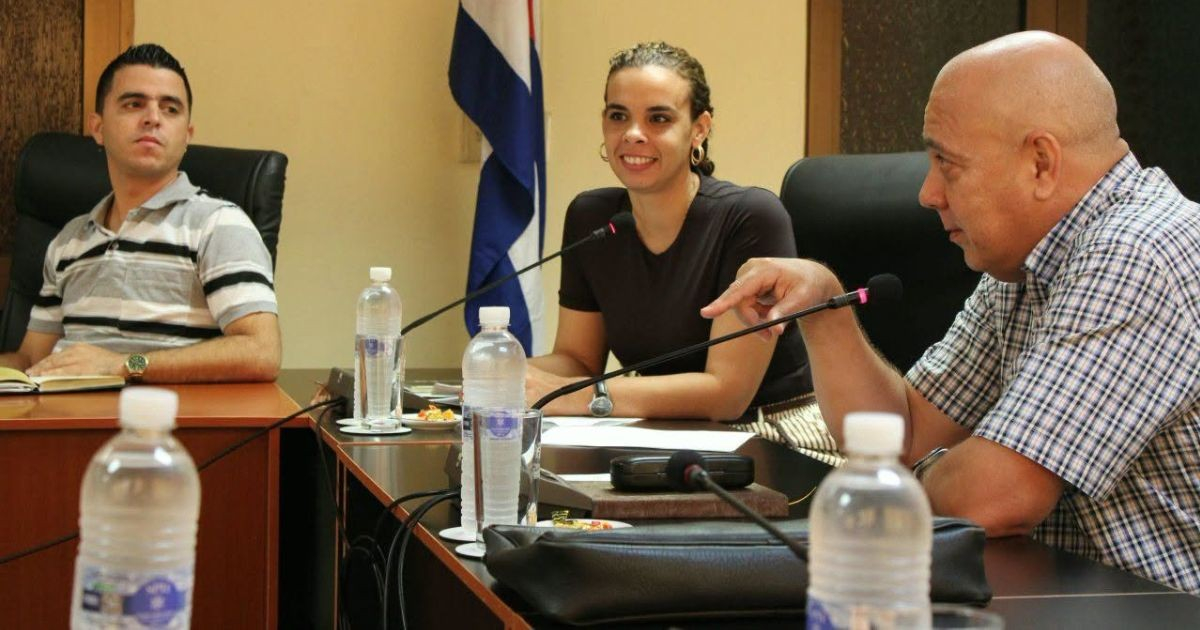
Roberto Morales Ojeda, Secretary of Organization of the Central Committee of the Communist Party of Cuba, met with the national leadership of the Union of Young Communists (UJC) in what the organization's First Secretary, Meyvis Estévez, described on Facebook this Saturday as "a moment of profound significance."
Estévez, showered in sweet tenderness, published a passionate account of the meeting on his personal account, where he compared the leader's presence to that of a supportive parent: “Coming as a father who accompanies his children in challenging times fills us with pride and, at the same time, commits us not to betray that trust.”
According to the leader herself, in the dialogue they "analyzed the priorities of the country and the youth organization," and Morales Ojeda emphasized "the vanguard role of the militants and their responsibility in mobilizing the youth amid the implementation of economic and social transformations." Transformations that, for most Cubans, result in power outages of more than 20 hours daily and electrical deficits exceeding 2,000 MW.
The secretary of the UJC went further in her sweetened enthusiasm, stating that "belonging to the UJC is not limited to a card or a meeting; it is demonstrated in the ability to take the lead in every activity, to take on tasks with discipline, and to inspire others by example." A statement that, in light of the Cuban reality, sounds more like a fanciful slogan than a concrete action plan.
The conclusion of the official text was even more grandiloquent: "We young people must be on the front lines, not out of obligation, but out of conviction, because the current generation has the responsibility to preserve and continue the Revolution for future generations."
The question that many Cubans are asking is which future generations, if about 50% of those who emigrate are young people under 35 years old, according to researchers at the Center for Demographic Studies (CEDEM).
Internet users were quick to respond with the irony the situation deserves. "What did they resolve? Nothing, just the good life of the leaders," wrote one user in the comments of the post. Another was even more direct: "We young people are the ones who will defeat communism." A third, without beating around the bush, issued the challenge: "Please share any achievements."
The contrast between the triumphalist language of the leader and the reality faced by young Cubans could hardly be more stark. Since 2021, over a million Cubans have left the island, and a survey released in 2025 among more than 4,400 Facebook users revealed that 93% of the participants would leave the country "tomorrow" if given the chance.
Meanwhile, the UJC is accumulating propaganda campaigns —youth parades, anti-imperialist festivals, Fidelist think tanks— but it's losing members at a steady pace: its membership dropped from 609,000 to 415,000 members between 2007 and 2024, a reduction of approximately 32%.
Meetings, gatherings, plenaries, campaigns: the regime on the island has been perfecting the art of seeming active without resolving anything for decades. The question that Cubans keep asking on social media every time a new photo of leaders sitting around a table appears remains unanswered: what did they resolve?
Related videos:
Filed under: