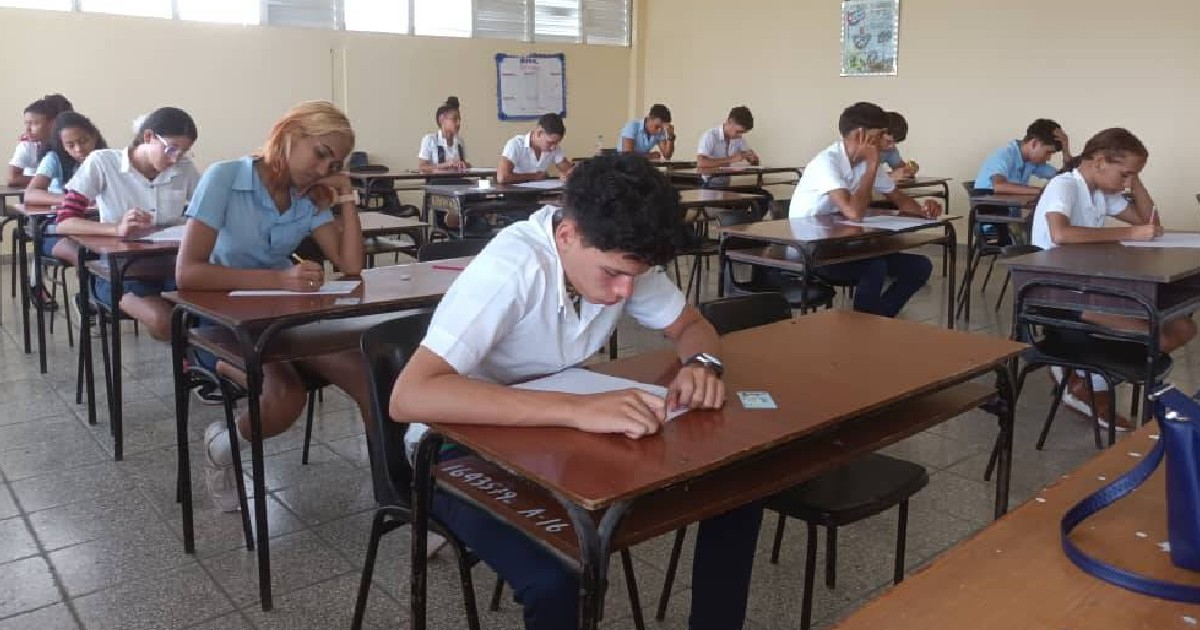
An English teacher from the Ramón López Peña Basic Secondary School in San Cristóbal, Artemisa, published a reflection circulating on social media that starkly summarizes the crisis of the Cuban education system: the double school session, far from being a pedagogical solution, is "a way to cover up the fact that the school is falling apart."
The educator, identified as Juana, 36 years old and a mother of two, shared her testimony on Facebook through her former teacher from the pedagogical institute, Pepe Morejón, who disseminated and publicly supported her. Morejón urged the educational authorities of San Cristóbal and the province to revoke the measure, which he described as having "only administrative character and not pedagogical, much less psychological."
"When they announced the double session, I felt a knot in my stomach. Not because I don't want to teach more classes, but because I know what that means in a municipality like ours, where transportation is a miracle, water comes when it wants, and the electricity goes out for 18, 20, or 24 hours," Juana wrote.
The teacher describes a day that starts at six in the morning with the uncertainty of whether there will be water or electricity. She arrives at school already exhausted, teaching in classrooms without fans with groups of 40 students and no snacks during the break. "The double shift did not come with anything. There are no more teachers, no more food, no more transportation, no more electricity. Just more hours," she stated.
Without access to audio, videos, or the internet, he teaches English "with chalk and a blackboard, with songs I create, with miming." To make matters worse, there is a shortage of teachers for English, math, and history at his school. In this context, the salary feels like an affront: "I earn less than the cost of a chicken. I can't afford shoes, soap, or a decent snack for my children."
That salary has concrete figures. Resolution 18/2026, implemented from July 1, 2026, established basic salaries for teachers and professors ranging from 6,130 to 7,735 Cuban pesos per month, depending on their qualification level. At the informal market rate at the end of September, these amounts equate to less than 11 dollars.
A basic purchase in the informal market can exceed the salary of a newly graduated teacher. The result is the exodus: "Those of us who remain do so for the kids, not for the salary," wrote Juana.
The testimony is not an isolated case. The 2026-2027 school year, which began on September 1, started with a shortage of at least 24,000 teachers —12.5% of the expected positions— leaving thousands of students without a permanent teacher. The Minister of Education, Naima Ariatne Trujillo Barreto, acknowledged before the start that schools would open under "very difficult" conditions.
The post generated responses from numerous teachers who confirmed experiencing the same situation. A university professor from Pinar del Río wrote that she remains in the classrooms "out of love and dedication," but that with her salary "she can’t even buy the rice she needs for a week." A retired teacher with 44 years of service recounted that her pension is not enough to buy a dozen eggs a month and that today she has four jobs. “Will Cuban teachers only be able to rest in the cemetery?,” she asked.
Juana concluded her reflection with a phrase that encapsulates both protest and resilience: "I hope that one day the Cuban school will be a place where teaching is not an act of forced heroism. In the meantime, I will continue to give my English classes as best as I can, but I will not pretend that this works."
Related videos:
Filed under: