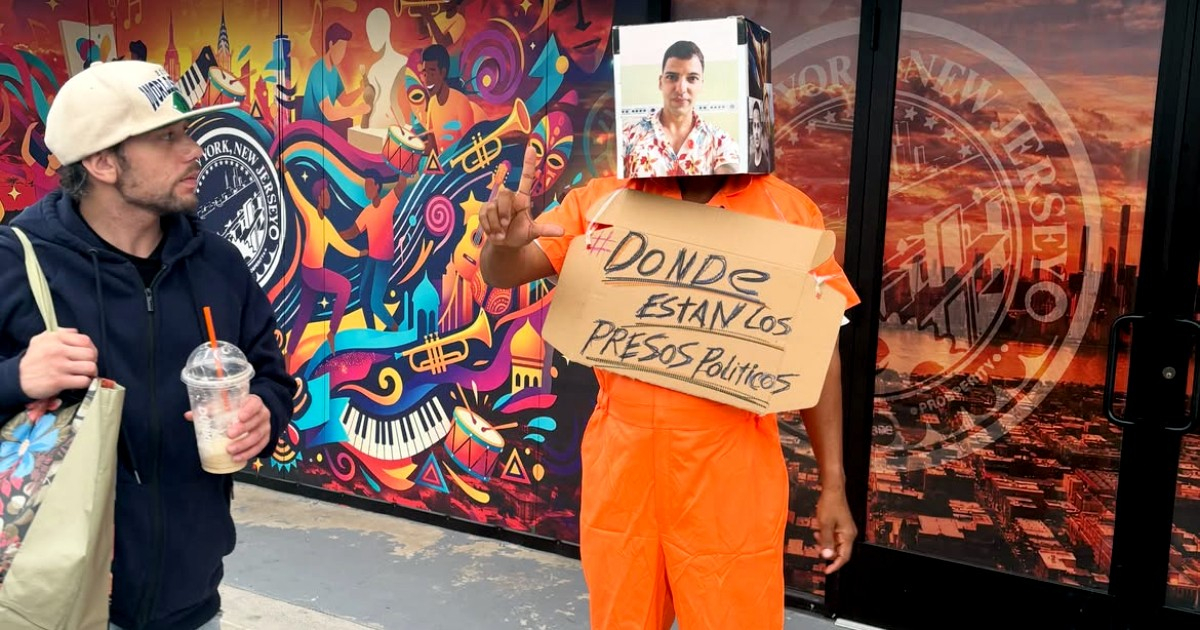
Dressed in an orange prison uniform —a symbol of incarceration— and with a cardboard box on his head covered in photographs of political prisoners, Luis Manuel Otero Alcántara brought his art of protest to the West New York Cultural Center this Sunday, in a performance that directly challenged the Cuban regime regarding the hundreds of people imprisoned following the protests on July 11, 2021.
The event was part of "Libres x Derecho 2: Voices of 11J," organized by Juventud Cuba MDJC and CubaLex, described by the artist himself as "a space to talk about memory, human rights, and those who remain imprisoned for political reasons."
Otero Alcántara presented a reworking of his piece "¿Dónde está Mella?", created in 2017 in Havana, when he stood as a living statue asking about the missing bust of the student leader Julio Antonio Mella during an urban renovation, which was interpreted as a critique of the symbolic erasure of historical memory by the Cuban state.
In its 2026 version, the question evolved completely: "I presented a new version of my performance Where is Mella? This time the question changed: Where are the political prisoners?", the artist wrote.
And the recipient also changed: «The question was no longer just for the audience. I asked it directly to the dictatorship: How much longer will there be so much suffering? How much longer will the confinement last? How much longer will the pain of so many families endure?»
The sign he held during the protest summarized the demand in a single line: "#WhereAreThePoliticalWeights".
Otero Alcántara, co-founder of the San Isidro Movement, arrived in Miami on July 18 of this year after being released by the regime on the condition of permanent exile, having served five years in prison for charges of "offending national symbols," "contempt," and "public disorder." He described his departure as an expulsion.
Since his arrival in exile, the artist has not ceased his activism: he exhibited in Miami works created during his imprisonment and, in September, he was portrayed by former President George W. Bush and included in a book about political prisoners and dissidents.
The performance on Sunday in New York is one of their first high-profile artistic actions in the Northeast of the country, just over two months after their arrival.
The concept of artivism —a fusion of art and activism— has deep roots in Cuban cultural resistance. The artist Tania Bruguera founded the Hannah Arendt Institute of Artivism (INSTAR) in Havana in 2015, an institution that received the Arnold Bode Prize 2021 in Kassel and participated in documenta fifteen in 2022.
The urgency of Otero Alcántara's claim is supported by concrete figures: according to Justicia 11J, in April 2026 there were 775 political prisoners in Cuba, with 338 of them directly linked to the protests of 11J. Prisoners Defenders raised that count to 1,339 by the end of August.
The releases announced by the regime have proven insufficient: in March, the release of 51 individuals was announced, but Justicia 11J could only verify 20. The April pardon freed over 2,000 inmates, but explicitly excluded those convicted of "crimes against authority," the legal category used precisely against the demonstrators of July 11.
Let the Cuban people go. Let the political prisoners go. May no prison be able to contain the desire for freedom forever, concluded Otero Alcántara in his post.
Related videos:
Filed under: