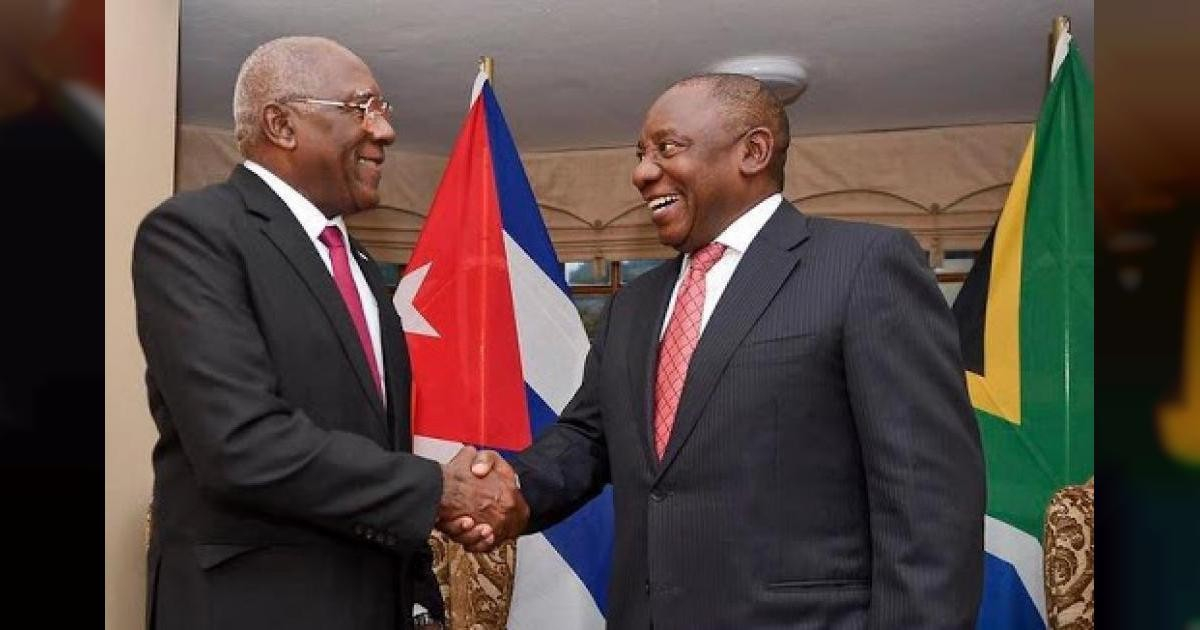
The expenditure of over 1.4 billion rands —more than 80 million dollars at current exchange rates— on agreements and cooperation programs with Cuba has once again sparked controversy in South Africa, this time amid revelations about the deterioration of the African country's diplomatic properties abroad, according to the local newspaper Newsday.
Ryan Smith, a member of the Democratic Alliance (DA) and spokesperson for the party on international affairs, questioned the government's priorities after a parliamentary response from the Minister of International Relations and Cooperation, Ronald Lamola, revealed that the necessary repairs to embassies and other South African properties abroad are estimated to cost 830 million rands.
The figure is based on reports concerning the condition of those properties over three years. Repairs for the assets of the South African High Commission in the United Kingdom are estimated at around 170 million rands, while those for the embassy in the Netherlands are approximately 110 million.
Smith contrasted those outstanding expenses with the approximately 1.4 billion rands allocated over the last decade to various agreements with Cuba, and accused the African National Congress (ANC) of prioritizing its international political alliances over the needs of the country itself.
However, that amount does not correspond solely to financial aid given to Havana. An investigation by the DA itself based on parliamentary responses estimated the combined cost of agreements with Cuba at 1.425 billion rands across five government departments.
The largest portion went to Defense, with over 1.076 billion rands. Approximately 138 million was accounted for in Public Works; 83 million in Health; 64.6 million in Human Settlements, Water, and Sanitation; and 63 million in Basic Education. The funds were linked, among other issues, to the hiring of Cuban professionals and service providers.
A relationship marked by controversies
The multimillion-dollar agreements between Havana and Pretoria have sparked controversies for years.
In 2021, data about bilateral contracts in the military, hydraulic, and healthcare sectors also emerged, which, according to the figures released at that time, exceeded 93 million dollars. This amount corresponds to estimates published at that moment and should not be confused with the 1,425 million rands currently cited by the Democratic Alliance, calculated from agreements and expenditures identified over the past decade.
The
Health cooperation has also come under scrutiny. In 2024, it was reported that the province of Gauteng was spending around $745,000 annually on 11 Cuban doctors, while hundreds of South African professionals were struggling to find employment in the public sector.
Medical cooperation between the two countries dates back to an agreement signed in 1996 during the administrations of Nelson Mandela and Fidel Castro. South Africa has also sent students to train at Cuban universities and hired healthcare professionals from the island.
Another controversial episode occurred during the pandemic, when the South African Armed Forces purchased Interferon Alpha-2b from Cuba for about $17.7 million without initially having the necessary health authorizations. Part of the medication ended up being destroyed or returned and the irregularities surrounding the operation were subject to investigations and political criticism.
In December 2024, the South African Air Force also ended a program that had been sending cadets to train in Cuba since 2014. Military authorities pointed out difficulties in reconciling the training received on the island with the operational standards used in South Africa.
Controversies have continued up until recently. In early September 2026, the South African National Defence Union (SANDU) called for an investigation into allegations that 38 South African military personnel sent to Cuba for training were pressured to contribute part of their financial allowances to needy Cuban citizens.
The South African Defence Forces later denied that the military had been pressured to provide money.
Despite these controversies, the South African government maintains a close relationship with Havana.
In August, the International Relations Committee of Parliament reaffirmed its support for Cuba and highlighted bilateral cooperation in health, education, and vocational training. It also noted that South Africa previously granted an economic assistance package that included a loan component of 210 million rands, of which approximately 13 million remained outstanding. According to Parliament, Cuba has met the agreed deadlines for those payments.
The new controversy arises precisely when sectors of the South African opposition claim that public resources allocated to foreign policy should be focused on domestic needs and the maintenance of the country's own diplomatic infrastructure.
“The taxpayers' money that finances DIRCO’s budget is not meant to keep the ANC's international friends afloat,” Smith stated, calling for a reorientation of the budget priorities of the Ministry of International Relations.
Related videos:
Filed under: