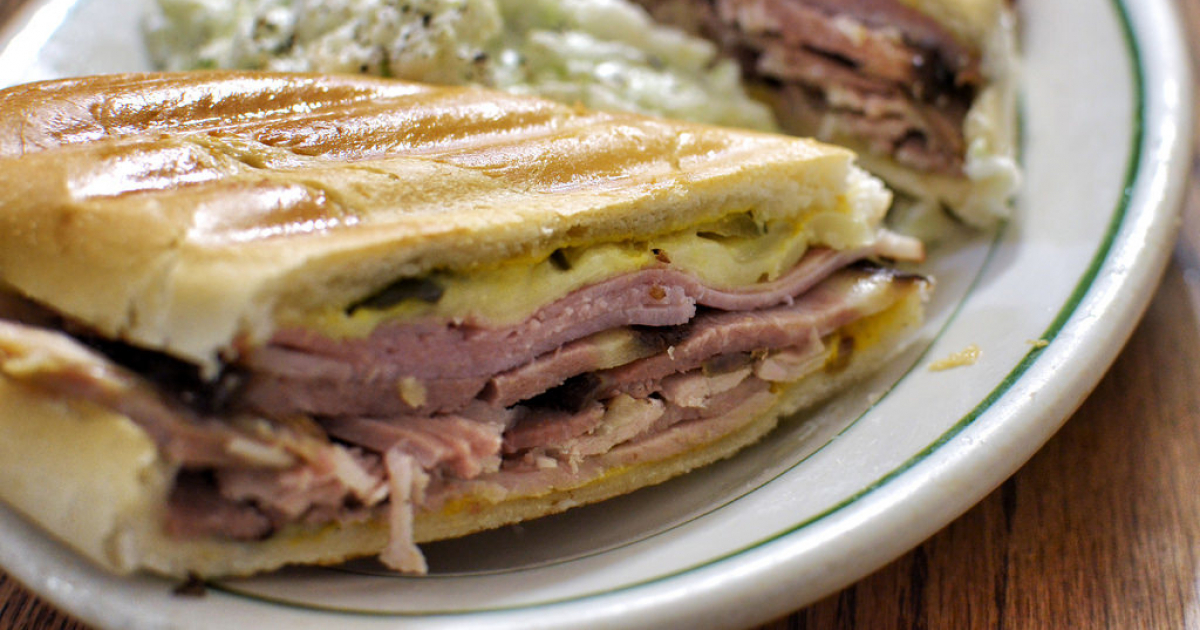
Miami and Tampa have been claiming the Cuban sandwich as their own for decades, one of the most recognizable dishes in Cuban-American cuisine. However, research into its history points to a more complex answer: its roots are in Cuba, although it was in Florida that it evolved into the form known today.
A report published by CNN Travel reconstructed the journey of the popular sandwich based on the book The Cuban Sandwich: A History in Layers by Andrew T. Huse, Bárbara C. Cruz, and Jeff Houck, along with testimonies from historians, restaurateurs, and chefs from both cities.
The Cuban sandwich absolutely has its origins in Cuba, said Cruz, a professor at the University of South Florida and one of the authors of the book.
According to the research, in its early versions on the island, it resembled the Spanish bocadillo: bread accompanied by cheese and some available protein. By the end of the 19th century, it evolved into what began to be known as “mixto”, precisely because it combines more than one type of meat.
The researchers even found ads from old bakeries in Havana promoting mixed sandwiches, providing evidence that the concept was already circulating in Cuba before becoming established in the United States.
Cuban emigration later brought this preparation to different U.S. cities. Key West saw a significant influx of Cubans around 1868, while Tampa began to transform with the expansion of the tobacco industry.
In 1885, Spanish entrepreneur Vicente Martínez Ybor moved part of his tobacco manufacturing operations to Tampa. The arrival of Cuban workers and those from other nationalities helped to create the environment in which the sandwich evolved.
For Houck, it was precisely in Tampa, between the late 1880s and the 1890s, where the snack began to take on the form that later became popular. It was a convenient meal for the workers in the tobacco factories, who could eat it quickly and even save part of it for later.
The traditional version of Tampa ultimately reflects the diversity of Ybor City as well: in addition to roasted pork, ham, Swiss cheese, pickles, and mustard, it includes Genoa salami, an ingredient associated with the city's Italian community.
Miami developed a different tradition. The significant influx of Cubans to South Florida mainly occurred after 1959, allowing the city to build its own version and an equally strong identity around the sandwich.
One of the most noticeable differences is precisely in the salami: it is common in the Tampa recipe, but it is not part of the classic Miami version.
There are also differences in the bread. According to Houck, the one from Tampa is very crispy on the outside and soft on the inside, while the one from Miami has a thinner, more delicate crust and is often pressed to achieve a greater texture.
The rivalry is not new. Tampa was declared the historical city of the Cuban sandwich in 2012, a decision that fueled the controversy with Miami.
Years later, the debate continued to be present at the International Cuban Sandwich Festival in Tampa, where the inclusion of salami among the official ingredients sparked criticism from South Florida.
Miami has also made the sandwich a part of its culinary identity: every August 23, the Cuban Sandwich Day is celebrated there.
The relationship between Tampa and the recipe remains especially evident in Ybor City. The historic La Segunda Bakery, founded in 1915 and managed by four generations of the Moré family, currently produces more than 20,000 loaves of bread per day, many specifically intended for Cuban sandwiches.
The recipe, however, has long transcended Florida. It has reached restaurants in numerous countries, and the Tampa festival has even welcomed international competitors.
In 2026, a young man raised in Key West opened a business in Texas dedicated to the traditional Cuban sandwich recipe, yet another example of how the dish has continued to travel with the diaspora.
Thus, the question of where it was born does not have a single-city answer: research places its direct roots in Cuba and its transformation into the modern version in the Cuban communities of Florida, with Tampa playing a decisive role since the late 19th century.
However, Miami, arriving later to that story, later transformed the sandwich into one of the gastronomic symbols of its own Cuban community.
Related videos:
Filed under: