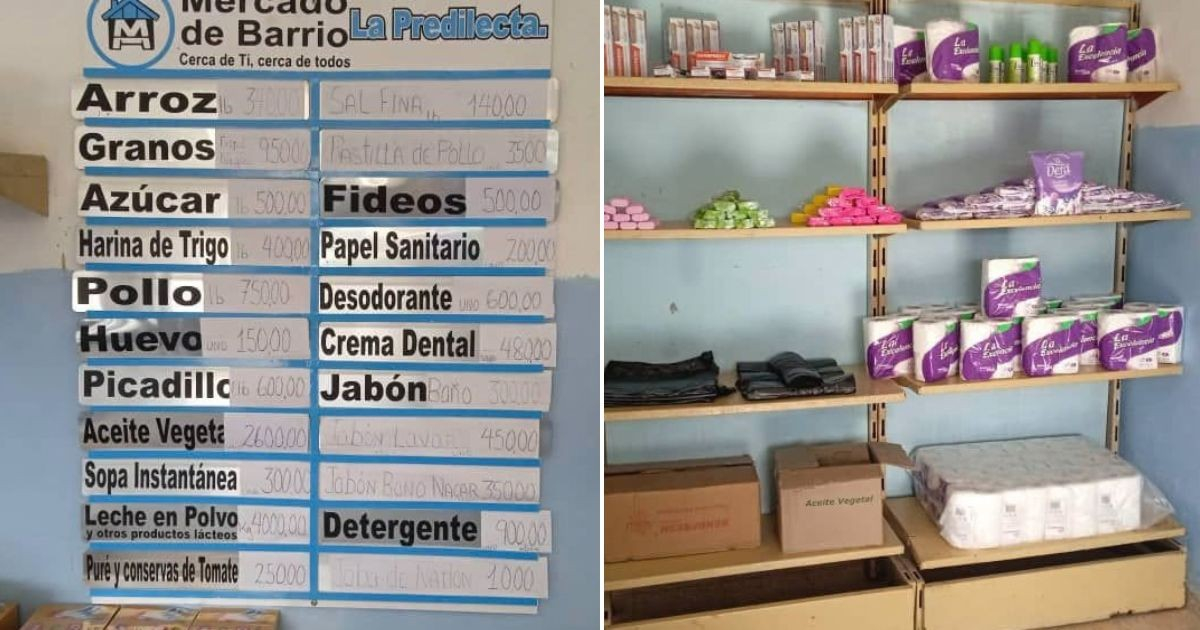
A recently converted grocery store into “Neighborhood Market” in Contramaestre, Santiago de Cuba publicly displayed its price list, featuring products such as rice, chicken, eggs, oil, powdered milk, grains, and hygiene items.
The opening of the store La Predilecta, located in the Frank País Popular Council, was announced this Monday in a Facebook post, where it was presented as part of the so-called "Economic and Social Transformations."
"The 'La Predilecta' Store was inaugurated today as a Community Market, Close to you, close to everyone," the post stated, accompanied by several photographs of the establishment.
One of the images shows the price list of available products. Among the amounts listed are rice at 350 pesos, grains at 950, sugar at 500, wheat flour at 450, and chicken at 750.
Eggs for 150 pesos each, ground beef for 600, vegetable oil for 2,000, instant soup for 300, and powdered milk for 4,000 are also displayed. In the section for other products, noodles are priced at 500, chicken bouillon cubes at 350, deodorant at 600, toothpaste at 480, and detergent at 900, as can be seen in the photograph.
The list also includes items such as toilet paper, bath soap, table salt, and tomato puree or canned tomatoes. The published image is dated September 28, 2026.
Reactions were predominantly critical of the prices and the supposed benefits of the new market. Several users pointed out that they do not see discounts compared to other sales points and questioned whether the amounts could be considered affordable for workers and retirees.
Among the harshest comments, one person summed up the initiative like this: "they brought the mipymes closer to home", referring to the fact that, despite being a reconverted state-run store, the prices seemed similar to those of private businesses.
Others users stated that "the prices are the same", that they are "almost higher than in the stores" and that they are "unreachable for the worker".
There were also criticisms from those who felt that the measure is "more of the same" or that it simply involved changing the name of the establishment without addressing the underlying issue.
Some comments emphasized retirees and low-income workers, questioning whether they will really be able to afford products like oil, chicken, or powdered milk at those prices.
The opening in Contramaestre is part of a project that the Cuban government began to extend this year across various provinces.
The first known municipal pilot of the "Mercado del Barrio" launched on July 23 in Plaza de la Revolución, Havana, through a bidding process to incorporate warehouses, butcher shops, and other establishments into a shared management model between state entities and private actors.
The initiative was subsequently regulated by the Resolution 16/2026 of the Ministry of Domestic Trade, published in the Official Gazette on August 4th and effective from the 11th of that month.
The scheme allows small and medium-sized enterprises, cooperatives, self-employed workers, and other economic actors to manage state establishments under different contractual modalities.
Since then, the model began to be replicated in other provinces. In August, Ciego de Ávila put six warehouses up for auction, while Santa Clara offered 16 establishments to non-state managers in September, with incentives that include up to two years without paying rent.
In mid-September, a MINCIN official stated that there were already 30 establishments operating under this project in Pinar del Río, Artemisa, Havana, Matanzas, Camagüey, Granma, Santiago de Cuba, and Guantánamo. Havana, Camagüey, and Guantánamo would each have seven.
The government claims that these markets should sell basic products between 15% and 30% cheaper than other stores, although official figures have varied depending on the region and the source. In a market recently opened in Boyeros, Havana, for example, the authorities spoke of discounts ranging from 10% to 15%.
Related videos:
Filed under: