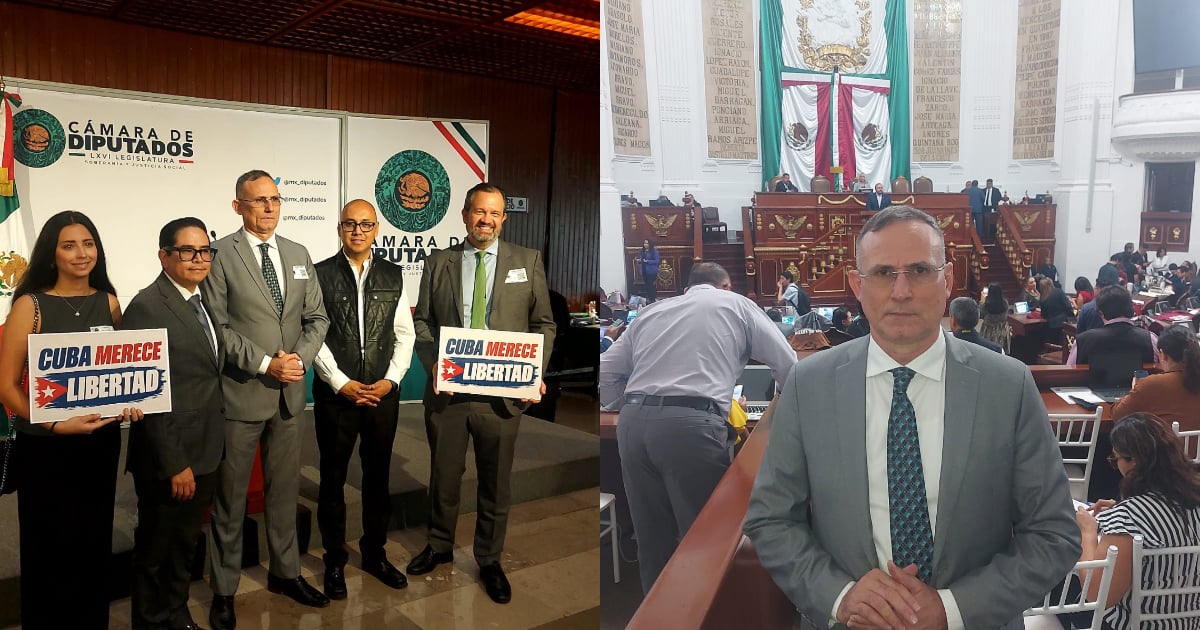
On Wednesday, a new edition of the Foro América Libre will be held in Mexico City, a space that brings together political leaders, parliamentarians, academics, representatives of civil society organizations, and advocates for democracy from numerous countries in Latin America and Europe. Founded in 2023, the Forum has established itself as a meeting point for center and center-right organizations committed to representative democracy, the rule of law, human rights, and economic freedoms.
For Cuban democrats, participating in international forums like this holds special significance. Cuba is undergoing a profound economic, social, political, and humanitarian crisis, while numerous actors both inside and outside the island are working to coordinate efforts in favor of a democratic transition, the release of political prisoners, respect for fundamental freedoms, and the establishment of institutions capable of ensuring prosperity and the rule of law.
The Latin American experience also demonstrates the importance of international networks. For decades, socialist movements and governments have established mechanisms for regional political coordination such as the São Paulo Forum and, later, the Puebla Group. The latter is currently defined as a space for the articulation of progressive leaders from different countries, and among its founders are figures from the Latin American left such as Brazilian President Luiz Inácio Lula da Silva and Uruguayan President Yamandú Orsi, allies of the Cuban communist regime. The President of Mexico Claudia Sheimbaum is also closely linked to this group.
In light of this reality, spaces such as Foro América Libre aim to strengthen cooperation among organizations and leaders from different political traditions. The Konrad Adenauer Foundation, one of the institutions connected to the meeting, explains that its regional program specifically focuses on cooperation among Christian-democratic and center parties in Latin America. For its promoters, the Forum serves as a platform to exchange experiences, analyze threats to democratic institutions, and establish relationships among leaders from different countries.
The regional situation has changed considerably during 2026. The capture and ousting of Nicolás Maduro in January marked a profound alteration of the Venezuelan landscape and the political balances that had prevailed for years. However, the Venezuelan transition remains incomplete. Recent reports from the United Nations indicate that repressive structures created during the previous era remain active and that hundreds of political prisoners continue to be incarcerated. At the same time, the interim government led by Delcy Rodríguez has promised elections, although there is still no definitive timeline.
This process demonstrates that the replacement of a leader does not automatically equate to a transition to democracy. Independent institutions, free and competitive elections, separation of powers, freedom of the press, guarantees for the opposition, and effective respect for all human rights are needed.
For those of us working towards the democratization of Cuba, this Forum holds special significance. The Cuban transition cannot be reduced to a mere change of names. It must involve an institutional transformation that allows for the recovery of fundamental rights, guarantees political pluralism, establishes independent courts, and creates the conditions for citizens to freely decide the future of the country.
The presence of representatives from the pro-democracy Cuban opposition at the Free Americas Forum provides an opportunity to directly explain the magnitude of the crisis facing the Island, to showcase the work being carried out by organizations both inside and outside of Cuba, and to present the coordination initiatives that have emerged among various opposition sectors both on the Island and in exile.
It also allows for dialogue with parliamentarians, political organizations, and representatives of civil society from other countries about the role of the international community. The United States maintains an active policy regarding Cuba, while the European Parliament and various European and Latin American governments have repeatedly addressed the situation of human rights and political prisoners in Cuba. Moreover, Washington has increased its pressure on Havana during 2026, and President Donald Trump recently stated before the United Nations that he expects political changes in Cuba.
From the perspective of the Cuban democratic opposition, these international relations are particularly relevant because no transition occurs in complete isolation from its regional environment. The experiences of Central and Eastern Europe, Latin America, and other regions demonstrate that international solidarity, diplomatic and economic pressure, and support from democratic institutions can play a significant role in certain processes of opening up.
But the fundamental responsibility lies with the Cubans themselves. It is the people of Cuba, the internal opposition, the exile community, and civil society who will have to lay the foundations for a future democratic society.
The importance of Cuba extends beyond its borders. For more than six decades, the Castro-communist regime has not only been an enemy of freedom, human rights, and a free economy in the largest of the Antilles, but it has also played a significant role in promoting extreme leftist ideas in Latin America, throughout the American continent, and beyond.
Forums like América Libre are very important for leaders and organizations that share certain principles to get to know each other, coordinate positions, and establish lasting relationships that strengthen the fight for democracy and human rights in a world where authoritarians are becoming increasingly bold.
For Cuban democrats, being present means bringing the reality of Cuba to leaders of numerous countries, explaining the aspirations of those of us who demand rights and freedoms, and participating directly in one of the fundamental debates of our time: how to preserve democracy and build institutions capable of ensuring freedom, justice, the rule of law, and well-being for future generations.
Related videos:
Filed under:
Opinion article: Las declaraciones y opiniones expresadas en este artículo son de exclusiva responsabilidad de su autor y no representan necesariamente el punto de vista de CiberCuba.