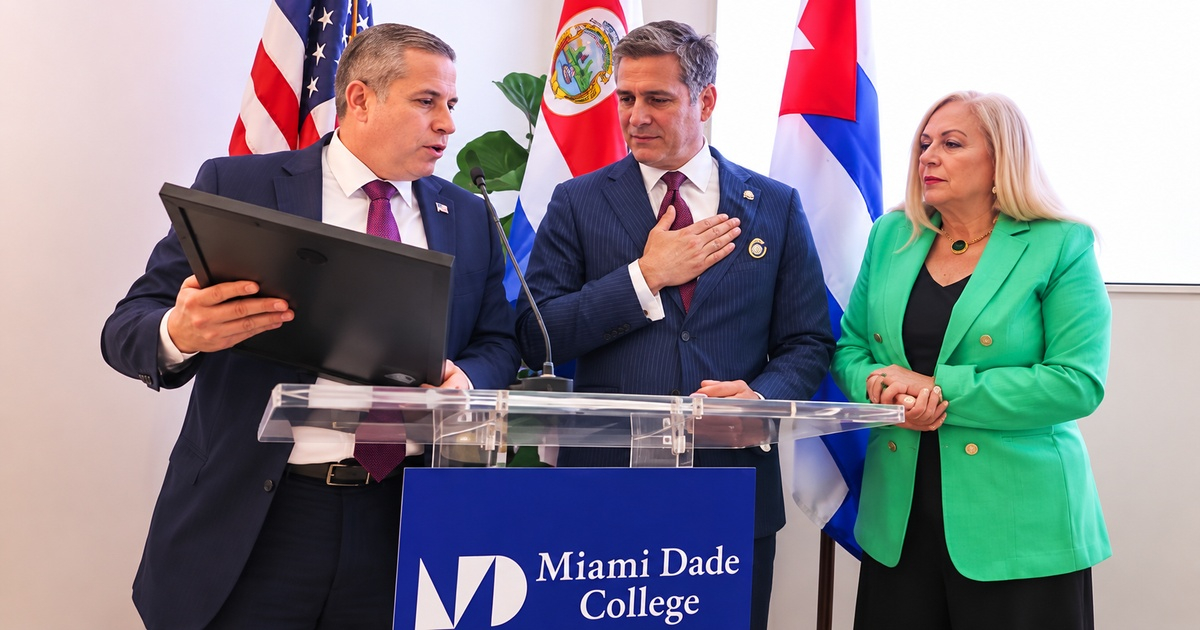
The historic Tower of Freedom, owned by Miami Dade College, was the venue for an event organized by the Assembly of the Cuban Resistance, led by its Secretary General, Orlando Gutiérrez-Boronat, to pay tribute to Costa Rica, its people, its government, and its Chancellor, Manuel Tovar Rivera. During the ceremony, the minister received the Pedro Luis Boitel Freedom Award in recognition of his support for human rights and democracy in Cuba.
The tribute takes place at a moment of intensified Costa Rican solidarity with the Cuban people, characterized by diplomatic decisions, public statements, and new international initiatives. However, this solidarity is historical: its roots go back to the independence struggles of the 19th century.
In 1891, General Antonio Maceo and other exiled Cubans were welcomed by the people and government of Costa Rica. President José Joaquín Rodríguez authorized the establishment of an agricultural colony for Cuban emigrants in La Mansión de Nicoya, Guanacaste.
That colony was not just an economic project. It became a gathering place for former fighters and patriots who kept alive the aspiration of liberating Cuba from Spain. The Costa Rican government materially contributed to the development of the settlement.
José Martí visited Costa Rica on two occasions, in 1893 and 1894, while organizing the Necessary War. There, he met with Maceo, strengthened ties with emigrants, and worked to ensure the participation of the Titan of Bronze in the independence project.
Costa Rica was, therefore, a land of refuge, organization, and preparation for one of the decisive stages of Cuban history.
This historical connection takes on particular significance when recalling the mambí heritage of the current chancellor, Manuel Tovar Rivera, linked to the Puerto Rican general Juan Rius Rivera, who fought for Cuban independence and achieved the rank of major general in the Liberating Army.
In 1959, José Figueres Ferrer, a key figure in Costa Rican democracy who had shown sympathy for the struggle against Batista, began to express concerns about the direction of the new regime.
In January of that year, he expressed his concern about the possibility of Cuba ending up under another dictatorship. Months later, his public disagreements with Castro elicited a strong reaction from the Cuban leader.
The contrast between both political models became more pronounced: Costa Rica had abolished its army in 1948 and, through the Constitution of 1949, established a democratic system of competitive elections and an independent electoral tribunal. Cuba, on the other hand, moved towards a totalitarian one-party system.
1961: Mario Echandi breaks relations with Havana
On September 10, 1961, the then-president of Costa Rica, Mario Echandi Jiménez, severed diplomatic relations with Cuba. This decision was preceded by Costa Rican protests against the executions of political prisoners. The government had warned that further executions would lead to a break in relations. The confirmation of additional executions hastened the move. It was one of the diplomatic episodes that defined bilateral relations during the Cold War.
1980: Rodrigo Carazo and the Cuban refugees
During the crisis at the Peruvian embassy in Havana, thousands of Cubans sought asylum. The President of Costa Rica, Rodrigo Carazo, facilitated the arrival of refugees and made his country available for an international evacuation operation.
On April 20, 1980, your government announced that it was willing to accept the approximately 10,000 Cubans who were awaiting a way out of the island, even on a permanent basis if necessary. Costa Rica also promoted an international conference to seek solutions to that emergency.
February 26, 2004
Six former Costa Rican presidents—Luis Alberto Monge, Mario Echandi, Óscar Arias, José Joaquín Trejos, Rafael Ángel Calderón, and Rodrigo Carazo—signed a letter in support of the Cuban civic movement, demanding respect for human rights and popular sovereignty.
In November of that year, San José hosted an international forum on democracy in Cuba, organized with the participation of Latin American political leaders, civil organizations, and representatives of the Cuban opposition.
From the failed approach to the new break with the dictatorship
In 2009, Óscar Arias restored diplomatic relations with Havana, advocating for dialogue as a means to address differences and promote changes. In March 2026, Arias explained that he had hoped for a democratic opening that ultimately did not occur.
During the migration crisis of 2015-2016, the government of Luis Guillermo Solís issued 7,802 extraordinary visas to Cuban citizens, assisted 5,500 people in 44 shelters, and organized the transportation of 4,817 migrants through 36 flights.
In July 2021, Costa Rica condemned the violence against participants in the massive protests against the communist regime and demanded respect for the freedoms of expression, assembly, and peaceful protest.
2026: Solidarity with the people, steadfastness against tyranny
On March 18, 2026, President Rodrigo Chaves announced the closure of the Costa Rican embassy in Havana and demanded the withdrawal of Cuban diplomats from San José, while maintaining consular functions.
President Laura Fernández, who took office on May 8, continued with this policy and appointed Manuel Tovar Rivera as Foreign Minister, who was previously the Minister of Foreign Trade. On September 19, during the tribute in Miami, Tovar confirmed that there is a formal break in diplomatic relations, not merely a reduction of representation.
He specified that Costa Rica will maintain this position until Cuba regains its freedoms and holds free and plural elections. He also announced a review of Costa Rica's actions in the United Nations regarding Cuba.
The ceremony thus links two historical moments: the Costa Rica that welcomed Maceo when he was preparing for the independence of Cuba and the one that, 135 years later, places the rights of Cubans back at the center of its relations with Havana.
It is a story of human connections, solidarity, diplomatic decisions, and humanitarian efforts that spans generations and keeps both peoples connected.
The Cubans, now free, will know how to erect a monument to the solidarity of Costa Rica. Its president and foreign minister already hold a place in the hearts of those of us who fight for the homeland for which Martí, Maceo, and many other brave compatriots gave their lives.
Related videos:
Filed under:
Opinion article: Las declaraciones y opiniones expresadas en este artículo son de exclusiva responsabilidad de su autor y no representan necesariamente el punto de vista de CiberCuba.