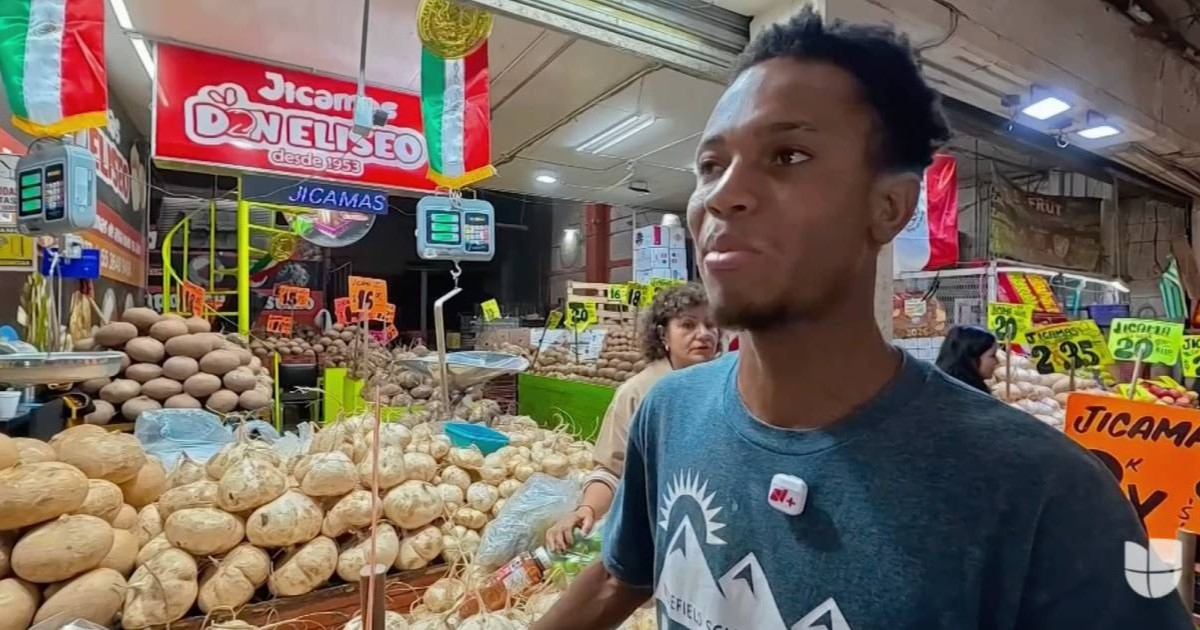
Hundreds of Cuban, Haitian, Venezuelan migrants, and individuals from other nationalities have turned the Central de Abasto of Mexico City into their new starting point, working among the aisles and warehouses of the world's largest wholesale food market after abandoning the American dream, according to a report by Univision/N+ published this Thursday.
The gigantic facility, located in the Iztapalapa borough and covering 327 hectares, handles approximately 30,000 tons of goods daily and accounts for around 70,000 direct and indirect jobs.
In light of the local labor shortage, traders have opened their doors to migrants from Haiti, Cuba, Venezuela, Honduras, Guatemala, Colombia, Ecuador, and the Dominican Republic, the report states.
The tasks range from loading and unloading food to working in warehouses and assisting in retail stores. A merchant interviewed by Univision summarized the situation with a striking figure:
"It is a necessity for us. They come every day; they are very hardworking. I have 143 migrants," said Ramiro Encino, one of the entrepreneurs from the central.
The absence of discrimination is one of the factors most valued by those who work there. "There are many opportunities here, and they don't check for race, color, or anything. If you can work, they give you a job, no matter where you come from," stated one of the interviewed Haitian migrants.
For Cubans, salaries range from 300 to 500 pesos a day for shifts of up to ten hours, which amounts to between 1,500 and 2,500 pesos per week.
The conditions are demanding, and the income barely suffices to cover rents that can reach 5,000 pesos a month, but many prefer this precarious stability to the uncertainty of the journey north.
This phenomenon reflects a profound change in migratory patterns. The tightening of U.S. border policy since 2025 has dramatically reduced irregular crossings, forcing thousands of Cubans to remain in Mexico as a permanent destination rather than just a transit point.
In 2025, Mexico received almost 40,000 asylum applications from Cuban citizens, and the proportion of Cubans with humanitarian visitor cards skyrocketed from 23% to 78% in just one year.
This is accompanied by deportations: according to a report by Human Rights Watch, between January 2025 and March 2026, the United States deported to Mexico 4,353 Cubans, making them the largest group among nationals of third countries sent to that territory. Since June 2025, more Cubans have been deported monthly to Mexico than to Cuba.
The Central de Abasto has been integrating migrants into its workforce for at least five years through an informal program that has registered more than 4,000 people of various nationalities, according to reports from the Mexican press.
Many of them lack migration documents, which excludes them from formal employment and pushes them into these types of markets.
But for many more years, other Cubans were a point of reference in this establishment. Cubans in Mexico City knew and passed the word, "that in the carrot ship, beneath the Chinese lanterns, was the stand of the Cuban who sold the best yuca and malanga."
The UN migration statistics bulletin for 2025 recorded 155,730 events of individuals in irregular migration situations in Mexico, a figure that illustrates the extent of the phenomenon that the Central de Abasto partially accommodates with its warehouses and carts.
For many of these migrants, life in Mexico has become a long-term gamble. A Dominican migrant interviewed by Univision stated clearly: "My children are in the Dominican Republic. What’s the plan? To bring them here. I like Mexico; my country is still not stable."
Related videos:
Filed under: