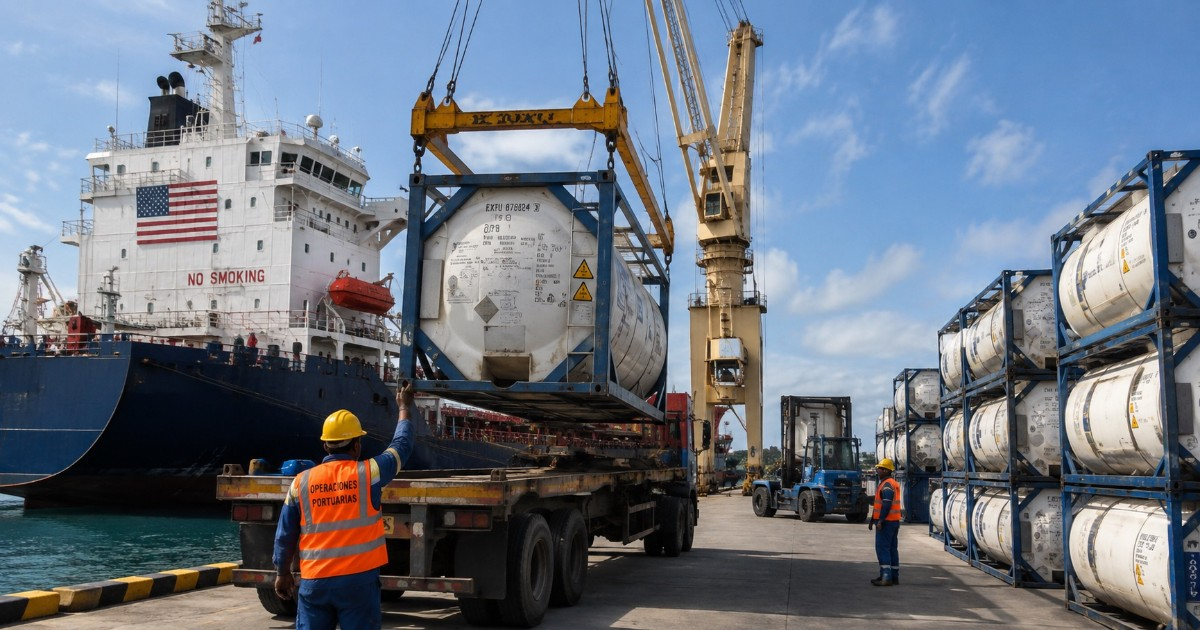
Petroleum product exports from the United States to Cuba reached an unprecedented volume in July 2026: 3,222,000 barrels, according to data from the Energy Information Administration (EIA) published on September 30.
That figure represents between 3.5 and 3.9 months of the average monthly supply that Venezuela sent to Cuba in 2025, meaning that Washington matched what Caracas took almost four months to deliver in just thirty days.
The comparison is based on the most reliable estimates available regarding Venezuelan output: the news agency Reuters, using data from PDVSA, calculated an average of 27,000 barrels per day for 2025, while Jorge Piñón, a researcher at the Center for Energy at the University of Texas, estimated the figure to be between 30,000 and 35,000 barrels per day.
This amounts to between 821,000 and 913,000 barrels per month. Dividing the 3,222,000 barrels from July by that range yields a quotient of 3.53 to 3.92 Venezuelan months in a single U.S. month.
The turning point of this change was the abrupt cut-off of Caribbean supplies following the capture of Nicolás Maduro by U.S. special forces on January 3, 2026, which ended decades of subsidized oil.
In January, U.S. exports to Cuba were virtually nonexistent—only 1,000 barrels—which is equivalent to zero percent of a Venezuelan month.
The curve rose rapidly: February accounted for 2% of that reference; March, between 21% and 23%; April, between 23% and 26%; May, between 52% and 58%; and June was already close to 85-95%, before the extraordinary jump in July.
The regulatory trigger was the "Support for the Cuban People" license exception, published by the Department of Commerce on February 25, 2026, which authorized the export of refined products to private Cuban entities without individual OFAC licenses, explicitly excluding the government, the Armed Forces, and sanctioned state entities.
The total from January to July 2026 reached nearly 4,896,000 barrels, with a daily average in July of approximately 103,900 barrels.
In monetary value, the U.S.-Cuba Trade and Economic Council registered 61.1 million dollars just in July, raising the total for the period to 156.8 million. The shipments mainly departed from Miami and Houston.
There are essential nuances to interpret these figures. What the U.S. exports are refined products — gasoline, diesel, kerosene, lubricants, propane — while Venezuela primarily provided crude oil and fuel oil.
In addition, the EIA records declared exports at U.S. ports, not confirmed arrivals in Cuba.
For these reasons, it is not accurate to claim that the U.S. is already the main energy supplier to the island on a global scale, although Reuters did position it as the largest exporter of goods to Cuba during the period of January to July 2026.
The magnitude of the change contrasts with the severity of the crisis that preceded it. In May, the Minister of Energy and Mines, Vicente de la O Levy, publicly admitted that Cuba had "absolutely no fuel, no diesel, only associated gas," describing the situation as "acute, critical, and extremely tense."
An additional revelation adds to this picture: according to a senior U.S. official cited by the Miami Herald, Venezuela is believed to have supplied Cuba with around 70,000 barrels daily between late 2024 and late 2025—more than double what was estimated by Reuters and Piñón using public data—and the regime allegedly resold nearly 60% of that volume to Asia while the population endured blackouts of up to 32 hours.
This estimate comes from a previously undisclosed government analysis and should be taken with caution as it cannot be independently verified.
The economist Pavel Vidal, a former official of the Central Bank of Cuba, warned in January that "if the supply of oil were to stop completely, the Cuban economy would come to a halt," describing it as "a devastating blow to an economy that has already been in recession for six years."
Related videos:
Filed under: