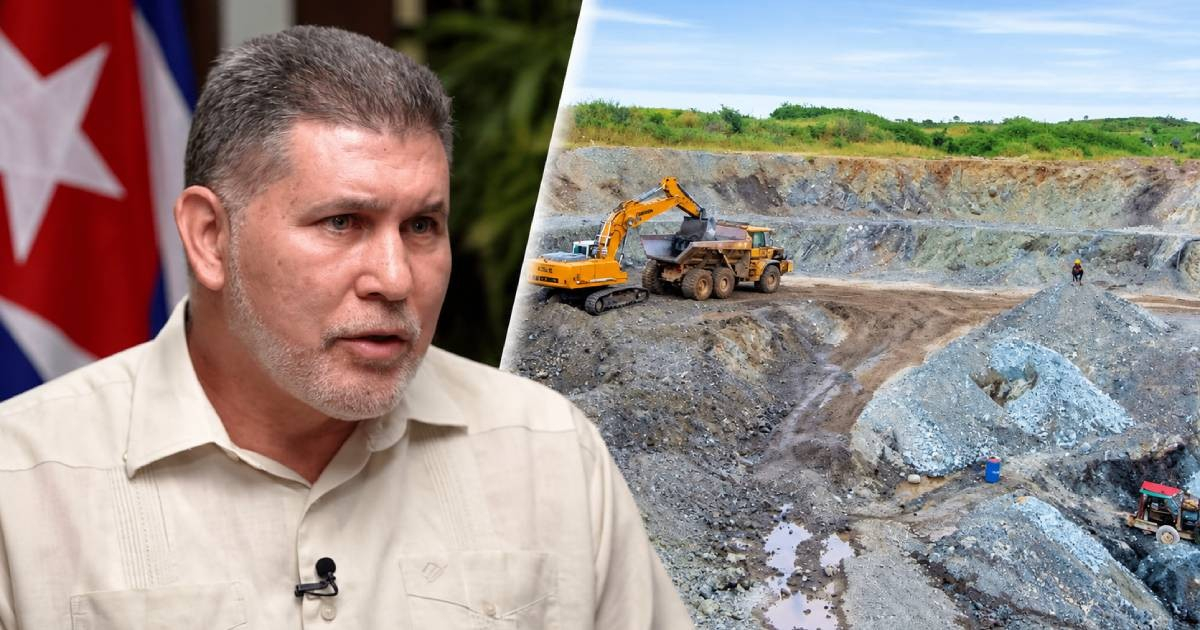
The Cuban Vice Prime Minister Óscar Pérez-Oliva Fraga stated that Sherritt International and Antilles Gold have not withdrawn from Cuba, although Sherritt has suspended its direct participation, and Antilles Gold's subsidiary in Cuba has paused its involvement in the management, administration, and financing of Minera La Victoria while both assess alternatives.
"Neither Antilles Gold nor Sherritt have withdrawn from Cuba," stated Pérez-Oliva in an interview granted to Reuters from Havana.
"Faced with these sanctions, these companies are evaluating alternatives to determine how to continue their operations," added the official, who, in addition to being the deputy prime minister, heads the Ministry of Foreign Trade and Foreign Investment.
The statements come after months of uncertainty regarding two significant foreign investments in the Cuban mining sector, which have been impacted by the expansion of sanctions from Washington since May.
Sherritt remains in Cuba, but it has suspended its direct participation
The Canadian company Sherritt International, with over three decades of presence in Cuba, holds a 50% partnership with the state-owned General Nickel Company in the joint venture at Moa, dedicated to the extraction and processing of nickel and cobalt.
The situation changed after the executive order signed by Trump on May 1, 2026, which expanded the sanctions related to Cuba.
On May 7, Sherritt suspended its direct involvement in the activities of its joint ventures in Cuba.
The company itself then explained that it had not been formally designated under the executive order, but warned that the new measures substantially altered its ability to operate normally.
Days later, Sherritt announced its intention to dissolve its Cuban interests, including the Moa joint venture. In that process, it revealed that the state-owned General Nickel Company owed it approximately 277 million dollars.
However, on May 19, the mining company reversed its dissolution plan, following new consultations with advisors, stakeholders, and government authorities.
The company made it clear that it was maintaining its suspension of direct participation in the activities of Cuban joint ventures while it explored other options.
That situation continues. In a financial update published this September, Sherritt reiterated that its direct participation in the joint operations in Cuba has remained suspended since May 7 and warned that it is facing liquidity constraints and "material uncertainty" regarding its ability to continue as a going concern.
Antilles Gold maintains its stake, but has suspended its direct intervention
The Australian Antilles Gold is facing a similar situation.
Its subsidiary Antilles Gold Inc. holds 50% of Minera La Victoria S.A.; the other 50% is owned by Gold Caribbean Mining S.A., a subsidiary of the state-owned GeoMinera.
On June 4, the U.S. Office of Foreign Assets Control (OFAC) added Minera La Victoria to its list of Specially Designated Nationals (SDN) for operating in the Cuban metals and mining sector.
As a result, Antilles Gold has temporarily suspended the trading of its shares and its subsidiary halted its direct involvement in the administration, management, and financing of Minera La Victoria, although it retained its 50% equity stake. Construction work on Nueva Sabana has also been suspended.
The stock suspension was lifted on June 18, but the underlying issue remains. Antilles Gold has been in discussions with the U.S. State Department and is working with the American investment group Global Emerging Markets (GEM) in search of a solution to lift the sanction or obtain an OFAC license for certain operations.
Pérez-Oliva blames the sanctions
During the same interview, the Deputy Prime Minister accused Washington of pressuring foreign companies to reduce their commercial ties with Cuba while facilitating certain operations of American companies.
“On one hand, international companies—Cuba's traditional partners around the world—are being threatened and pressured to cease their economic and commercial relations with our country,” he stated.
Pérez-Oliva cited the U.S. policy that permits certain fuel exports to the Cuban private sector as an example, interpreting it as an attempt to increase the island's economic dependence on the United States.
Washington holds a different interpretation. Secretary of State Marco Rubio has attributed Cuba's difficulties in attracting investments to the island's economic and political model and the lack of guarantees for investors.
Pérez-Oliva also denied during the interview having knowledge of recent contacts between Cuban authorities and companies directly linked to President Trump.
"I have no knowledge that any company directly linked to President Trump has contacted Cuba," he stated.
Related videos:
Filed under: