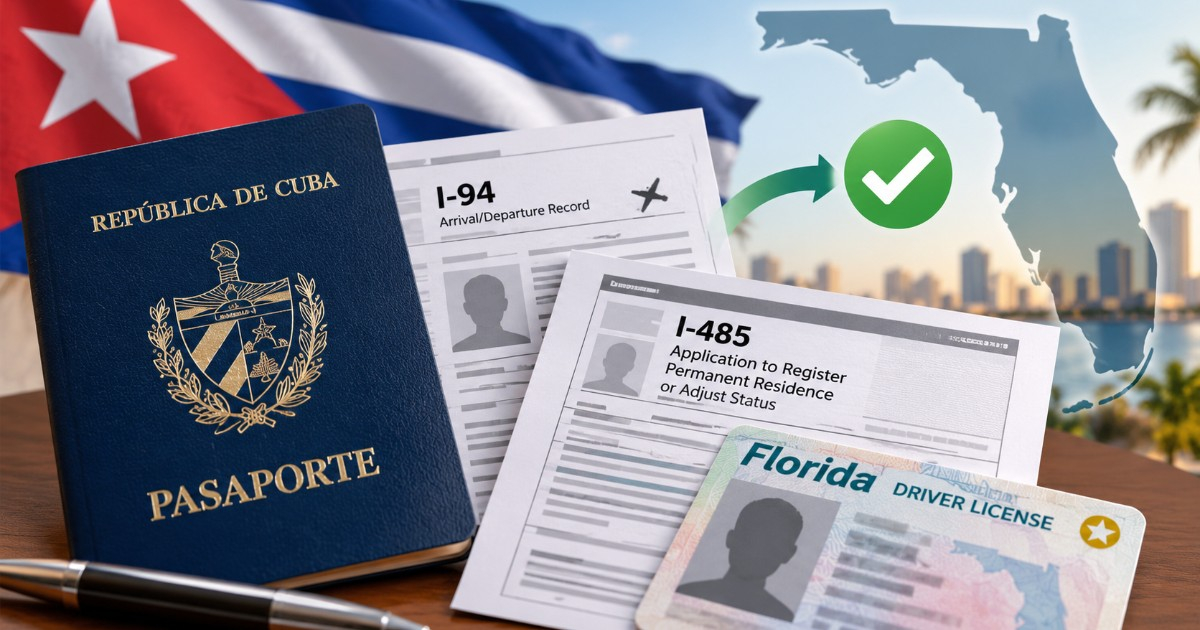
Cubans who are processing permanent residency under the Cuban Adjustment Act and need to obtain a driver's license or identification card in Florida must demonstrate more than just the existence of a pending residency application.
According to an operational document from the Florida Department of Highway Safety and Motor Vehicles (FLHSMV), updated on September 17, 2026, and accessed by CiberCuba, Cuban citizens who are already in the process under the Adjustment Act must present an I-94 or another document demonstrating that they were inspected and admitted or that they received parole in the United States.
Additionally, they must show that they have a pending Form I-485, Application to Register Permanent Residence or Adjust Status.
The accuracy is important because having only a receipt for the I-485 does not necessarily mean that all documentary requirements to obtain a Florida license or identification are complete.
The two elements that Florida wants to verify
For Cubans going through the process under the Adjustment Act, the document consulted by CiberCuba outlines two fundamental elements.
The first is to verify that the person was inspected and admitted or paroled. For this, an I-94 or another document that demonstrates this circumstance can be used.
The second is to demonstrate that there is a pending I-485, meaning that the applicant is indeed processing the adjustment to legal permanent residency.
These FLHSMV requirements align with the immigration conditions that USCIS considers for the Cuban Adjustment. In its guidelines on the Cuban Adjustment Act, the federal agency explains that the residency process is available, among other requirements, for certain Cuban natives or citizens who have been inspected and admitted or placed in parole in the United States.
This does not mean that the FLHSMV determines whether a person is eligible to obtain residency. USCIS adjudicates the I-485, while Florida verifies the necessary documentation to issue the license or identification.
The I-94 can be key, but it is not an identification
One of the documents that may be particularly important is the I-94 Form, record of entry and exit from the United States.
The FLHSMV operational guide states that the I-94 can be used to establish legal presence, but it does not serve on its own as proof of identity.
Many people no longer receive a paper I-94 because the registration is generated electronically. Those who need to obtain a copy can check and download their most recent record from the official I-94 portal of the U.S. Customs and Border Protection (CBP).
CBP allows you to retrieve and print the electronic I-94, which is especially useful before going to process a license.
What happens if you submit an I-797 from the I-485?
The operational document revised by CiberCuba includes another important clarification for Cubans who validate their residency application through an I-797 related to the I-485.
In those cases, the FLHSMV indicates that proof of Cuban nationality is also required.
However, proving Cuban nationality and demonstrating identity are different requirements. The guide warns that evidence of nationality does not automatically become a valid identity document.
In the specific case of a Cuban passport used for this purpose, the operational document states that it must be valid and accompanied, when relevant to that documentation path, by an attached U.S. visa and the I-94 in order to meet the requirements outlined by the FLHSMV.
For this reason, a person should not assume that the USCIS receipt showing that their I-485 is pending substitutes all other documents required for the license.
How to check if the I-485 is still pending
Those who have an I-797 with the receipt number of their application can check the status of their case using the official tool USCIS Case Status Online.
The receipt number typically consists of three letters followed by ten numbers and allows you to check the status of the immigration process.
That the system shows a pending I-485 can help confirm the status of the case, but does not replace the other identification documents, legal presence, and residency required by Florida.
What is advisable to take to the office?
To reduce the risk of having to return for missing documents, a Cuban who is processing their residency under the Adjustment Act should carry with them all documentation related to their entry and their I-485 application, not just the most recent receipt from USCIS.
This may include the I-94 or documentation verifying inspection and admission or parole, the I-797 related to the pending I-485, and the necessary documentation to prove Cuban nationality when required.
You must also bring the relevant documents for the other Florida requirements, such as proof of identity, Social Security number or secondary documentation when applicable, and two proofs of residence.
The FLHSMV maintains a public guide of the documents that applicants for licenses and identification cards must bring.
A pending I-485 does not guarantee a license by itself
The main conclusion for Cubans undergoing the Adjustment process is that submitting a pending I-485 application is not necessarily sufficient by itself to complete the Florida licensing procedure.
The FLHSMV must be able to verify both the relevant immigration documentation and the identity of the applicant, as well as the other requirements needed to issue the credential.
This also explains why two individuals waiting for residency under the Cuban Adjustment Act may need different documents depending on how they entered the United States and the immigration documentation available in their files.
Those needing more information about the migration process can consult the CiberCuba guide on the Cuban Adjustment Act, while the specific requirements to obtain the license should be checked directly with the FLHSMV before visiting the office.
Related videos:
Filed under: