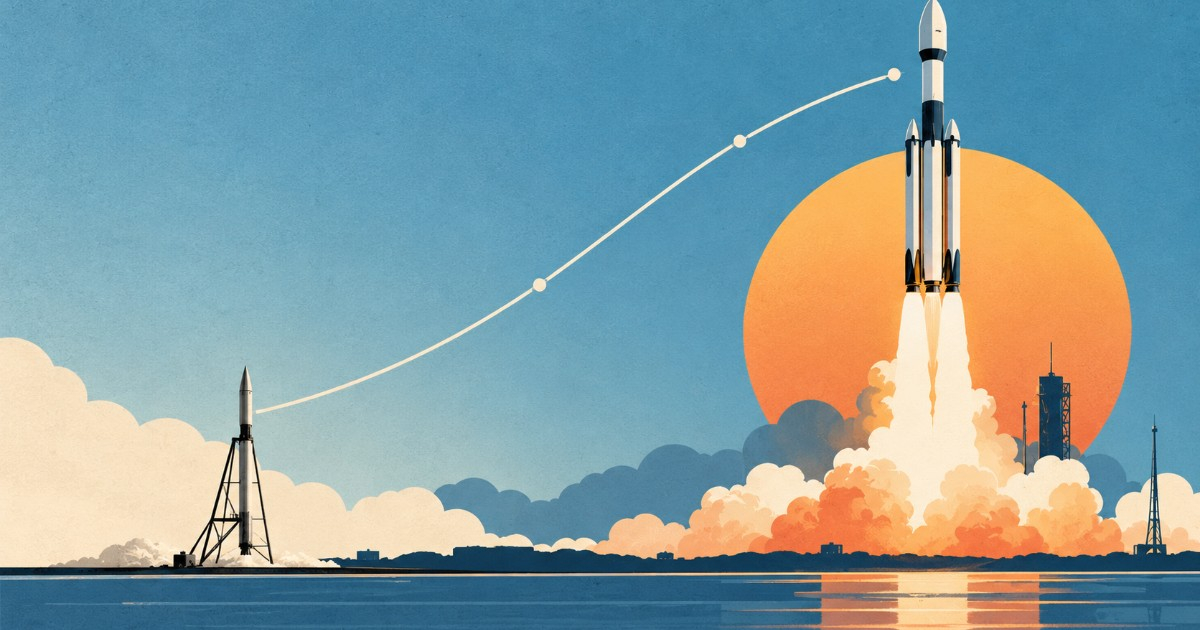
The World Space Week 2026 begins this Sunday, October 4, with rockets taking center stage and an underlying question: how is access to space changing when it no longer relies solely on a small group of large government programs?
The international celebration, which will continue until October 10, has this year's official theme “Rocket Revolution”, according to the United Nations page dedicated to World Space Week 2026.
The topic highlights the rapid transformation of launch systems: private companies, reusable rockets, universities, startups, and new national space programs are expanding a sector that for decades was primarily dominated by a few powers and state agencies.
Why is it celebrated from October 4 to October 10?
The dates of World Space Week are not random; they commemorate two pivotal moments in space history.
The October 4, 1957 saw the launch of Sputnik 1, the first artificial satellite of Earth. Its placement in orbit officially opened the space age and triggered a phase of rapid scientific and technological advancements.
Ten years later, on October 10, 1967, the Outer Space Treaty came into force, one of the main international legal pillars for regulating the exploration and use of outer space.
The United Nations General Assembly officially proclaimed World Space Week in 1999 through Resolution 54/68, with the aim of celebrating the contributions of space science and technology to human well-being.
What does the "rocket revolution" mean?
For much of space history, building and launching a rocket required enormous budgets, specialized infrastructure, and the support of large governments.
That landscape has been changing. The United Nations highlights that access to space is currently expanding with the participation of commercial launch providers, reusable systems, university equipment, startups, and new national players.
The change is not only about developing different rockets. It also affects who can place a payload in orbit, how often launches can occur, and what applications can later be developed in space.
Reuse is one of the technologies associated with this transformation. Instead of necessarily discarding all components after each mission, some systems are designed to recover and reuse certain parts of the vehicle.
NASA has also been relying on partnerships with private companies for years to transport cargo and crews to the International Space Station. Its Commercial Crew Program, for instance, was established to develop commercial capabilities for human transport to low Earth orbit.
From governments to a much broader ecosystem
The so-called "Rocket Revolution" also reflects a transformation in the participants of the sector.
Traditional space agencies still play a fundamental role, but they now coexist with private companies, manufacturers, universities, research centers, student clubs, and companies that develop everything from small launch vehicles to next-generation space transport systems.
The World Space Week Association, the organization that coordinates the global celebration, reports that during the 2025 edition there were around 50,000 activities in 102 countries.
During this week, schools, universities, museums, planetariums, space agencies, and companies are organizing conferences, workshops, exhibitions, and educational activities aimed specifically at sparking young people's interest in science, technology, engineering, and mathematics.
2026 also marks one hundred years since a historic launch
This year's edition also coincides with a particularly symbolic anniversary for the history of rockets.
On March 16, 1926, the American physicist and inventor Robert H. Goddard conducted the first successful launch of a liquid-fueled rocket in Auburn, Massachusetts.
The experiment was extremely modest compared to current launchers: the rocket remained in flight for just a few seconds and reached a height of about 12.5 meters. However, it introduced a technology that would ultimately be essential for modern space exploration.
NASA commemorated in March 2026 the centenary of that launch, remembering that propulsion using liquid fuels has been key to sending satellites, probes, and humans into space.
Florida will also celebrate World Space Week
One of the events of the 2026 edition will take place in Florida.
The Kennedy Space Center Visitor Complex will host an exhibition dedicated to World Space Week and the “Rocket Revolution” on Friday, October 9th.
The event will take place in the area of the Space Shuttle Atlantis and will feature representatives from organizations and companies related to the space sector. It is scheduled from 9:00 a.m. to 5:00 p.m. and is included with regular admission to the complex.
For the organizers of World Space Week, the goal for 2026 is to leverage the appeal of rockets to showcase a much broader transformation: a space sector with more participants and new opportunities for science, education, and industry.
The celebration begins this Sunday and will conclude on October 10, exactly 59 years after the entry into force of the Outer Space Treaty.
Related videos:
Filed under: