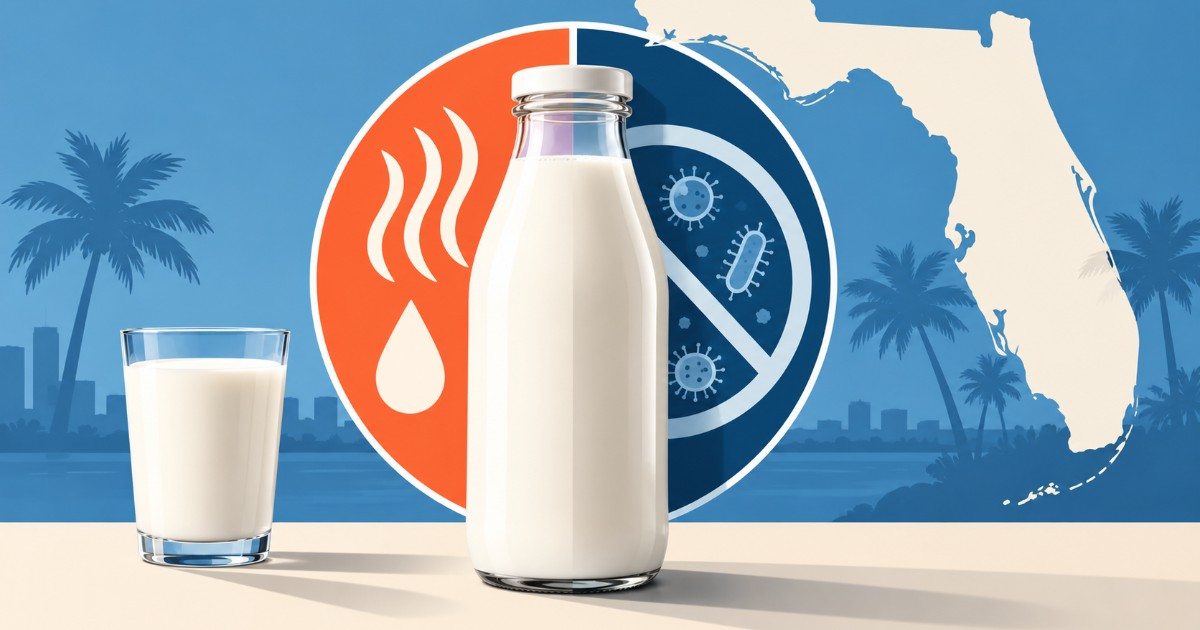
A viral video of a Cuban who buys fresh milk from his Amish neighbors for $2.50 a gallon has sparked curiosity among thousands of users about a practice that still exists in numerous rural communities in the United States.
But there is an important difference for those living in Florida: raw milk cannot be legally sold in the state as food intended for human consumption.
The scene recently shared by CiberCuba took place in Tennessee, where the protagonist visits Amish neighbors to obtain fresh milk. The rules vary from state to state, and this experience should not be automatically applied to Florida.
Can you buy raw milk in Florida?
The short answer is: yes, it can be found for sale, but not as milk intended for human consumption.
The Florida Statute 502.091 states that only Grade A pasteurized milk and dairy products may be sold to the final consumer, restaurants, and other food establishments.
State legislation defines raw milk simply as milk that has not been pasteurized.
Therefore, describing the product as "farm" milk, artisanal, organic, grass-fed, or from an Amish community does not change its legal status. If it has not been pasteurized, it remains raw milk for regulatory purposes.
So, why is raw milk sold in Florida?
Here lies the peculiarity that can confuse many buyers.
The Florida Department of Agriculture and Consumer Services (FDACS) explains that raw milk and its derivatives are not approved for human consumption in the state, but they can be sold with a label that clearly states they are not for human consumption.
In practice, these products are marketed as animal or pet food.
That is why a consumer may encounter unpasteurized milk bottles at certain farms, markets, or distributors, while at the same time seeing warnings on the packaging such as "for animal consumption" or "not suitable for human consumption."
It’s not just a decorative phrase. The product is entering the market under a regulatory category different from that of milk intended for individuals.
Sellers also have rules to follow
Selling raw milk as animal feed does not mean that the product is exempt from all regulation.
The Chapter 580 of the Florida Statutes, dedicated to commercial animal feed, requires distributors to obtain an annual Feed Master Registration before distributing these types of products in the state.
The legislation also establishes labeling requirements for commercial food intended for animals.
This means that finding raw milk in a farm refrigerator or at a farmers' market does not automatically imply that it can be legally offered as a drink for people.
Does the law prohibit a person from drinking it?
Florida's regulation focuses on how the product can be sold and marketed. A bottle sold as animal feed does not thereby become state-approved milk for human consumption.
This distinction explains an apparently contradictory situation: it is possible to find raw milk in Florida and purchase it legally within the corresponding category, while the seller cannot offer it as milk intended for drinking.
An exception: certain raw milk cheeses
Florida's legislation itself includes an important exception.
Cheeses made from unpasteurized milk can be sold to consumers when they have been aged for more than 60 days at a temperature higher than 35 degrees Fahrenheit, approximately 1.7 degrees Celsius.
Therefore, the ban on the sale of unpasteurized liquid milk for human consumption does not mean that all products made from raw milk are automatically excluded from the market.
And what if the milk comes from another state?
There is also a federal restriction.
The U.S. Food and Drug Administration (FDA) has prohibited since 1987 the introduction of packaged raw milk intended for human consumption into interstate commerce.
States can decide what they allow within their own borders, but Florida has chosen to require pasteurization for the sale of milk intended for human consumption.
Why do authorities recommend pasteurized milk?
The discussion is not just legal.
The Centers for Disease Control and Prevention (CDC) warn that unpasteurized milk may contain microorganisms such as Campylobacter, E. coli, Listeria, Salmonella, Brucella, and other pathogens that can cause foodborne illnesses.
According to the CDC, good farm practices can reduce the risk of contamination, but they cannot guarantee that raw milk is free from harmful microorganisms.
The agency considers children under five years old, adults over 65, pregnant women, and individuals with weakened immune systems to be especially vulnerable.
This point is particularly relevant for families looking for "more natural" products for young children. The CDC indicates that pasteurized milk provides the nutritional benefits of milk without the added risks associated with consuming raw milk.
Florida has already recorded illnesses linked to raw milk
In August 2025, the Florida Department of Health reported 21 cases of infections caused by Campylobacter and Shiga toxin-producing E. coli, which their investigation linked to the consumption of raw milk from a farm in the state.
Six of the affected individuals were children under ten years old, and seven people required hospitalization, according to the official report.
The Department of Health itself then reminded that in Florida, raw milk can only be sold for non-human consumption and that the containers must clearly indicate that they are intended for animals.
What to consider before buying
For a consumer in Florida, the key factor lies in the packaging and the way the product is presented.
A bottle of raw milk legally marketed under the regulations for animal feed must not be presented as milk approved for human consumption.
Terms like "fresh," "natural," "farm," "Amish," "grass-fed," or "organic" do not replace pasteurization nor create an exception in state legislation.
In short, Florida allows the existence of a raw milk market under animal feeding regulations, but maintains a clear boundary: liquid milk legally intended for people must be pasteurized.
Related videos:
Filed under: