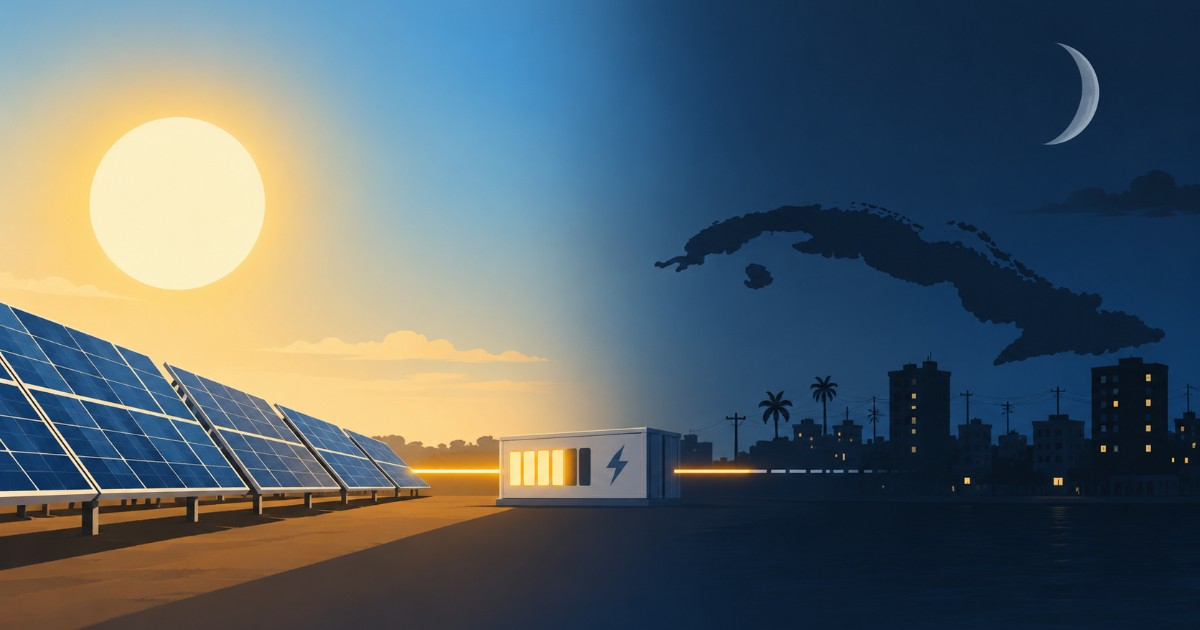
China promises to continue expanding solar generation in Cuba, but the data from the National Electric System itself shows why installing more photovoltaic panels, while helpful during the day, is not enough on its own to end the blackouts that plague the country during peak night hours.
The example from October 1st is particularly clear. According to the report from the SEN compiled by the CiberCuba Blackout Observatory, solar parks generated 3,169 MWh of energy that day and reached a maximum power of 493 MW during the hours of highest solar availability.
However, at 9:00 PM, when the photovoltaic generation had practically disappeared from the system, the impact from the deficit reached 2,059 MW.
For the peak demand period of the following day, October 2, the situation remained critical: the UNE forecasted 3,100 MW of demand against only 1,060 MW available. The difference left a projected deficit of 2,040 MW and an estimated impact of up to 2,070 MW.
The difference between the two time zones encapsulates one of the biggest issues of the current Cuban energy model: the sun generates energy at its peak, but the highest consumption and the worst deficits typically occur hours later.
493 MW does not mean electricity available throughout the night
To understand the problem, it is necessary to distinguish two concepts that are often conflated.
The 493 MW represents the maximum instantaneous power delivered by the solar parks at a specific moment on October 1st. This does not mean that this power was maintained throughout the entire day.
The 3,169 MWh, on the other hand, represents the total amount of energy produced by those facilities throughout the day.
When the sun sets, the panels stop producing. If that energy is not previously stored in batteries, it cannot be automatically transferred from midday to peak nighttime.
This is why it is possible that for several hours of the day, solar energy partially alleviates the deficit, and just a few hours later, Cuba once again registers disruptions exceeding 2,000 MW.
Solar generation changes from one day to the next
The data from the CiberCuba Blackouts Observatory also show that photovoltaic production is not consistent.
On September 29, the parks produced 3,614 MWh and reached a maximum power of 562 MW.
One day later, according to the report for October 1st, the production for September 30th decreased to 2,843 MWh, and the maximum power dropped to 442 MW.
On October 1st, it rose again to 493 MW and 3,169 MWh.
Cloud cover, weather conditions, the actual capacity of the parks, and the limitations of the network itself cause the available generation to fluctuate even with the same installed photovoltaic capacity.
The problem also lies in the thermoelectric plants
While the solar parks were generating power during the day, a significant portion of conventional generation remained out of service.
The report from October 2 listed failures in unit 5 of the Máximo Gómez thermal power plant in Mariel, the Antonio Guiteras in Matanzas, unit 6 of the Antonio Maceo, and unit 2 of Felton.
Additionally, units in Santa Cruz, Nuevitas, and Renté were undergoing maintenance, while limitations in thermal generation accounted for another 377 MW.
For the peak, it was only expected to recover 30 MW from Energás Varadero and 60 MW from unit 5 at Mariel.
This deterioration explains why adding solar capacity during the day does not automatically replace the power plants that should support the grid when the sun goes down.
China now promises more parks and storage facilities
The Chinese ambassador in Havana, Hua Xin, assured this week that Beijing will continue to support energy projects in Cuba.
According to CiberCuba, in 2025, 35 MW were added in solar parks with Chinese assistance, and the Cuban government expects to complete an additional 85 MW spread across 15 installations by October.
Hua Xin also announced that the first batch of materials for a new 200 MW photovoltaic energy generation and storage project has arrived in Cuba.
The integration of storage is precisely one of the elements that can make solar energy more useful, as it allows for part of the daytime production to be preserved and used when the system needs it.
But there is no automatic solution either.
Cuba now has another battery program of 200 MW
Alongside the project announced by the Chinese ambassador, Cuba has been developing since 2025 a program for four large battery energy storage systems, known as BESS.
The planned facilities are located in Cotorro and Habana 220, in Havana; Cueto, in Holguín; and Bayamo, in Granma. Each has a nominal capacity of 50 MW, for a total of 200 MW.
However, the latest update documented by CiberCuba on the program indicated that only the Cotorro system was confirmed to be operational.
Cueto was still in the process of completion and testing, Habana 220 was officially scheduled to enter service by the end of October, and Bayamo was still under construction.
Therefore, it would not be accurate to state that the SEN currently has the full 200 MW from that program.
200 MW of batteries do not equate to 200 MWh
There is also another important technical difference.
Official announcements primarily describe these systems by their power in megawatts (MW). However, to understand how long they can supply electricity, it is also necessary to know their energy capacity in megawatt-hours (MWh).
A system capable of delivering 50 MW could maintain that power for one hour, two hours, or a different period depending on how much energy it has stored.
The publicly available information consulted about the four major Cuban BESS does not consistently detail that total capacity in MWh.
Therefore, it is not possible to seriously calculate how many peak night hours could be covered solely based on the figure of 200 MW announced by the authorities.
Batteries also have another function: to prevent the SEN from collapsing
Cuban BESS systems are not designed exclusively to store solar energy and release it during a blackout.
One of their main functions is frequency regulation: they can react quickly when a large generating unit goes offline or when there is a sudden imbalance between generation and demand.
That function is especially important in a weakened system like the Cuban one. The SEN register of CiberCuba accounts for eight total national disconnections during 2026.
Batteries can help stabilize the grid and reduce the risk of some collapses, but stabilizing the system is not the same as generating the thousands of megawatts that are currently lacking.
The solar paradox of Cuba
The Minister of Energy and Mines, Vicente de la O Levy, acknowledged months ago that the weakness of the system even limits how much of the available solar energy can be utilized.
CiberCuba explained then that a high penetration of photovoltaic generation in a grid with limited stable conventional generation can cause frequency issues and require the regulation of solar parks.
The result is a paradox: Cuba needs more renewable energy to reduce its dependence on fuels, but at the same time needs reliable thermal power plants, sufficient storage, and a stable grid to fully take advantage of that renewable generation.
The panels help, but they do not replace a functional electrical system
The expansion of solar energy can reduce the deficit during the day, decrease fuel consumption, and provide new capacity to an extremely deteriorated National Electric System.
But the data from early October shows its current limitations.
On October 1, the solar parks delivered 493 MW and produced 3,169 MWh. That same day ended with a peak impact of 2,059 MW at nine o'clock in the evening.
The next day, the UNE expected only 1,060 MW available to meet a peak demand of 3,100 MW.
More solar parks could improve those figures during daylight hours. However, to substantially change Cuban nights, it is also necessary to have large-scale storage, available conventional generation, fuel, maintenance, and a network capable of supporting the system.
Until those pieces function simultaneously, the growth of solar energy will continue to provide relief during certain hours without eliminating the structural problem that is reflected daily in the CiberCuba Blackouts Observatory.
Related videos:
Filed under: