
Related videos:
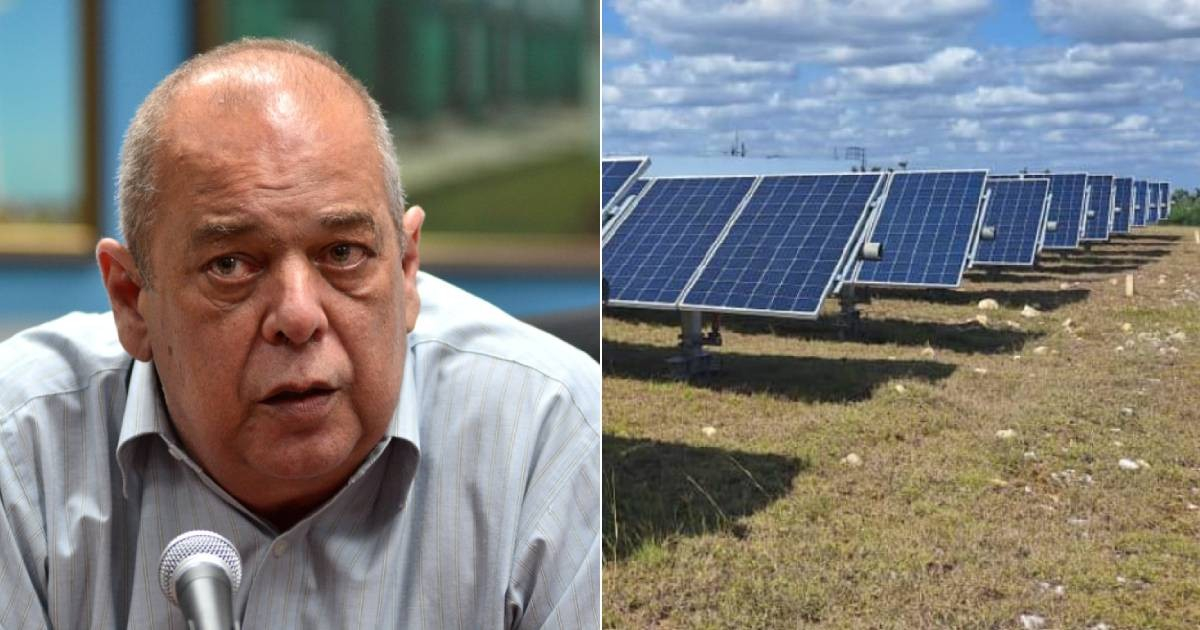
Cuba has more than 1,300 MW of installed solar photovoltaic capacity, but this power is not sufficient to solve the blackouts because the country lacks large-scale operational battery storage systems, as acknowledged by the Minister of Energy and Mines, Vicente de la O Levy, in a press conference held this Wednesday.
According to the official site Cubadebate, the minister explained the paradox faced by the Cuban electrical system: the weaker the grid, the less solar energy it can absorb without destabilizing.
"The weaker the national electric power system is, the more we have to regulate the photovoltaic solar parks, which has been the new capacity we have incorporated," stated De la O Levy.
The problem is technical and structural: solar generation fluctuates with cloud cover, rain, and the weather conditions of each province, and when its share exceeds 50% of the grid, the system cannot absorb those variations.
"The rest of the system is so weak that the share of renewable energy exceeds 50%," the official explained, adding that "if the rest of the system were stronger, much more photovoltaic solar power could be utilized."
The structural solution would be storage batteries, but Cuba does not yet have them operational for that purpose. Although the regime announced in August 2025 the installation of four energy storage systems of 50 MW each in Cotorro, CUJAE, Cueto, and Bayamo —200 MW in total— their function is to control the frequency of the system, not to store energy for nighttime consumption, when the most severe blackouts occur.
In this context, the fuel crisis further worsens the situation. De la O Levy acknowledged that since December 2025 and until just a few weeks ago, Cuba did not receive a single ship with fuel, with the only exception being a donation from Russia of 100,000 tons of crude processed at the Cienfuegos refinery.
"That happened almost four months after no fuel ship entered Cuba," the minister emphasized.
That Russian crude led to a temporary improvement: blackout hours decreased, and several days without outages were recorded in Havana. However, the fuel ran out at the beginning of May, just as summer began and demand increased. At the time of the conference, the system was operating, in the minister's own words, "with no reserves."
In that scenario, the Felton thermoelectric plant, in Holguín, the largest in the eastern part of the country, was taken out of service for urgent maintenance: a leak in the boiler and a broken bearing in the regenerative air heaters. The minister warned that if no action had been taken, "the entire unit would have been completely damaged."
The maximum impact recorded on Wednesday was 2,113 MW at 8:40 PM, with an availability of only 1,230 MW against a demand of 3,250 MW. In some provinces, outages have exceeded 15 hours daily.
The Cuban electrical system has experienced at least seven total collapses in 18 months, including a nationwide blackout on March 16, 2026, and in April, only one of the eight monthly fuel ships needed for the system to operate arrived.
Filed under: