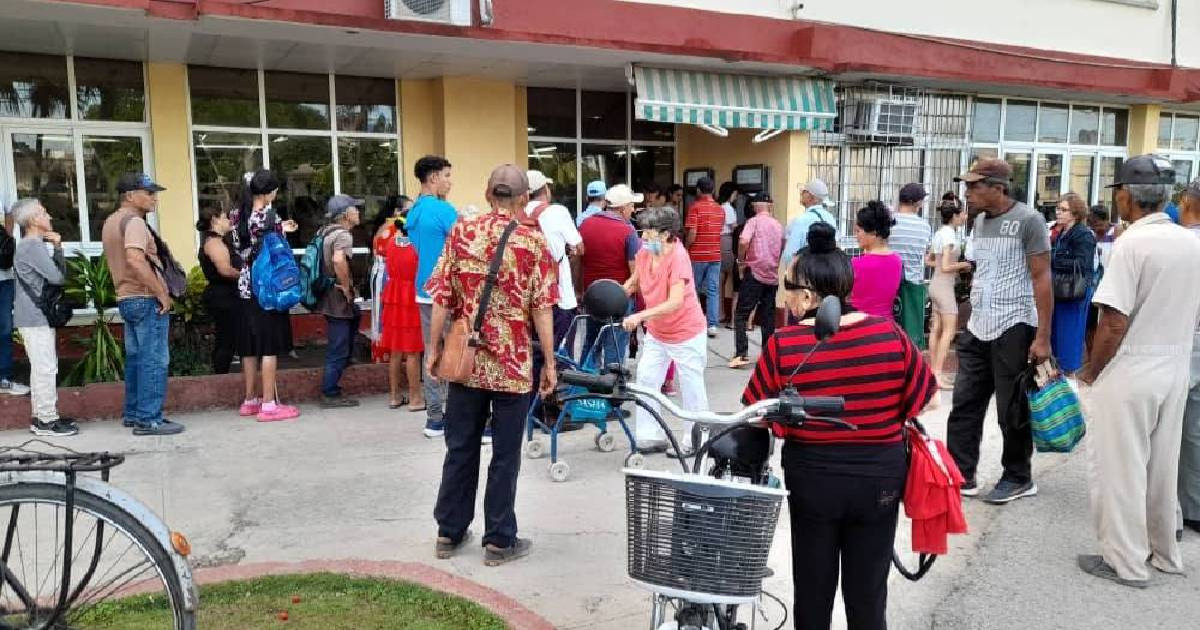
Withdrawing cash in Las Tunas can turn into hours of waiting for dozens of people, including the elderly, due to technical disruptions affecting banking services.
Images circulated this Saturday on Facebook by the journalist José Luis Tan Estrada under the hashtag #TanteandoCuba show between 25 and 40 citizens waiting on the sidewalk in front of a yellow and red bank building, under the sun. In one of the snapshots, an elderly person with a walker can even be seen.
A testimony featured in the publication summarizes the difficulties faced by those attempting to withdraw their pesos. "When it's not the connection dropping, it's the panel that ran out of power and all the other issues you know about," recounted a person quoted by Tan Estrada.
The highlighted issues include connection outages and terminals without charge, situations that ultimately prolong access to a basic service for those who need to have cash available.
The scenes depict how a seemingly simple operation like withdrawing a few bills can turn into a long wait for users, without any guarantee that the transaction will be completed.
What is happening in Las Tunas is evidence of a banking crisis throughout the island. In Havana, lines exceed eight hours in front of branches of the Banco Metropolitano. This was described months ago by journalist and professor Iraida Calzadilla, who recounted spending an entire day sitting on the curb to collect her pension.
In Holguín, the Popular Savings Bank has closed its doors at 3:00 p.m., leaving dozens of retirees unable to withdraw their payments, despite having electricity, cash, and internet access.
In Guantánamo, more than 31,000 retirees in the province, representing 63% of the total, continue to visit the branches each month to collect their pensions. The local Credit and Commerce Bank barely manages to capture just over 34% of the cash it needs to deposit daily.
In light of such a collapse, the government has turned to private businesses as a relief valve. In the easternmost province of Cuba, the authorities signed 1,056 contracts with economic actors to facilitate cash payments of pensions to 18,344 retirees. In the municipality of Amancio, a private bar has been operating as a payment point for pensions since August.
The failure of mandatory banking, imposed in August 2023 through Resolution 111/2023 of the Central Bank, is undeniable considering that three years later, less than five percent of transactions in Cuba are digital, and over 50% of the ATMs in the country are out of service or empty.
The Central Bank issued Resolution 74/2026 in July, which removed the 5,000 pesos cap on cash transactions among economic actors; in September, it put into circulation new 10,000 and 20,000 pesos banknotes. Neither of these measures has alleviated the queues.
The official newspaper Venceremos from Guantánamo acknowledged in July that the situation "has ceased to be a banking difficulty and has become a social problem," an admission that stands in contrast to the government's inability to provide real solutions for the more than 1.7 million Cuban retirees who depend on a collapsed system.
Related videos:
Filed under: