A five-word question posted on Facebook with a black background and bold white letters triggered an avalanche of responses this week that vividly reflect the mood of millions of Cubans. "Honestly, Cubans, are we living?" wrote the broadcaster and television host Laritza Camacho on her public profile, and the collective response was overwhelmingly negative.
The words that dominated the comments were not "yes" or "more or less." They were "surviving," "dying while alive," "over-dying," "living poorly," and "badly buried."
"Definitely not, breathing is not living, and the worst part is that if we continue like this, impassive, we will run out of credit in this dimension without having lived even an iota," wrote a netizen. Another resorted to a medical image to describe the situation: "We are on the threshold that people see when they fall into a coma and then come out of it. The space that exists between being alive and being dead. I think that’s where we are. In short, surviving."
Political dissent has also emerged strongly. One internet user who emigrated was direct: "Clearly, the answer is no; the people are not living and are barely surviving. The only ones who live well are the dictators and their families, who enjoy the good life right under the nose of the everyday Cuban. [...] They make it very difficult for you." Another internet user summarized the daily suffocation: "Live? What are you talking about? You can't even decide your future, let alone your dreams and aspirations. And what can I say about your day-to-day life: bread or crackers, water with sugar or guachipupa."
The digital outcry does not arise in a vacuum. According to the IX Report from the Cuban Observatory of Human Rights, published in August 2026 and based on 1,318 interviews across 79 municipalities in all provinces, 94% of Cubans live in extreme poverty, calculated with a threshold of $1.90 per day per person.
This social situation is compounded by an unprecedented economic collapse. The ECLAC projects a contraction of the Cuban GDP of 10.3% in 2026, the worst in all of Latin America and the Caribbean. Economist Pedro Monreal warned that the actual decline could be much higher.
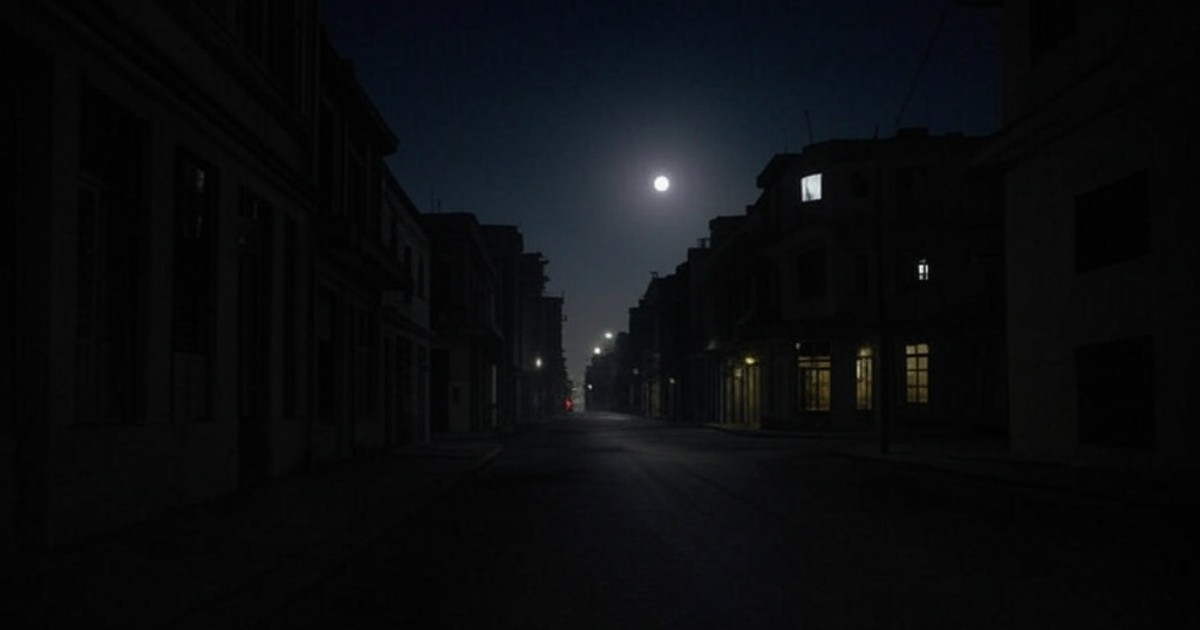
The energy crisis worsens the situation: Cuba experienced its eighth total disconnection from the National Electric System on September 19. Tourism also plummeted: Cuba received only 387,591 international visitors in the first half of 2026, a decrease of 60.7% compared to the same period the previous year, according to data from the National Office of Statistics and Information (ONEI).
Demographics tell their own story of exhaustion. In 2025, Cuba registered 136,214 deaths compared to only 68,064 births—practically two deaths for every birth—while the effective population fell to 9,434,593 inhabitants, a decrease of 313,414 from the previous year, according to data from the National Office of Statistics and Information (ONEI).
Laritza Camacho's question is not the first of its kind to circulate on social media. Since at least May 2026, messages with phrases like "I don't want to survive, I want to live" have spread across digital platforms, reflecting a weariness that fluctuates between resignation and open protest.
"There is no way to survive in the current Cuban context. We are all dying, no longer so slowly as it was a few years ago. We are agonizing for every second of life," wrote a netizen in the comments, encapsulating in a few lines what the data confirms with figures.
Related videos:
Filed under: