The withdrawal of the Spanish group Vima in Havana may be one of the most visible signs of the impact of the tightening U.S. sanctions against the military conglomerate GAESA, but it is not the only European business that is now under a new risk spotlight.
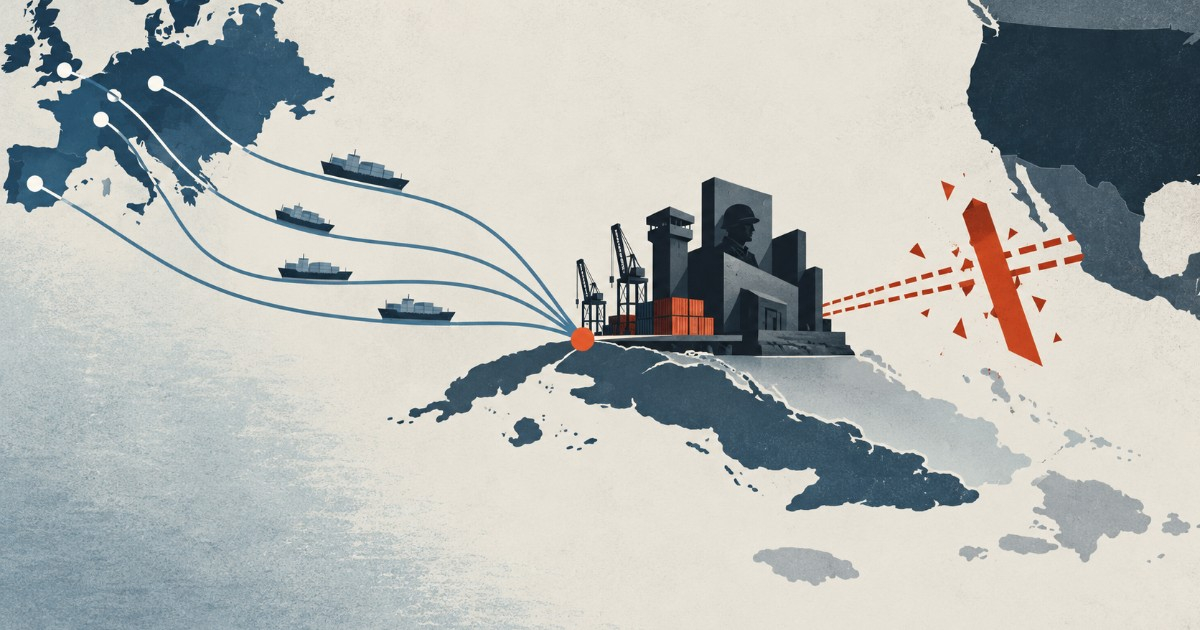
A review by CiberCuba of corporate documents, official records, and primary sources indicates that companies from the United Kingdom, Italy, and Belgium have documented presence in the Mariel Special Development Zone (ZEDM) or in related projects, an area that the U.S. Department of State includes among the subentities linked to GAESA in the Cuba Restricted List.
Among the cases are Unilever, GIB Holding through Lácteos Mariel, BDC International, and Sistem Costruzioni. However, their situations are not the same, and their presence in Cuba does not, by itself, mean that these companies are sanctioned or have violated U.S. regulations.
The distinction is important after Vima removed its brand from its store in Havana and scaled back its operations, having previously conducted business through entities linked to the powerful business conglomerate controlled by Cuban military.
The risk for foreign companies changed in 2026
The United States designated GAESA under Executive Order 14404 on May 7, 2026. The Office of Foreign Assets Control (OFAC) explicitly warns that non-U.S. persons and entities may face sanctions for conducting transactions with GAESA.
This risk also extends, according to the official guide published by OFAC, to entities in which GAESA, the Ministry of the Interior, or the Ministry of the Revolutionary Armed Forces hold directly or indirectly 50% or more.
OFAC also issues a specific warning regarding the Cuba Restricted List: many of the entities included in it have at least a 50% stake from those organizations, while others may not yet be blocked. For this reason, it recommends that foreign companies exercise enhanced due diligence before engaging with any of them.
The situation became even more complex on September 30. From that date, U.S. regulations prohibit individuals under U.S. jurisdiction not only from engaging in certain direct financial transactions with entities on the Cuba Restricted List, but also from indirect transactions.
The OFAC itself provides an example of a payment made by a foreign individual to a Cuban establishment included on the list that goes through a U.S. bank: although the customer may not be American, the bank's involvement can turn the operation into a prohibited indirect transaction for the U.S. financial entity.
This increases the practical risk for European companies that rely on U.S. correspondent banks, dollar payments, or other financial services linked to the United States, even if the European company has not been sanctioned.
Mariel appears directly on the list of entities linked to GAESA
The significance of Mariel is not a journalistic interpretation. The Mariel Special Development Zone is expressly listed in the Cuba Restricted List published by the State Department under the section for additional GAESA subentities, along with the Mariel Container Terminal, Almacenes Universales, Tecnoimport, and other entities.
This does not mean that every foreign company established within the ZEDM is automatically sanctioned. What is required is to accurately determine who they hold contracts with, who they make payments to, and which entities are involved in their operations.
Unilever maintains Unilever Suchel in Mariel
One of the most significant cases is that of Unilever.
The Annual Report and Accounts of Unilever for 2025, published in 2026, lists Unilever Suchel S.A. among its group companies, with Unilever holding a 60% stake and located in the Mariel Special Development Zone, Artemisa province.
The document shows that the multinational has a documented corporate presence in Mariel. It does not, by itself, demonstrate that Unilever is engaging in a prohibited transaction with GAESA.
The sensitive point for the company lies elsewhere: determining which entities manage the services, infrastructures, payments, and contractual relationships necessary for that operation, and whether any of them are subject to U.S. restrictions.
GIB Holding and Lácteos Mariel: Italian capital within the ZEDM
Another visible case is Lácteos Mariel, belonging to the Italian GIB Holding Company.
The company itself currently states on its corporate website that its production plant is located within the Mariel Special Development Zone and belongs to GIB Holding.
The company produces yogurts, cheeses, butter, and other dairy products in Cuba and maintains an active commercial website with an address, phone numbers, and job offers in Mariel.
Furthermore, the official portal InfoMercatiEsteri, under the Ministry of Foreign Affairs of Italy, continues to include Lácteos Mariel S.A.-GIB Holding Company among the Italian companies with a presence in Cuba.
Again, this presence does not amount to a U.S. designation. However, it places the company within a context that Washington explicitly identifies on its list of entities connected to GAESA, making it particularly important to understand which Cuban counterparts are involved in its operations.
BDC International maintains commercial facilities in Mariel
The presence of BDC International, a Belgian group that developed the subsidiaries BDC Log and BDC Tec in Mariel, remains evident.
The commercial website of BDC currently has among its establishments a BDC Log center in the ZEDM, identified as a store and workshop located in plot 191 of Zone A-5.
BDC also offers services in logistics, transportation, storage, workshops, industrial equipment, and the marketing of vehicles and spare parts in various provinces of Cuba.
Its presence within Mariel raises the same compliance issue: what Cuban entities are involved in the operations and payments, and whether any transaction ultimately benefits directly or indirectly any entity included in the Cuba Restricted List.
Sistem Costruzioni: the most direct link documented by Italy
The case of the Italian company Sistem Costruzioni deserves a different consideration because there is official documentation that explicitly described a project associated with GAESA.
In February 2025, the Italian Ministry of Foreign Affairs reported that Sistem Costruzioni was building a glass factory in the Mariel Special Development Zone through a joint venture with a state-owned company belonging to the GAESA economic conglomerate.
On the other hand, the corporate site of Sistem Costruzioni currently lists a branch in Havana, established in 2010, from which it claims to manage projects in Cuba and other markets in the region.
However, the public documentation reviewed by CiberCuba does not allow us to determine whether, following the sanctions imposed on GAESA in May 2026, the contractual structure of that joint venture remains exactly the same, has been modified, or is under review.
Therefore, it would be incorrect to state without additional documentation that Sistem Costruzioni is violating the sanctions. What is confirmed is that the Italian government officially described its project as a partnership with a GAESA company and that the firm has a corporate presence in Cuba.
From large hotels to less visible industrial companies
The U.S. pressure had already led to much more visible changes in tourism. In July, CiberCuba reported on the departure of Meliá, Iberostar, and Barceló from their operations in Cuba, after years of managing hotels owned by Cuban state entities.
For that reason, those chains should not be automatically used now as examples of companies that continue to operate on the island just because the names of some hotels they historically managed still appear in U.S. documents.
The new front is in businesses that are much less visible than resorts: factories, logistics, food, infrastructure, and companies established in Mariel.
The problem is no longer just being sanctioned
For a European company, the current danger is not limited to the possibility of its name appearing one day on the U.S. sanctions list.
OFAC warns that foreign companies may be exposed to U.S. measures for transactions with GAESA or entities controlled by the military conglomerate at least 50%. At the same time, a U.S. bank appearing as an intermediary may be unable to process a payment involving an entity on the Cuba Restricted List.
This can result in banks rejecting transactions, suppliers demanding more information, insurers reviewing contracts, and companies needing to provide much greater detail about who the ultimate beneficiary of each payment is.
The Vima case may be more a warning than an exception regarding what is happening within the business framework controlled by the Cuban military: the cost and risk of operating with structures linked to GAESA have just increased significantly, even for foreign companies that are not sanctioned.
Related videos:
Filed under: