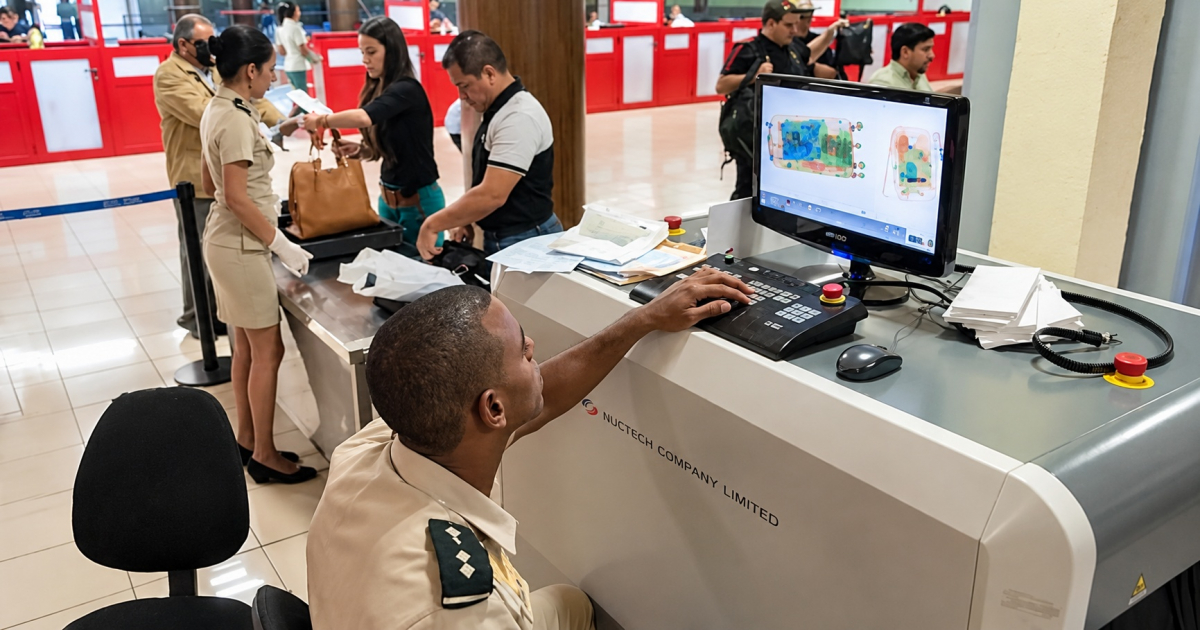
The General Customs of the Republic of Cuba published the , a regulation that establishes the rules applicable to non-commercial imports made by individuals on the island and sets specific limits for goods such as cell phones, computers, appliances, clothing, footwear, tools, and building materials.
The regulation was published this Monday in the , and will come into effect on October 12.
The resolution defines non-commercial imports as those made by citizens occasionally for personal, family, or household use, through luggage, shipments, household goods, or other authorized cargo.
According to the text of the regulation, "the customs authority recognizes as non-commercial imports carried out by individuals those that they perform occasionally for personal, family, or household use, through luggage, shipments, household items, or other authorized carga."
The most significant change is that when Customs determines that certain goods exceed the permitted limits or are of a commercial nature, the person may choose to formalize their importation as commercial and pay in U.S. dollars (USD), instead of being subjected solely to the treatment intended for items that do not qualify as personal imports.
The regulation thus develops the mechanism approved by the Cuban government for individuals to formalize certain goods for commercial purposes by paying the corresponding tariffs and customs services in USD.
When does Customs consider an importation to have a commercial nature?
The Customs will continue to differentiate between goods intended for personal, family, or domestic use and those that, due to their quantity, nature, frequency, or value, are considered of a commercial nature.
The customs authority allows imported items that correspond to a non-commercial import, are declared transparently, are presented in varied quantities, and comply with current legislation.
When Customs determines that an item is of a commercial nature due to its quantities, it will allow the importation of the quantity permitted for non-commercial purposes and will apply to the excess the procedure outlined in Annex III of Resolution 340/2026, titled "Common Provisions for Determining the Commercial Nature of Non-Commercial Imports."
In those cases, the dispatch of goods that meet the ordinary rules will be carried out first.
Subsequently, if the holder agrees, a new independent office will be opened for the excess items, to which the applicable tariff rates and corresponding technical-productive services will apply, payable in USD.
Five units or three, depending on the value of the merchandise
One of the general rules states that for items whose value is determined by Customs declaration, purchase invoice, or reference value, up to five units of each type may be accepted as non-commercial imports when their value does not exceed 50 USD.
When the value of each item exceeds 50 USD, the maximum allowed will be three units of each type.
Amounts that exceed those limits may be subject to the new commercial clearance and payment procedure in dollars, provided that the goods can legally qualify for that mechanism.
The regulation itself cites the importation of five toilet bowls with a reference value of 55 USD each as an example.
In that case, three units could be accepted through the non-commercial route, while the remaining two would be subject to the treatment established for surpluses.
This general rule does not apply uniformly to all goods, as numerous categories have specific limits that take precedence over it.
Up to five cell phones and three computers
Resolution 340/2026 establishes specific limits for information and communication technology equipment.
Individuals will be able to import up to five mobile or smart phones. The list included in the regulations sets a reference value of 80 USD per unit for these devices.
In the case of computing equipment, up to three units in total may be imported, regardless of whether they are desktop computers, laptops, tablets, or other similar devices.
The reference values are 200 USD for a desktop computer, 250 USD for a laptop, and 100 USD for a tablet.
Up to three items related to telecommunications, network devices, and certain peripherals are also allowed.
However, some communication equipment remains subject to specific authorizations. This includes certain routers, radio transmitters, satellite phones, and other devices that require permission from the Ministry of Communications.
Two appliances of the same kind
Household appliances are subject to a specific rule: up to two items of the same type may be imported, provided that the total value does not exceed the authorized limit for the corresponding operation.
The regulation expressly includes electric plants, of which up to two units may also be imported under this rule.
The fixed reference value list includes, among others, 300 USD for a household refrigerator and 350 USD for a freezer.
In the case of flat-screen televisions, the reference values range from 250 to 500 USD, depending on their size, while certain air conditioning units of up to one ton have values between 150 and 200 USD.
Clothing, shoes, food, and hygiene products
The miscellaneous category includes products such as footwear, clothing, food, personal and household hygiene items, costume jewelry, perfumes, and other similar items.
In these cases, Customs will take into account both the quantities and the variety of goods to determine whether they have a personal nature or if there are signs of commercial importation.
When it is determined that there is a commercial nature due to the repetition or excessive quantity of the same product, up to five kilograms of that item will normally be permitted through the non-commercial route, and any excess may be subject to new commercial processing.
In the case of small-sized objects for which five kilograms would be an excessive amount in relation to personal or domestic use, the quantity allowed through the non-commercial route may be reduced to one kilogram.
The regulation mentions examples such as stones for lighters (lighter flint) and watch batteries.
The Gaceta illustrates the procedure with the case of a traveler attempting to enter the country with 90 kilograms of women's shoes: five kilograms would be allowed through the non-commercial route, and the rest could be processed through the commercial procedure with payment in USD.
One kilogram is equivalent to 10 dollars for groceries
One of the relevant technical aspects of the resolution is the maintenance of the alternative valuation method for items classified as miscellaneous imported by passengers.
For these products, an equivalence of one kilogram equals 10 USD is established as the value-weight criterion to determine the taxable amount at Customs.
The regulation also establishes a "Reference Values List," included in Annex II, for the products that individuals most frequently import through various channels.
According to Article Five, that list "serves as a guide or recommendation for calculating the tax to be collected by Customs."
Tools and construction materials also have their limits
The resolution establishes specific rules for a number of other categories of goods. Among them, it allows for up to three musical instruments, while tools valued through declaration, invoice, or reference value are generally limited to two of each type.
Regarding construction materials, up to 50 square meters of cladding and flooring pieces, up to 50 units of certain manufactured construction products, and up to 10 units of other hardware and materials will be permitted.
Vehicles, motorcycles, and mopeds are also subject to specific provisions. In these cases, the new commercial procedure cannot be used to exceed the limits set by other legal regulations.
How much will have to be paid for the excess?
The new mechanism does not mean that any surplus can automatically enter the country. The person must agree to its formalization as a commercial import and pay the corresponding duties and customs services in USD.
The establishes the applicable rates for those operations.
Tariffs are progressive: 15% on the value of goods up to 2,000 USD; 20% on the excess up to 4,000 USD; 25% up to 6,000 USD; and 30% on amounts above that.
For goods arriving via postal shipments, a fee of 30% is established.
Payment can be made using international or national cards enabled for transactions in dollars. Cash in USD will only be accepted at airports.
What happens if the traveler doesn't want to pay in dollars?
When the goods are to be passed to commercial clearance, the owner may accept payment of the corresponding taxes and services in USD or request the reshipment of the products, provided that the conditions set for that procedure are met.
If the person does not authorize the payment or proceed with the reshipment, Customs will apply the corresponding administrative measure in accordance with current legislation.
The procedure will also not serve as a means to regularize prohibited goods, fraudulent declarations, or other customs violations. Such cases will continue to be subject to the treatment specifically established by legislation.
When additional time is necessary to complete the shipment, the goods may be kept in custody at warehouses or storage facilities for the authorized period, though the costs arising from their storage must be borne by the recipient.
Recidivism can limit the right to import
Resolution 340/2026 also establishes consequences for those who repeatedly engage in imports that Customs determines have a commercial nature.
In such cases, the authority may impose an administrative measure that temporarily limits the person's right to import.
As long as that restriction remains in effect, only your personal effects will be allowed, while the rest of the goods will be subject to the treatment established in customs legislation.
The impact on the so-called "mules"
The new rules directly affect the model used for years by the so-called "mules," travelers who bring back clothing, footwear, food, hygiene products, appliances, and other items from abroad that are later sold in Cuba.
In September, economist Elías Amor warned CiberCuba that the new regulations could displace these workers from the import business, at a time when the government was expanding foreign trade opportunities for micro, small, and medium enterprises and cooperatives.
The now approved mechanism establishes a way for part of those goods to be formalized as commercial imports, although this entails assuming tariffs and customs services paid in dollars.
Three regulations make up the new customs package
The Official Gazette No. 83 publishes three closely related provisions: Resolution 340/2026 from the General Customs, the , and Resolution 197/2026 from the Ministry of Finance and Prices.
Decree-Law 132 modifies Decree-Law 22 regarding the Customs Tariff for non-commercial imports and establishes the possibility for an individual to formalize the commercial importation of certain goods with the customs authority.
Resolution 197, for its part, establishes the tariff rates and the corresponding technical and productive services, as well as the currency in which the goods subject to that procedure must be paid.
Resolution 340 establishes the rules for determining what can be considered a non-commercial import, the limits applicable to different goods, and the treatment of items that exceed those quantities.
The latter is structured into three annexes: Annex I contains the general rules for non-commercial imports; Annex II includes the list of reference values; and Annex III sets out the common provisions for determining the commercial nature of the goods.
Resolution 340 replaces the rules that have been in effect since 2022
The Resolution 340/2026 repeals and replaces Resolution 175/2022 of the General Customs, which had been subsequently amended by Resolution 170/2024 and Resolution 312/2026.
Its main legal basis is the , issued on June 11, 2025, and in effect since April 21, 2026, whose Article 14 empowers the head of the General Customs Office to establish the conditions, terms, and deadlines for customs controls and to update the list of reference values.
The text of Resolution 340 itself justifies its approval by referencing "the results of the study on the application of the aforementioned Resolution 175 of 2022" and "the implementation of measures to apply the economic and social transformations demanded by the country."
The package also specifies the announcement made in June by Prime Minister Manuel Marrero Cruz, when the government announced that it would allow individuals to import goods for commercial purposes, breaking with the framework that had for decades primarily limited citizens to "non-commercial" imports.
Starting from October 12, Resolution 340/2026 will be the regulation that specifies in detail the quantities that can be brought into Cuba as personal imports and which excess goods can proceed to a second commercial dispatch with payment in dollars.
Related videos:
Filed under: