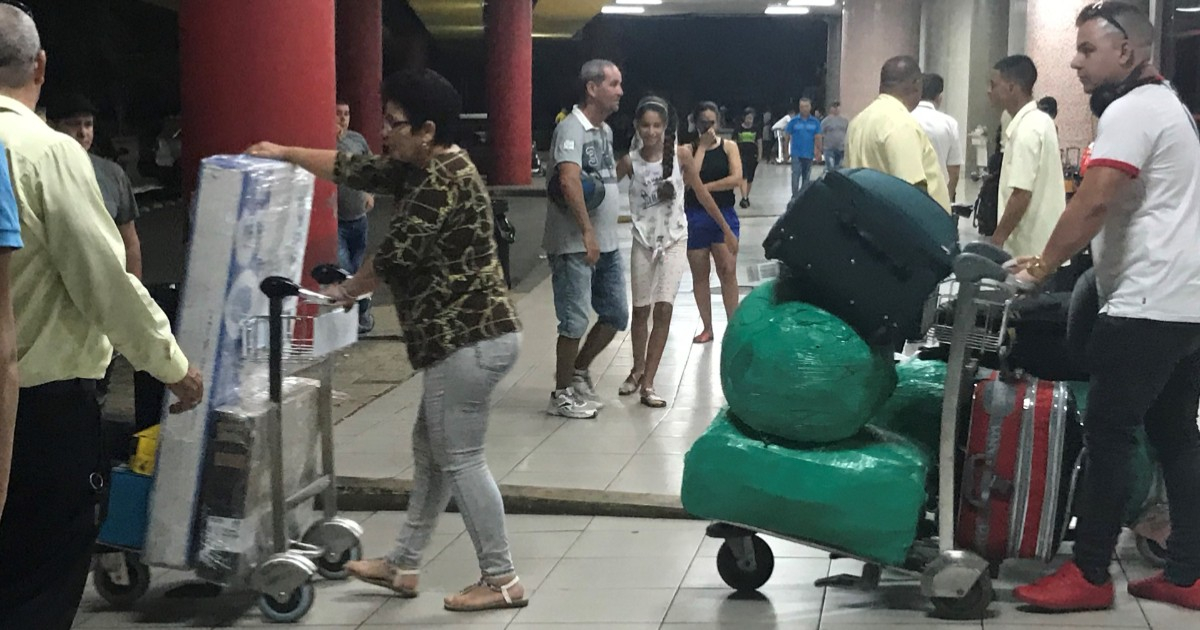
The General Customs of the Republic established new rules to determine which goods can enter Cuba as non-commercial imports and which will need to go through a second processing as commercial items requiring payment in dollars, with specific limits set for appliances, mobile phones, computers, clothing, footwear, tools, and other products.
The provisions are outlined in the , published this Monday in the , and will come into effect on October 12, seven days after its publication.
The regulations detail the mechanism approved by the Cuban government for individuals to submit certain goods for customs clearance on a commercial basis, paying customs duties and fees in USD.
The key point of the new resolution is that Customs will continue to distinguish between what it considers a non-commercial import and what it identifies as commercial based on quantity, nature, frequency, or value.
Non-commercial importation continues to be defined as that which a person undertakes occasionally for personal, family, or household use.
When excessive quantities or goods of a commercial nature are detected, the items that comply with the ordinary regulations will be processed first. Afterwards, if the owner agrees, a new independent dispatch will be opened for the excess, to which tariffs and services in dollars will apply.
The specific measure is an announcement made in June by Prime Minister Manuel Marrero Cruz, when the government announced that it would allow individuals to import goods for commercial purposes for the first time in decades. Until then, the legislation limited citizens to "non-commercial" imports, while this activity was primarily reserved for companies and other authorized parties.
Five units or three, depending on the price
One of the most important rules states that for items valued through a Customs declaration, purchase invoice, or reference value, up to five units of each type may be accepted as a non-commercial import when their value does not exceed 50 dollars, and up to three units when it exceeds that amount.
Anything that exceeds those limits may, if the holder agrees, be transferred to a second dispatch with a commercial nature and payment in USD. However, this rule does not generally apply to all goods, as several categories have specific limits that take precedence over it.
The Gaceta itself provides an example: if a person intends to import five toilets, with a reference value of 55 dollars each, Customs will authorize three within the ordinary limit and will apply the procedure for commercial imports to the remaining two.
Two appliances and up to five cell phones
Appliances will have a different limit: up to two items of the same type will be allowed, as long as the sum of their values does not exceed the authorized limit for the corresponding operation.
The regulation explicitly includes power plants, with up to two units also being importable under this rule.
For information technology and communications equipment, Customs will allow up to three computing devices, regardless of whether they are desktop computers, laptops, tablets, or other similar devices.
You will also be allowed to bring up to five cell phones or smartphones and up to three items related to telecommunications, networking devices, and certain peripherals.
Some communication equipment remains subject to specific permits. The Gaceta notes, for example, that routers, certain radio transmitters, satellite phones, and other devices require authorization from the Ministry of Communications.
Clothing, shoes, food, and hygiene products
The so-called miscellaneous category includes footwear, clothing, food items, personal and household hygiene products, costume jewelry, perfumes, and similar products.
In these cases, Customs will take into account the diversity of the products. When it considers that there is a commercial nature due to the repetition or excessive quantity of the same item, it will normally allow up to five kilograms of that product and subject the rest to commercial clearance.
If we are dealing with very small objects, and five kilograms would represent an disproportionate amount for personal or household use, the limit may be reduced to one kilogram. The regulation mentions matches and watch batteries as examples.
La Gaceta illustrates the procedure with a passenger trying to bring in 90 kilograms of women's shoes: Customs would allow five kilograms through non-commercial means, and the rest could be processed via the new paid procedure in USD.
For products that apply the value-weight alternative, the new resolution also maintains for travelers the equivalence of one kilogram for 10 dollars for the purpose of determining its customs value.
Other categories have their own limits
The resolution establishes specific rules for numerous products. For example, up to three musical instruments are allowed, while tools valued by declaration, invoice, or reference value are generally limited to two of each type.
In construction materials, Customs allows up to 50 square meters of tile and flooring pieces, up to 50 units of certain manufactured items for construction, and up to 10 units of other fittings and materials.
Vehicles, motorcycles, and mopeds also have specific rules. In these cases, the new commercial dispatch cannot be used to exceed the limits established by other legal provisions.
What happens if the traveler does not want to pay in dollars?
When a product needs to go through customs, the owner may accept payment of the corresponding taxes and services in USD or request the return of the products, as long as they meet the established conditions for that process.
If you do not authorize the payment or proceed with the re-shipment, Customs will apply the corresponding administrative measure in accordance with current legislation.
The new procedure will apply when there is no attempt to evade customs control. Prohibited goods, fraudulent declarations, and other violations remain subject to different treatments and cannot simply be regularized by paying in dollars.
If the person needs time to complete the shipment, the goods may remain in custody in warehouses or storage for the authorized period, but the expenses will be borne by the recipient.
The resolution also warns that those who repeatedly engage in imports that Customs considers commercial may face a penalty that temporarily restricts their right to import. While this measure is in effect, only personal effects will be allowed, and the rest of the goods will be treated according to the provisions of the law.
The new rules could directly impact the so-called "mules," travelers who have spent years transporting clothing, food, toiletries, and other products for sale in Cuba. In September, economist Elías Amor warned CiberCuba that the new regulations could displace these workers from the import business, as the government expanded the foreign trade opportunities for small and medium-sized enterprises and cooperatives.
Resolution 340/2026 replaces Resolution 175 of 2022 and its subsequent amendments, and from October 12, it will be the regulation that outlines how to determine the commercial nature of goods and how to process excesses of travelers and shipments.
Related videos:
Filed under: