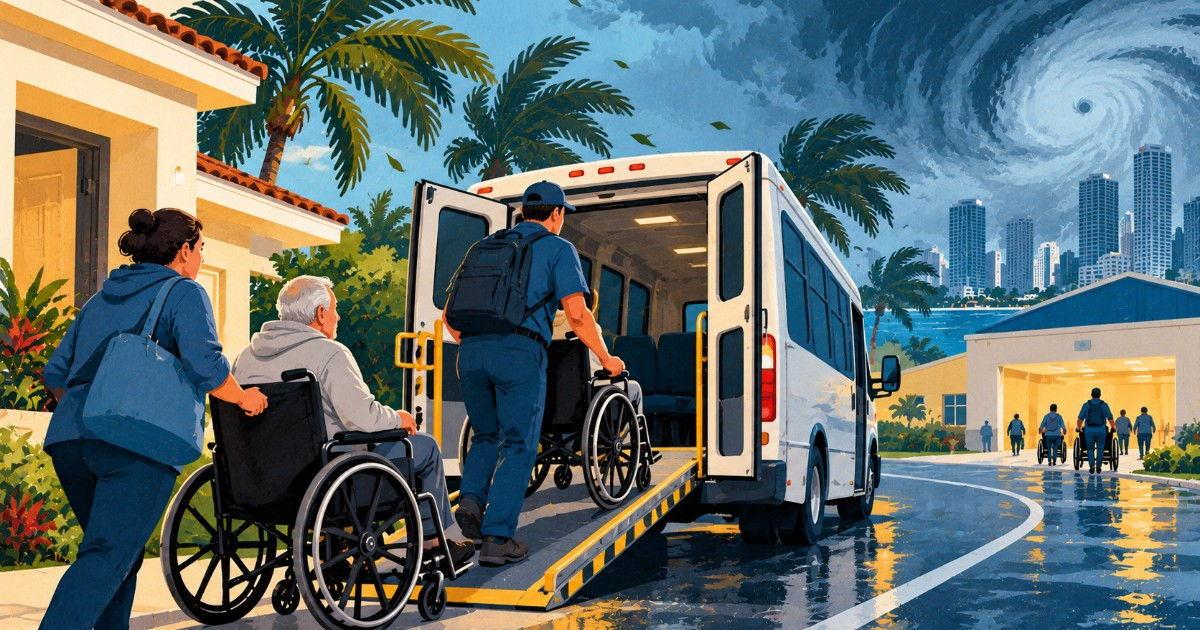
Residents of Miami-Dade who, due to a disability, medical condition, or mobility issues, are unable to evacuate on their own during a hurricane or other emergency can register free of charge for a county program to receive specialized transportation, shelter, and assistance during evacuation.
This is the Emergency & Evacuation Assistance Program (EEAP), administered by the Miami-Dade Emergency Management Department.
The program accepts registrations year-round, but there is one especially important warning: registration closes before an evacuation order is issued.
That's why authorities recommend not waiting for a hurricane to directly threaten South Florida to request assistance.
The official Miami-Dade information on how to register for EEAP indicates that residents who are accepted only need to enroll once and will remain in the program as long as they keep their information updated.
Who can register
The program is aimed at residents of Miami-Dade who live in their homes, apartments, or other private residences and need additional assistance to evacuate safely.
Among the individuals who may be eligible are those who:
They cannot evacuate on their own due to a need for specialized transportation.
They are confined at home and cannot walk to a bus pickup point.
They have no relatives or other people who can transport them.
They have medical conditions that prevent them from evacuating without assistance.
They are bedridden.
They depend on essential medical equipment that requires electricity.
They need assistance with everyday activities such as walking, moving around, dressing, eating, or taking medications.
They require supervision or medical care during an evacuation.
Miami-Dade again reminded in May 2026 that individuals with disabilities who require specialized care, assistance with daily living activities, or life-saving medical equipment that relies on electricity must register before an emergency.
There's no need to live alone
The EEAP is not solely reserved for people who live alone.
It can be used by a person who lives alone or with family members as long as they meet the assistance criteria.
If there is more than one person in a household who needs assistance to evacuate, each must submit an individual application.
Who does not qualify
Residents of certain long-term care facilities do not participate in the program in the same way.
Miami-Dade excludes those who live in:
Residences for seniors or assisted living facilities.
Nursing homes.
Certain care centers or group residences.
The reason is that those facilities are required to have their own emergency and evacuation plans for the people they serve.
What assistance does Miami-Dade offer?
The EEAP offers different levels of assistance depending on the resident's needs.
Among the services published by the county are:
Specialized transport.
Shelter during the emergency.
Medical follow-up or monitoring.
Calls after the disaster to check on the person's status.
The transportation and shelter provided as part of the program are free of charge for the resident.
However, if during the evacuation a person needs to be transferred to a hospital for medical treatment, the relevant health services may incur the usual costs.
Transportation from the residence can be included
A person who is unable to reach an evacuation point due to reduced mobility or other needs can indicate this situation in their application.
The county can arrange specialized transportation and determine what type of vehicle is necessary based on the applicant's characteristics.
The application asks, among other details, whether the person uses:
Wheelchair.
Walker or cane.
Crutches.
Service animal.
Oxygen.
Electric medical equipment.
It also asks if the person is bedridden and what type of assistance they typically need.
Not everyone goes to the same type of shelter
Registering with EEAP does not automatically mean being sent to a hospital or a medical needs shelter.
Miami-Dade assesses the level of care for each individual and assigns them to the appropriate center.
A person with a disability who normally functions independently may be sent to a general evacuation center and receive specific accommodations or specialized transportation there.
Those who require closer medical monitoring can be placed in centers equipped to meet special needs.
Cases with higher medical requirements may receive a different allocation based on their situation.
An emergency shelter is not a hospital
The county advises that evacuation centers are a last resort resource for those who do not have another safe place to go.
They do not necessarily have the same level of equipment, personnel, or services as a hospital or another healthcare facility.
That's why Miami-Dade recommends that those who can evacuate safely with family or friends also consider that option as part of their personal plan.
You need to bring medications and personal equipment
A person accepted into the EEAP must prepare to stay away from their home during an emergency.
The county recommends carrying a kit that includes:
Medications.
Food and water.
Necessary medical equipment.
Disposable medical supplies.
Clothing.
Personal hygiene products.
Blankets or bedding.
Food and supplies for service animals.
Those following a medical or special diet should also bring the foods they need.
A companion or caregiver is also important
Miami-Dade recommends that a caregiver or companion stays with the evacuated person during the emergency to help address their needs.
The application allows for the identification of that person.
In medical needs centers or facilities with limited capacity, there may be restrictions on how many family members can stay with the evacuee.
How to register online
The quickest way is to use the official online registration portal of the EEAP of Miami-Dade.
The county recommends completing the application from a laptop or desktop rather than from a phone.
It is important to consider another practical detail: the online form cannot be left incomplete to finish it later.
The system does not save an incomplete application.
At the end, the applicant receives a temporary EEAP number for their records.
There is also a request in Spanish
The county provides forms in English, Spanish, and Haitian Creole.
The official EEAP application in Spanish can be downloaded directly in PDF from Miami-Dade.
Since direct links to documents can change over time, the county also keeps the forms updated on its official EEAP registration page, where versions in English, Spanish, and Haitian Creole are available.
You can also call 311 to request that they send a request.
People who need an accessible format, such as Braille or large print, can also request it from the county.
Where to send a paper application
Requests can be sent to:
Emergency & Evacuation Assistance Program
Miami-Dade County Department of Emergency Management
9300 NW 41st Street
Doral, FL 33178
The assistance phone number for the program is 305-513-7700.
Some applicants will need their doctor's intervention
When a person requires a high level of medical care, Miami-Dade indicates that their primary care physician must complete and sign the relevant medical information before submitting the request.
This information helps the Department of Emergency Management determine what transportation, shelter, or level of assistance the person requires.
What happens after registering?
Submitting the form does not mean that the registration is instantly approved.
The Emergency Management Department may contact the applicant to verify information.
You will later receive a letter indicating:
If he was accepted into the program.
What type of assistance can you receive?
What responsibilities will you have during an evacuation?
The county may later contact the resident to update their personal, medical, or contact information.
There is no need to submit a new application every year
The current page of the program states that an accepted person only needs to register once.
But the resident or their caregiver is responsible for reporting any significant changes.
For example:
New address.
Phone change.
Change of medical condition.
New medical equipment.
Change in transportation needs.
Updates can be communicated through the program line or the contact channels provided by Miami-Dade.
Do not wait for the evacuation order
This is probably the most important point of the entire program.
Miami-Dade allows registration year-round, but closes online and paper registration before an evacuation order is issued.
A person who waits until the last moment can call 311 and request assistance, but the county warns that this does not guarantee that help will be received.
Residents who are already registered have priority over those who are requesting assistance during the emergency.
The program is useful for more than just hurricanes
Although the EEAP is often associated with the hurricane season, it can be activated in response to different types of emergencies.
Miami-Dade mentions, among others:
Hurricanes and tornadoes.
Wildfires.
Chemical spills or hazardous material spills.
Prolonged and widespread blackouts.
Radiological emergencies.
This is especially relevant for individuals who require continuous electricity to operate medical equipment.
The hurricane season is not over yet
The official Atlantic hurricane season runs until November 30.
CiberCuba reported at the beginning of the 2026 season about the call from Florida authorities to prepare evacuation plans in advance, especially among residents who have never directly experienced the impact of a hurricane.
The authorities in Miami-Dade insisted that preparation should not begin when a storm is already showing up on the radar.
The rains also serve as a reminder of the risk of flooding
Florida also experiences episodes of heavy rainfall during this time of year.
Although that specific episode does not have Miami-Dade as the main area of impact, it serves as a reminder that flooding, power outages, and other events can trigger evacuation or assistance needs.
What should a person who may need help do now?
Do not wait for an evacuation order.
Register online or download the application.
Gather medical and transportation information.
Identify a caregiver or companion.
Ask the doctor to complete the paperwork if specialized medical care is needed.
Keep address, phone number, and medical condition updated.
Prepare medications, medical equipment, and emergency supplies.
For a person who cannot evacuate on their own, registering in advance can make a fundamental difference when an emergency arises: those who registered beforehand are the first the county identifies to organize transportation, shelter, and assistance according to their needs.
Related videos:
Filed under: