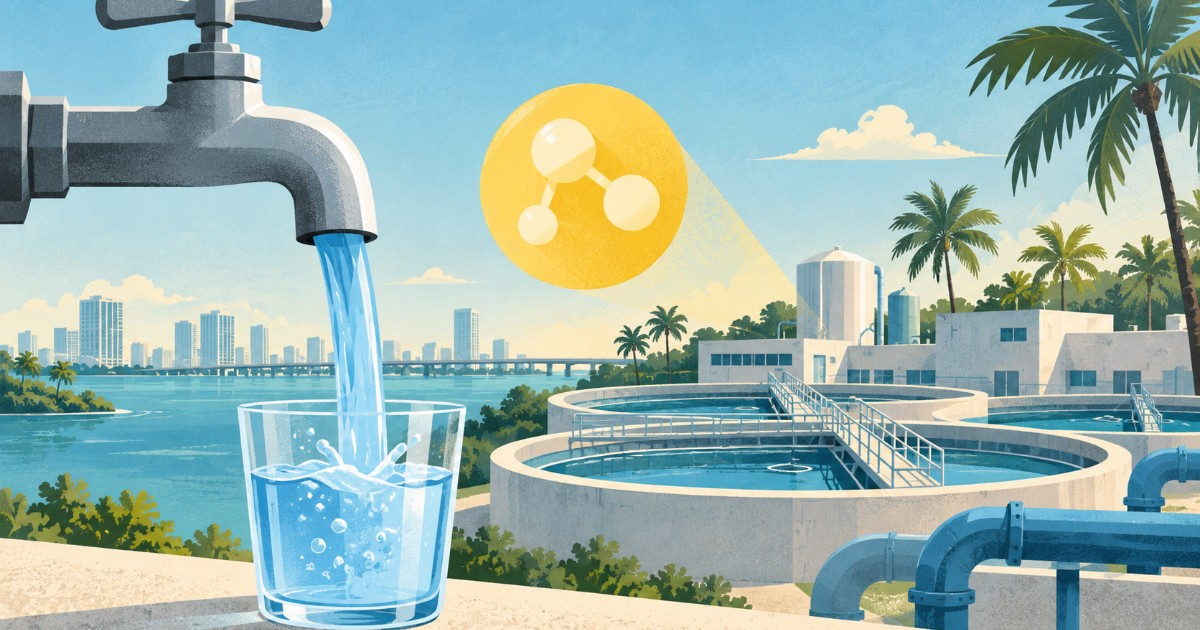
If the tap water in some areas of Miami-Dade has a stronger chlorine smell or taste than usual these days, there is an explanation: the county's Department of Water and Sewer is temporarily changing the process used to disinfect the supply.
The Miami-Dade Water and Sewer Department (WASD) reported that the conversion began on September 28 and will continue until October 11, 2026.
During these two weeks, the system uses free chlorine instead of the usual combination of chlorine known as chloramine in its treatment plants.
According to WASD, this is a scheduled procedure that the county has been carrying out annually for over four decades in coordination with the Florida Department of Health in Miami-Dade and the Department of Regulatory and Economic Resources.
Why can it smell more like chlorine?
Free chlorine is temporarily used as part of the cleaning and disinfection process of the water distribution system.
During this stage, some customers may notice a more pronounced chlorine smell or taste when turning on the tap.
WASD assures that this condition is temporary and does not cause adverse health effects.
The Department also maintains a highlighted notice on its official page to inform customers about the change, which will end on October 11.
You may also get cloudy water
During the procedure, workers from the Department may perform discharges and pipe cleaning at various points in the network to ensure that the treatment reaches the entire distribution system.
As a consequence, some households may experience lower water pressure than usual for brief periods or notice water appearing cloudy.
The County explains that if the water appears cloudy, you can let the tap water run for three to five minutes until it runs clear again.
WASD qualifies this situation as a temporary and cosmetic effect of the process, noting that it does not represent a deterioration in water quality.
Special attention for dialysis patients and aquariums
The official notice includes specific recommendations for certain situations.
People undergoing dialysis treatment can consult their doctor about the temporary change in water treatment.
Similarly, tropical fish owners and those responsible for restaurants, shops, or other establishments that keep fish in tanks are advised to consult with professionals specializing in aquarium maintenance.
These precautions are due to the fact that changes in the concentration and type of chlorine used in the water can be significant for those specific systems.
It is not an alert for contamination
The change in smell, taste, or appearance of the water may be striking, but the County insists that the procedure is part of the regular maintenance of its network.
This is not an alert about contamination, nor is it an order to stop consuming water.
The conversion specifically involves temporarily replacing the commonly used chloramine with free chlorine as a disinfection method.
Once the scheduled period is over, the system will return to its usual treatment method.
Miami-Dade has issued other water-related warnings this year
The current measure should not be confused with the water availability issues that previously affected South Florida.
In February, CiberCuba reported an alert for water shortage in Miami-Dade and other counties in South Florida after several months of below-average rainfall and exceptionally low levels in the Biscayne aquifer.
That situation was related to the drought and the availability of water resources, while the process currently underway is a scheduled disinfection operation of the system.
Who to call if there are questions about the water?
Miami-Dade has activated phones from its Laboratory Division for clients with questions related to water quality.
Those residing north of Southwest Eighth Street can contact 786-552-4738.
Customers located south of Southwest Eighth Street can call 786-552-4181.
The temporary change will continue until Sunday, October 11, the scheduled date for the completion of the annual treatment conversion.
Related videos:
Filed under: