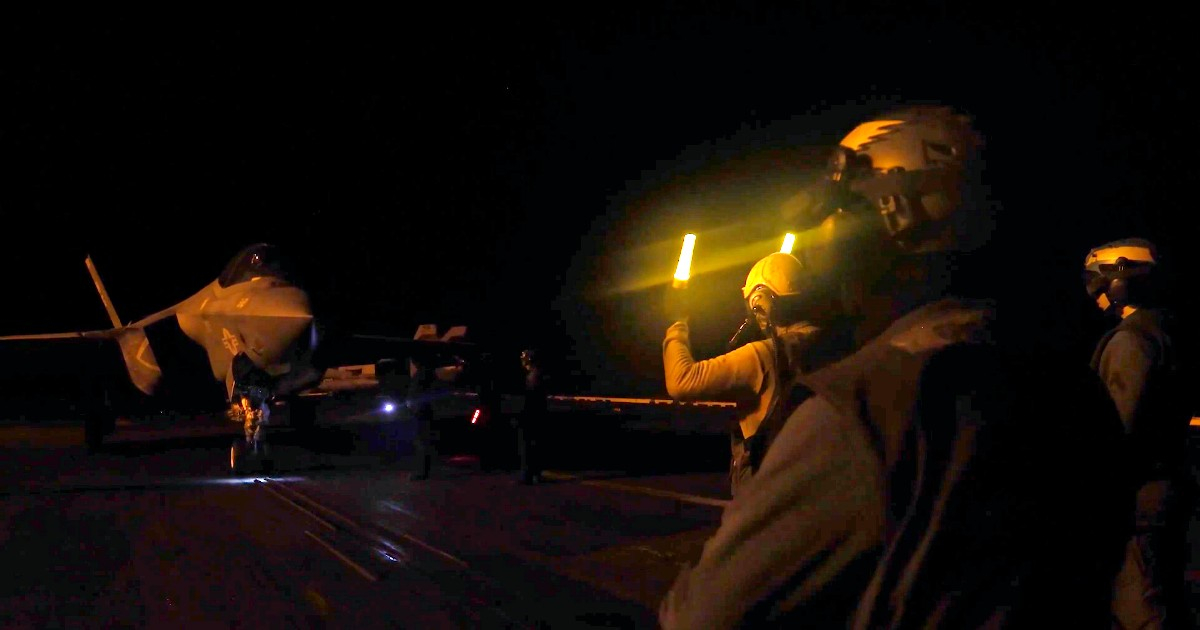
A F/A-18F Super Hornet from the VFA-41 “Black Aces” squadron of the United States Navy landed last Wednesday at Naval Air Station Lemoore, California, featuring an unprecedented decoration: the silhouette of a submarine painted on the nose of the aircraft.
The painting was accompanied by the inscription «Sub Buster», evidence of its involvement in the destruction of an Iranian submarine during Operation Epic Fury, according to the specialized outlet The Aviationist.
The aircraft in question, with serial number 168491, was part of the deployment of the USS Abraham Lincoln (CVN-72), which spent 302 days at sea —the second longest period for a U.S. aircraft carrier since the Cold War— before its squadron returned to California.
The Aviationist rated the brand as the first of its kind to carry a Super Hornet in its entire operational history.
The specific Iranian submarine destroyed by that aircraft has not been publicly identified. However, the analysis of the silhouette painted on the bow suggests a Kilo-class submarine, the most capable of the Iranian fleet, built by Russia and delivered in the 1990s.
Of the three Kilos that Iran possessed, one — the IRIS Taregh — was officially confirmed as destroyed while docked. The other two had been considered non-operational for some time, although their eventual destruction would also be counted as a loss.
Iran lost a significant part of its submarine force during Operation Epic Fury, making it impossible to determine with certainty what the target of the Super Hornet was.
The U.S. also confirmed the sinking of the Fateh, the flagship of a native class of small coastal submarines, and the destruction of multiple units of the Ghadir class. At least one of the latter was targeted with an AGM-114 Hellfire missile launched from an MQ-9 drone, which rules out the Super Hornet as the responsible party for that particular attack.
To neutralize the Iranian submarine fleet, a variety of methods were employed: ATACMS ballistic missiles, unmanned surface vehicles, and fixed-wing aircraft, in addition to drones. The specific weapon used by the F/A-18F 168491 to attack the submarine has not been publicly confirmed.
The Kilo-class submarines represented, in theory, Iran's most dangerous naval asset: capable of attacking surface ships, laying mines, launching guided munitions, and even drones, with little prior warning.
However, the conditions of the Persian Gulf—shallow depth and high salinity—make underwater operations challenging even for experienced crews. Additionally, since their delivery in the 1990s, Iran has never been able to consistently maintain two operational Kilo submarines simultaneously.
The Epic Fury Operation was launched on February 28, 2026, by order of President Trump, with over 100 aircraft targeting Iranian objectives in the first wave.
The campaign formally concluded on May 5, 2026, following a partial ceasefire reported in early April. During that period, the U.S. claimed to have destroyed 17 Iranian warships and multiple submarines. The VFA-41 squadron launched a total of 421 missiles and bombs throughout the entire operation.
The brand «Sub Buster» will remain as a permanent decoration on the plane, in a tradition comparable to that of the F-15E Strike Eagle 89-0487, which bears a green star commemorating the destruction of an Iraqi helicopter by a laser-guided bomb.
The U.S. Secretary of Defense recently warned that Iran will never again have a naval force comparable to what it had before the conflict.
Related videos:
Filed under: