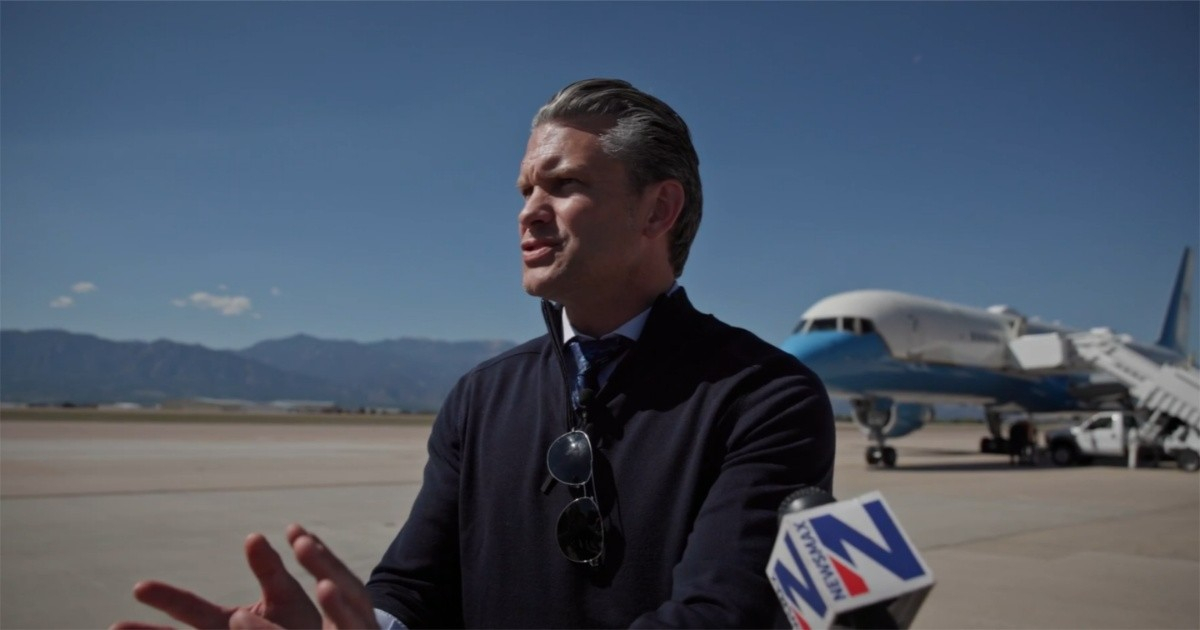
The United States Secretary of Defense, Pete Hegseth, issued a stark warning to Iran this Saturday: the country will never acquire a nuclear weapon, and it is Washington —not Tehran— that exercises effective control over the Strait of Hormuz, the most strategic maritime route in the world.
"Iran will never, ever, ever have a nuclear weapon," declared Hegseth to reporters, describing that goal as "a vital national interest of the United States." The secretary added that President Donald Trump is "determined at all costs" to prevent it and that he will keep "all options on the table" if Tehran refuses to give up its nuclear ambitions.
Hegseth explicitly invoked the two major U.S. military operations against Iran to support his stance: "We made it clear with Midnight Hammer, we made it clear with Epic Fury. We continue to assert that today."
Operation Midnight Hammer, carried out on June 22, 2025, was the first direct attack by the U.S. against Iranian nuclear facilities in Fordow, Natanz, and Isfahan, involving B-2 Spirit bombers and Tomahawk missiles launched from submarines.
The Epic Fury Operation, launched on February 28, 2026, extended the campaign to the entire Iranian military infrastructure —including the Revolutionary Guard, missile systems, and naval bases— and struck over 5,000 targets in its first ten days.
On the Strait of Hormuz, Hegseth was equally forceful: "Iran wants to play with things like the Strait of Hormuz. They do not control it. We do. They literally haven't been able to move anything. Our blockade has been ironclad, and we operate almost at pre-war levels every night."
The U.S. naval blockade in the Strait of Hormuz was ordered by Trump on April 12, 2026, temporarily lifted on June 18, and resumed on July 14.
Hegseth acknowledged that Iran is attempting to rebuild its damaged military and missile capabilities, but he argued that the destruction of its defense industry makes this process "slow and difficult."
The statements come at a time of intense diplomatic and military activity. On Friday, Vice President JD Vance chaired a meeting at Camp David with Secretary of State Marco Rubio, Hegseth himself, Special Envoy Steve Witkoff, CIA Director John Ratcliffe, and the Chief of Staff, General Dan Caine, where the situation with Iran and the Houthis in Yemen was discussed.
At the same time, the U.S. is reinforcing its naval presence in the Middle East: the aircraft carrier USS Theodore Roosevelt and the amphibious group USS Makin Island are heading to the region with over 7,000 sailors and 2,000 Marines, joining the already deployed USS George H.W. Bush and USS George Washington. If all these movements materialize, Washington could have three carrier groups in the area by the end of October.
Hegseth declined to confirm whether the USS Theodore Roosevelt would be sent specifically to the Persian Gulf, but emphasized that its mission is to maximize the president's "decision space."
Alongside military pressure, the Treasury Department expanded its sanctions campaign "Operation Economic Outcast" this week to include the Iranian automotive and railway industries, while additional Patriot missile defense systems are being deployed to protect energy infrastructure in Saudi Arabia and Qatar.
Trump, when asked this Saturday about his next steps regarding Iran, responded with a single phrase: "You'll see". The day before, he had warned that the decision regarding Iran would be made "the easy way or the hard way."
Related videos:
Filed under: