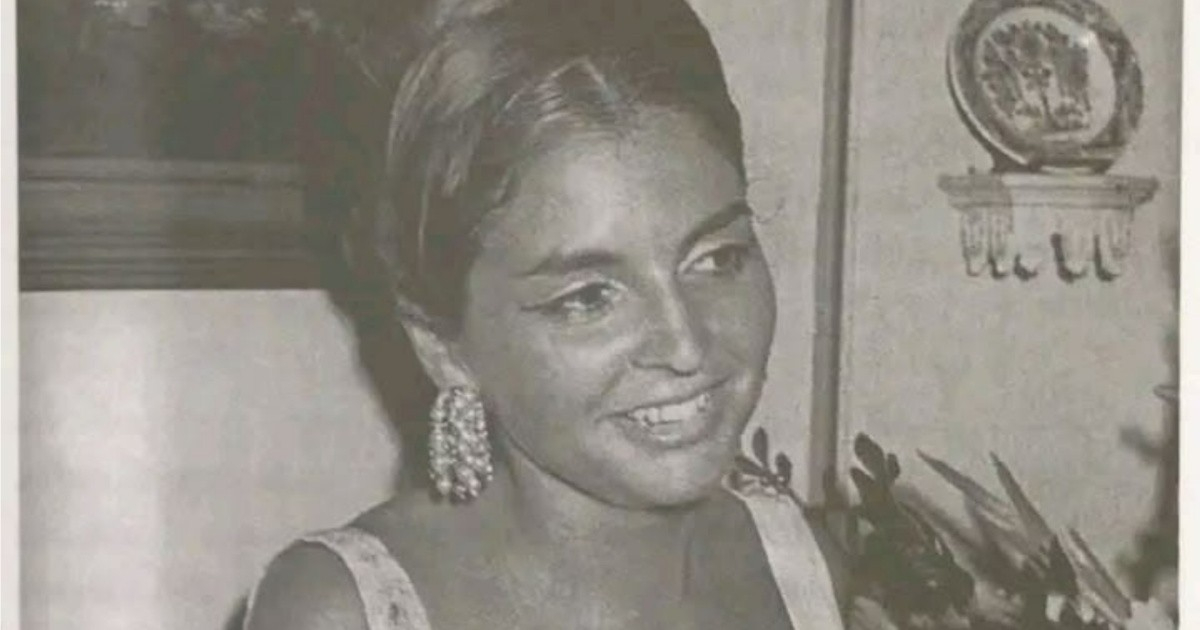
The Portuguese Annie Silva Pais, the rebellious daughter of the last director of the PIDE —the political police of the Salazar dictatorship—, arrived in Havana in October 1962 as the wife of a Swiss diplomat, attended parties at embassies, and had access to goods that Cubans could never buy.
Three years later, he abandoned everything to join the Castro regime and end his days with the same ration book as any Cuban. His story is the subject of a special report by the Portuguese outlet Observador, written by Inês André Figueiredo.
The couple landed in Havana on October 12, 1962, four days before the Missile Crisis, the most dangerous episode of the Cold War. Her husband, Raymond Quendoz, was responsible for deciphering the secret messages that arrived at the Swiss Embassy, which, in the absence of U.S. diplomatic representation, managed Washington's interests on the island. "It was a very tense time," he would admit decades later.
The couple settled in the Country Club, the most exclusive area of the capital, where almost all the embassies were concentrated.
Alfredo Duarte Costa, former Portuguese ambassador in Havana, accurately describes the gap that separated diplomats from the rest of the population: "There were stores where we could pay with dollars and had access to all goods: seafood, wines, sparkling wines, we had everything. Cubans, obviously, did not have money to go to those stores where foreign currency was accepted."
Annie spoke five languages and quickly integrated into both diplomatic and revolutionary circles.
From the first few months, she showed a growing fascination for Che Guevara: she attended his speeches, met him at a reception at the National Bank of Cuba, and even began to mimic his hairstyle. Her own husband described this admiration as a "sickly cult." The Swiss Embassy became a meeting place with figures from the regime: René Vallejo, a doctor and secretary to Fidel Castro, and José Abrantes Fernández, a member of the Castro regime's political police, were frequent visitors.
In September 1965, Annie traveled to Mexico under the pretext of a two-week vacation, which ended up lasting over a month.
The journalist Rui Ferreira, a friend of Annie's, explained to the Observador that the trip worked, "in terms of espionage," as a planned "exfiltration" with the complicity of the highest figures of the regime, including Fidel Castro. On October 25, 1965 —the fifth wedding anniversary— Raymond went to the airport in Havana to wait for her. Annie got off the plane and left with representatives of the Communist Party. She did not return.
He surrendered his Swiss diplomatic passport, renounced his privileged status, and became dependent on the ration book like any ordinary Cuban.
The paradox of her trajectory is hard to ignore: she was the daughter of the head of the PIDE, the political police that monitored, detained without judicial oversight, and tortured opponents of Salazar, and she embraced another dictatorship with its own repressive apparatus, one of whose agents frequented her home. She served as the official interpreter for the regime—eventually for Fidel Castro—in organizations like ICAP and OSPAAAL, and proudly wore the militia uniform.
His father, Fernando da Silva Pais, was arrested and imprisoned after the Carnation Revolution in April 1974. Annie traveled to Portugal to try to free him and returned to Cuba in 1981, after his death.
She died of cancer in Havana in July 1990, at the age of 54, having postponed surgery due to a work trip to North Korea. She is buried in an unmarked grave in the Colón Cemetery, on the brink of the Special Period, the greatest economic crisis Cuba has experienced since the Soviet collapse.
Related videos:
Filed under: