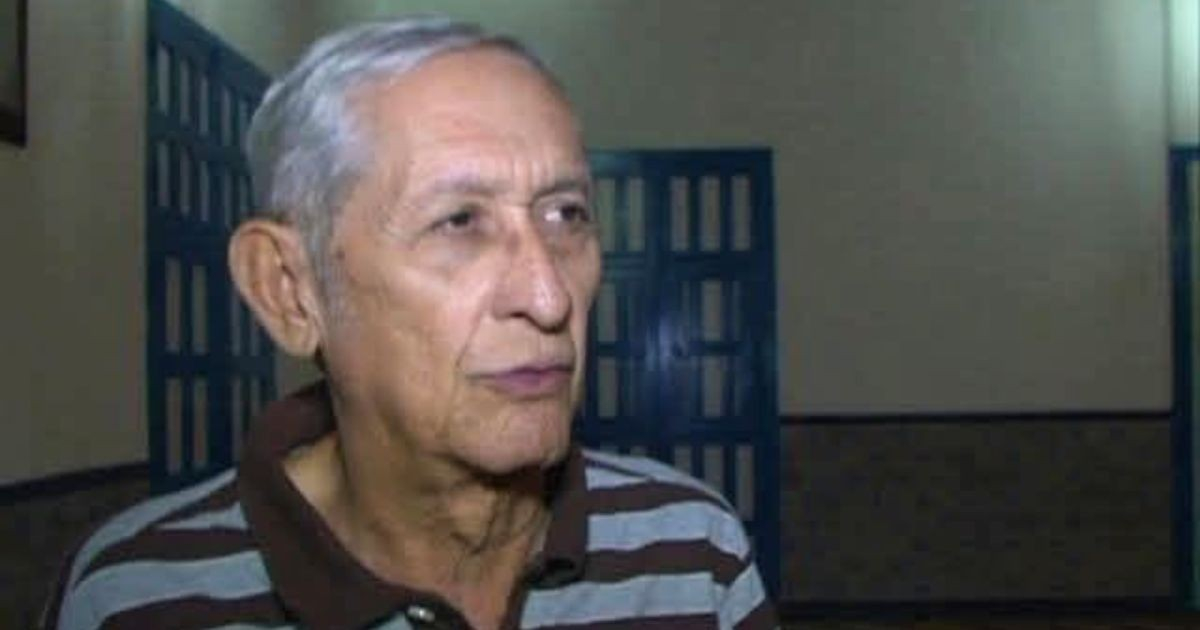
José Luis de la Tejera Galí, a full professor at the University of the East and Honorary President of the José Martí Cultural Society in Santiago de Cuba, passed away this Sunday in that city at the age of 79, according to Sierra Maestra.
CMKW Radio Mambí also announced his passing through their Facebook page. The condolence note was signed by Lioannis Meriño Manual, Provincial President of the Marti Youth Movement in Santiago de Cuba, on behalf of that organization and the José Martí Cultural Society.
“With deep sorrow, the presidency of the Martiano Youth Movement in Santiago de Cuba and the José Martí Cultural Society announce the passing of José Luis de la Tejera, a prominent scholar of José Martí’s work and Honorary President of the José Martí Cultural Society in Santiago de Cuba,” the text states.
De la Tejera dedicated decades to the study and dissemination of Marti's thought. According to the statement, “since his childhood and adolescence, he admired the Apostle in History classes and morning sessions, but it was in university, while studying Literature, that he delved into his extensive literary work.”
In 1997, De la Tejera founded and presided over the Santiago branch of the José Martí Cultural Society, as reported by Sierra Maestra. The statement from Radio Mambí notes that "everyone saw José Luis as the right person to lead it."
For 15 years, he was, according to the statement, "the most enthusiastic member, bringing many together, organizing events, and promoting Marti's work in the press," until he led the branch to stand out at the national level.
De la Tejera was also a professor at the Frank País Higher Pedagogical Institute, where he chaired the Marti Chair, and he led the Marti Youth Movement in Santiago de Cuba during the 1980s and 1990s.
Among his academic contributions is the book José Martí and Contemporary Challenges, published by Ediciones Santiago in 2007 in collaboration with Hart Dávalos and the philosopher Miguel Limia David. He also published articles in journals such as Honda, Casa de las Américas, Santiago—edited by the University of Oriente—and the Revista Ciencia y Sociedad of the Dominican Republic.
According to De la Tejera, Martí was "above all, an exceptional communicator, capable of reaching everyone with a purpose: freedom, humanity, and Latin American peace." He also believed that "Marti's thought is becoming increasingly relevant each day, especially at times when the unity of Latin American peoples is required."
The news of his death generated numerous messages of condolence among alumni, colleagues, and figures from Santiago's cultural scene. Several comments on social media remembered him as a "charismatic and excellent professor" who taught at the Frank País García Higher Pedagogical Institute and the University of Oriente. An alumna wrote that she had "the privilege of having him as a professor" and described him as "an excellence." Another person who knew him at the Frank País García Higher Pedagogical Institute remarked that "many professors owe him their unconditional support, not only in the study of the works of the Apostle."
The condolences from the forum members were extended to his widow, the fellow professor Martha Veneranda Fuentes Lavaut, as well as to family, friends, and colleagues. His death represents the loss of a prominent figure with a long history in Martian studies and the cultural life of Santiago de Cuba.
Related videos:
Filed under: