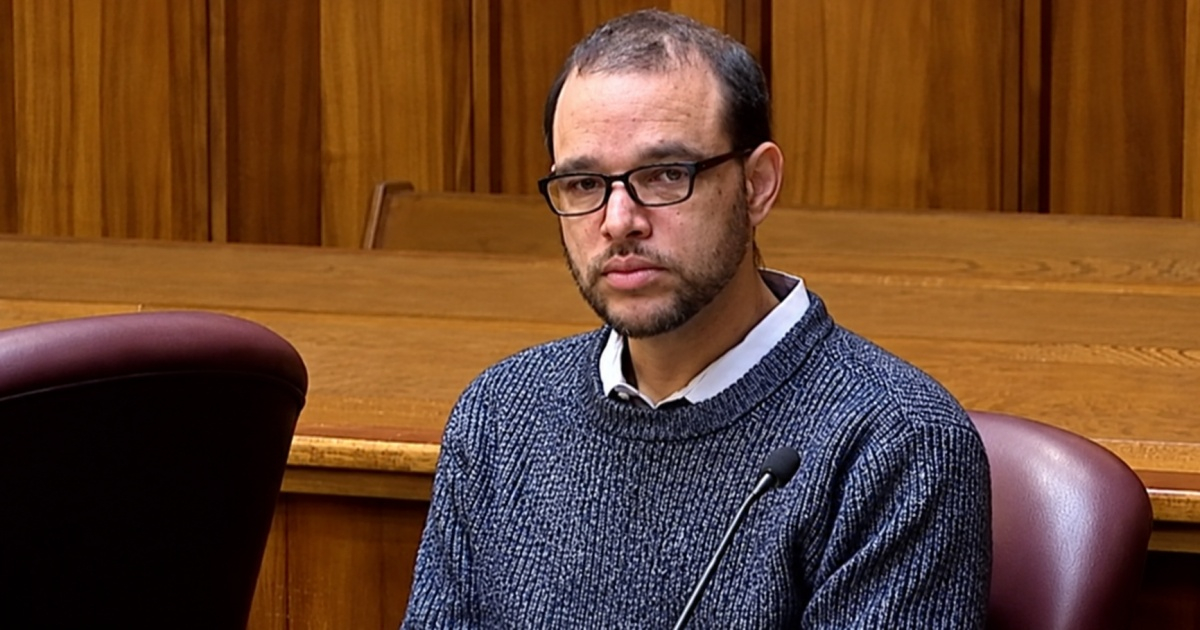
The jury that must recommend whether the Cuban Alberto Sierra, 42 years old, will spend the rest of his life in prison or be sentenced to death listened this Monday to the VHS recording in which the accused, with a calm voice and an almost indifferent tone, describes how he ended the life of his estranged wife and her two young daughters in November 2012, in one of the most chilling crimes recorded in Miami-Dade in recent decades.
The session took place during the sentencing phase of the trial, with Sierra sitting in the courtroom showing no emotion while the 12 jurors listened to the statement he gave to detectives on November 19, 2012, nine days after the murders and six days after the bodies were found.
The recording allowed for the reconstruction, based on Sierra's own words, of the sequence that began with a jealousy-fueled argument and ended with 29-year-old Gladys Machado and her daughters Julia Padrino, six, and Daniela Padrino, three, suffocated with plastic bags.
A jealousy-fueled argument that ended in a triple murder
According to the testimony presented to the jury, Sierra and Machado, who were separated, had taken the girls to the Mall of the Americas, where they bought ice cream.
In the parking lot, Machado received several calls from a man and declined them. Sierra, who suspected that his wife was being unfaithful, reacted with jealousy and tried to find out who was calling her.
"I was furious," he admitted during the questioning.
Sierra explained that he wanted to obtain Machado's phone password because he was looking for evidence of an alleged infidelity. The argument escalated, and both ended up struggling over a knife, according to the account presented during the trial.
The prosecutors argue that, after gaining control of the weapon, Sierra forced Machado and the two girls to move under threat to the home where the couple had previously lived, located at block 7300 on Northwest Fourth Street, in the Flagami neighborhood.
Once there, he locked the girls in a room while he continued arguing with Machado to hand over the password to his phone.
The woman's refusal led to even greater violence. Sierra tied her wrists behind her back with a white nylon rope and stabbed her with a knife while continuing to demand the device's code, as presented during the hearing.
"I tied his hands behind his back."
In the recording, Detective Juan Carlos Chaidez from the Miami-Dade Sheriff's Office asked Sierra if he knew he was being held for the murders of Gladys, Julia, and Daniela.
"Yes," Sierra replied. "I tied his hands behind his back."
In response to the investigator's questions, he explained that he had used a white nylon rope to restrain Machado's wrists.
He later recounted that he took a yellow plastic bag from the Sedano's supermarket chain and covered the woman's face with it to suffocate her.
The statement reproduced in court added another detail about Machado's final moments: the woman tried to resist while Sierra held the bag over her face.
"She was moving and struggling," was heard during the reconstruction of the interrogation.
Sierra later stated that he cried for what he had done.
Julia saw her dead mother
The violence did not end with Machado. Sierra described to the detectives how he later killed the two daughters of the woman, Julia Padrino, six years old, and Daniela Padrino, three.
Julia had witnessed what happened with her mother.
"He saw that his mother was dead and started crying and yelling. I grabbed the Sedano's bag and put it in his face," Sierra recounted.
Then he went over to Daniela, who was sleeping.
"I went to the girls' room, Daniela was sleeping, I sat on top of her and did the same," she stated.
According to his confession, he used the same method to end the lives of the three victims and later placed their bodies in the closet of the master bedroom.
At the end of describing that sequence, Sierra stated: “I don't know, I went crazy.”
Abuse of corpses and an attempt to erase evidence
The statement heard by the jurors also addressed what happened after the murders.
The Prosecutor's Office claims that Sierra sexually abused the corpses of Machado and Julia; and it also alleges that he disfigured Machado's face with a knife.
During the opening statements of the sentencing phase, lead prosecutor, Abbe Rifkin, argued that Sierra made cuts on Machado's face so that she would never be beautiful to another man again.
Sierra also described to the investigators his attempts to eliminate evidence from inside the house. In response to a question from Detective Chaidez about which areas he had scrubbed, he listed the master bedroom, the walk-in closet, the bathroom, the kitchen, the living room, and other areas of the house.
The three bodies remained in the closet of the master bedroom until a neighbor, alerted by the strong odor of decomposition coming from the house, made the grim discovery on November 13, 2012.
DNA changed the interrogation
Detective Chaidez testified before the jury that Sierra initially did not reveal what had happened and provided false information to the investigators.
The situation changed when he was confronted with the DNA evidence found on the victims.
Chaidez recalled that the accused's physical reaction was immediate. "He clasped his hands, looked towards the table for several seconds, and began to shake or quiver. It was then that he said something like he was going to tell us what had happened," the detective stated.
Prosecutor Rifkin used that moment during the interrogation to highlight to the jurors that the confession occurred after Sierra was confronted with the evidence.
The defense questions the interrogation and claims a brain injury
During the cross-examination, defense attorney Joyce Brenner asked Chaidez about the deliberately calm tone he maintained during the interview and whether that strategy aimed to establish a rapport with Sierra to get him to talk.
Chaidez responded that he had already established a relationship with the defendant during previous encounters, but he noted that something about his behavior had caught his attention from the very beginning.
According to his explanation, Sierra appeared overly calm when discussing Machado's alleged infidelity and extramarital relationships, a reaction that the detective found strange given the circumstances.
The defense strategy, however, has gone far beyond questioning the police interview. Sierra's attorneys attempted to persuade the jury that there are sufficient mitigating circumstances to avoid the death penalty.
One of their main arguments is a severe traumatic brain injury that Sierra allegedly suffered during his childhood when he was struck by a car. According to the defense, the accident fractured his skull and caused him to lose part of his frontal lobe, subsequently affecting his personality and cognitive functioning.
The jury will decide between life imprisonment and the death penalty
Sierra pleaded guilty in August before Judge Marisa Tinkler Méndez to nine charges: three counts of first-degree murder, three counts of kidnapping, two counts of abuse of a corpse, and one count of armed burglary. This was done without reaching any agreement with the Prosecutor's Office.
When the judge then reminded him that he was facing the death penalty, he replied, "Yes, ma'am. Fourteen years have passed, so..."
The phase currently underway does not seek to determine his guilt, which Sierra has already admitted, but rather to establish the punishment. The 12 jurors must recommend life imprisonment or the death penalty.
Under the reformed Florida law of 2023, unanimity is not required to recommend the death penalty; it is sufficient for at least eight out of the 12 jurors to vote in favor.
The lead prosecutor, Abbe Rifkin, has described the murders as "especially abhorrent, atrocious, and cruel," while the defense hopes to use the brain injury and other aspects of Sierra's personal history as mitigating circumstances to request that he serve the rest of his life in prison.
According to data from the Death Penalty Information Center cited in July 2026, there are currently five Cubans on death row in Florida.
Related videos:
Filed under: