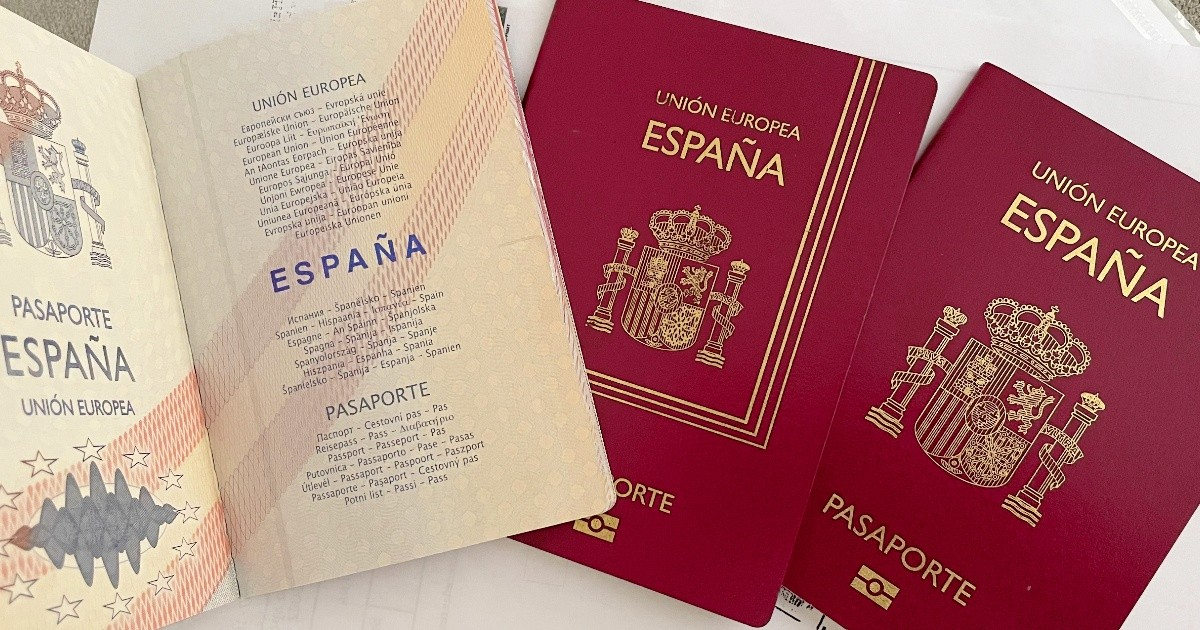
The Spanish Parliament is experiencing a new political and judicial battle surrounding the so-called "grandchildren's law," linked to the Law of Democratic Memory, which directly affects tens of thousands of Cubans with Spanish nationality or applications in process.
PSOE and Sumar have introduced an amendment in an educational reform to elevate the “presumption of exile” that supported thousands of nationalizations in Latin American consulates to the status of law. The amendment has been included by Hazte Oír in an ongoing procedure before the Supreme Court.
The amendment, number 63 presented by Sumar, was inserted into a reform project of the Organic Education Law—focused on student ratios, teaching hours, and teachers' working conditions—without any connection to that subject matter.
Its goal is to turn into law the instruction that Sofía Puente, then the General Director of Legal Security and Public Faith of the Ministry of Justice and sister of Minister Óscar Puente, signed in October 2022.
That administrative regulation established the presumption of exile for any Spaniard who had left the country between July 18, 1936, and December 31, 1955, without requiring individual verification.
The legal advisors of the Congress issued an opinion at the end of September declaring the amendment "inadmissible" for lacking the "minimum material connection" with the educational project, and warned that its acceptance could "harm Article 23 of the Spanish Constitution," which protects the participation of parliamentarians in the legislative process.
Despite that report —which is not binding—, the Education Commission's committee, with a majority of PSOE and Sumar, admitted it for processing on September 30.
The association Hazte Oír reacted immediately: it submitted a written statement expanding on the facts to the Administrative Litigation Chamber of the Supreme Court as part of its appeal 2/1091/2026, incorporating the amendment and the dissenting vote from four members of the Central Electoral Board.
He also requested that the high court resolve the pending precautionary measures and retain the electoral roll registration records in their entirety.
The association also filed a complaint for misconduct against Sofía Puente; the Instruction Court number 35 of Madrid forwarded the case to the Prosecutor's Office for a decision on its admission within five days.
The PP announced an appeal against the admission of the amendment and accused the Government of acting "through the back door."
VOX directly referred to it as a "pirate amendment."
The negotiation with Junts and PNV
For the amendment to be successful, the PSOE needs the votes of Junts and the PNV, who in June submitted total amendments to the educational project citing an infringement of autonomous competences.
According to sources from Congress cited by El Español, the PSOE will offer both parties to accept changes to the educational content of the regulation in exchange for not blocking the amendment regarding the law for grandchildren.
The first milestone of that negotiation will be the meeting of the committee scheduled for October 14.
Approval in Congress is expected in the first half of November, and the regulation could become law before Christmas due to expedited processing.
The Senate, with a majority from the PP, could amend or veto the text, although the Congress has the ability to override that veto with a simple majority.
What does this mean for Cubans?
The key to understanding the impact on Cubans is to distinguish what is suspended and what is not.
The Supreme Court decided on September 8 to provisionally suspend the electoral effects of about 170,000 registrations in the Electoral Roll of Absent Residents related to the inquiry by Sofía Puente, noting a "serious risk" that the integrity of the electoral process would be "severely affected."
That suspension, however, did not annul any nationality already granted nor did it halt the pending applications: what is at stake is the right to vote in the upcoming general elections on November 29, not Spanish citizenship.
As of July 1, 2026, 169,008 Spaniards residing in Cuba were registered in the overseas electoral roll, placing the island among the five countries with the highest number of Spanish voters abroad.
The Spanish Consulate General in Havana had accumulated more than 137,700 cases by the middle of this year, and it is estimated that between 300,000 and 350,000 people in Cuba have begun procedures since the regulation came into effect in October 2022.
If the amendment succeeds and comes into effect before November 29, it would give legal standing to the presumption of exile. Its eventual impact on the precautionary measures adopted by the Supreme Court would depend on the final wording of the regulation and the decisions of the court.
The schedule is tight: in-person voting at consulates for residents in Cuba is scheduled between November 21 and 26.
The presentation on October 14 will determine whether the parliamentary operation has enough support to be completed on time.
Related videos:
Filed under: