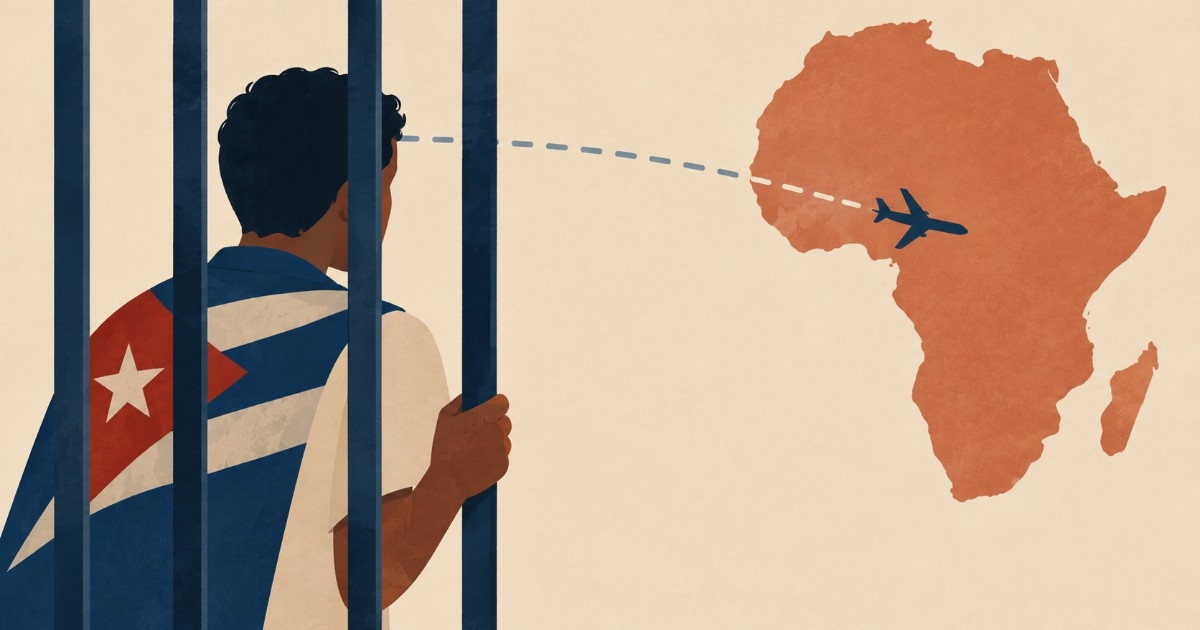
Cubans deported from the United States to African countries have reported months of imprisonment, transfers without knowledge of their destination, and difficulties accessing legal representation, according to a report published this Thursday, October 8, by Human Rights Watch (HRW). The organization documents testimonies from migrants sent to countries with which they had no connections and questions the guarantees provided during the procedure.
The report, consisting of 125 pages and titled To Scare People, examines the deportations to third African countries implemented by the Donald Trump administration. Among the accounts are those of Cuban men sent to Eswatini, where they ended up incarcerated in a maximum-security prison after having served criminal sentences in the United States.
According to data from the Immigration and Customs Enforcement (ICE) analyzed by HRW, 536 individuals from various nationalities were deported from the United States to African countries that were not their own between January 20, 2025, and August 5, 2026. This figure does not pertain solely to Cubans. The report includes interviews conducted between February and July 2026 with 24 individuals deported to six African countries, along with court documents and official records. HRW summarized the findings in a statement released this Thursday.
A Cuban who arrived via Mariel recounts how he ended up in an African prison
One of the testimonies collected by HRW is that of Geraldo C., identified by a pseudonym as a 59-year-old Cuban who arrived in the United States during the Mariel exodus in 1980. According to his account, immigration agents detained him in June 2025 during a routine appointment with ICE in Broward County, Florida.
The man recounted that he went through the Krome detention center in Miami and facilities in El Paso, Texas. He reported overcrowding, people sleeping on the floor, and poor sanitary conditions. He was later transferred to Eswatini in southern Africa. Describing his arrival, he said he encountered heavily armed soldiers and was escorted to a prison vehicle.
Another Cuban, identified in the report as Alberto C., 60 years old, stated that he was detained for six months in Buffalo, New York, before being deported to Eswatini in October 2025. According to his statement, he went through several stops and detention centers without anyone explaining to him that he would end up in Africa.
The abbreviated names used by HRW are pseudonyms intended to protect the individuals interviewed. Therefore, they should not be automatically identified with Cubans who have previously appeared with their full names in reports and videos shared on social media.
"I'm being held captive": report of prolonged detention in Eswatini
The report also includes the words of Alfredo C., another Cuban aged 60 who had been detained in Eswatini for nine months when he was interviewed in June. He stated that he did not consent to his transfer and described the psychological impact of being imprisoned without knowing when he would be released. "They have me kidnapped, I didn't sign to come here," he declared, according to the translation of his testimony collected by HRW.
According to the organization, Eswatini had received 32 deportees of different nationalities in five groups by September 2026. Among them were Cuban citizens. The individuals transferred were sent to the Matsapha prison complex, where human rights organizations have questioned the lack of effective mechanisms to challenge the detention.
The agreement between Washington and Eswatini includes a U.S. contribution of 5.1 million dollars to strengthen the border and migration management capacity of the African country, in exchange for receiving up to 160 deported individuals. This funding is outlined in the governmental agreement and does not represent an individual payment to each deportee.
The situation is not new for CiberCuba readers. In April, this outlet reported on the complaint of a Cuban who claimed to have been treated like a commodity after being transferred to Eswatini. In May, it also covered the case of Juan Carlos Font Agüero, who sought to return to Cuba after months of detention in that country. The new HRW report provides a broader investigation into the reported practices.
Other Cubans were sent to the Central African Republic and Equatorial Guinea
The transfers were not limited to Eswatini. HRW's investigation indicates that a flight that arrived in the Central African Republic on July 31 carried individuals from Cuba and other nationalities. It also documents a group transferred to Equatorial Guinea in August, after several deported individuals refused to disembark in Liberia.
CiberCuba previously reported on the case of Yasmany Moreno de Armas, a Cuban deported to Bangui who claimed he learned of his destination only while in flight. In September, the outlet reported on his efforts to assist other Latin Americans relocated to the same country.
In an independent report published this Thursday, Associated Press presented the testimony of Daniela Fuentes, a 32-year-old transgender Cuban living in Miami who was deported to the Central African Republic on August 29. Fuentes described the challenges of living safely and freely in a country where she has no personal ties. Her testimony to AP should not be confused with the interviews conducted by HRW, although it portrays another human consequence of the same immigration policy.
What does the United States say and what has the Justice System decided?
The U.S. government defends deportations to third countries as a tool to enforce immigration orders, especially when the country of origin does not accept the return of certain citizens. It also claims to obtain guarantees from the receiving governments regarding the treatment that the transferred individuals will receive. HRW argues that these guarantees have not prevented, in the investigated cases, situations of arbitrary detention and risks for those who fear being sent back to their places of origin.
The backgrounds of the expelled individuals are varied. In the first group sent to Eswatini, there were men convicted of serious crimes in the United States; the report acknowledges these backgrounds and specifies that they had served their sentences. Other Cubans sent to African countries have stated that they have no criminal record, although their individual situations require independent documentation. Having served a sentence does not, by itself, resolve issues related to detention conditions and the guarantees of subsequent deportation.
On September 29, 2026, the Supreme Court temporarily allowed the Trump Administration to continue enforcing these deportations while it examines the litigation regarding their legal requirements. CiberCuba explained the implications of that decision for Cuban migrants. The provisional ruling does not constitute a final decision on the legality of the entire policy.
Human Rights Watch demands procedures that allow for understanding and questioning the destination country, legal assistance, and effective guarantees against persecution or torture. Their investigation raises a central question for the Cubans expelled to Africa: what real resources do they have to challenge their relocation and avoid being indefinitely stranded in countries where they have no family, residence, or a clear path to protection.
Related videos:
Filed under: