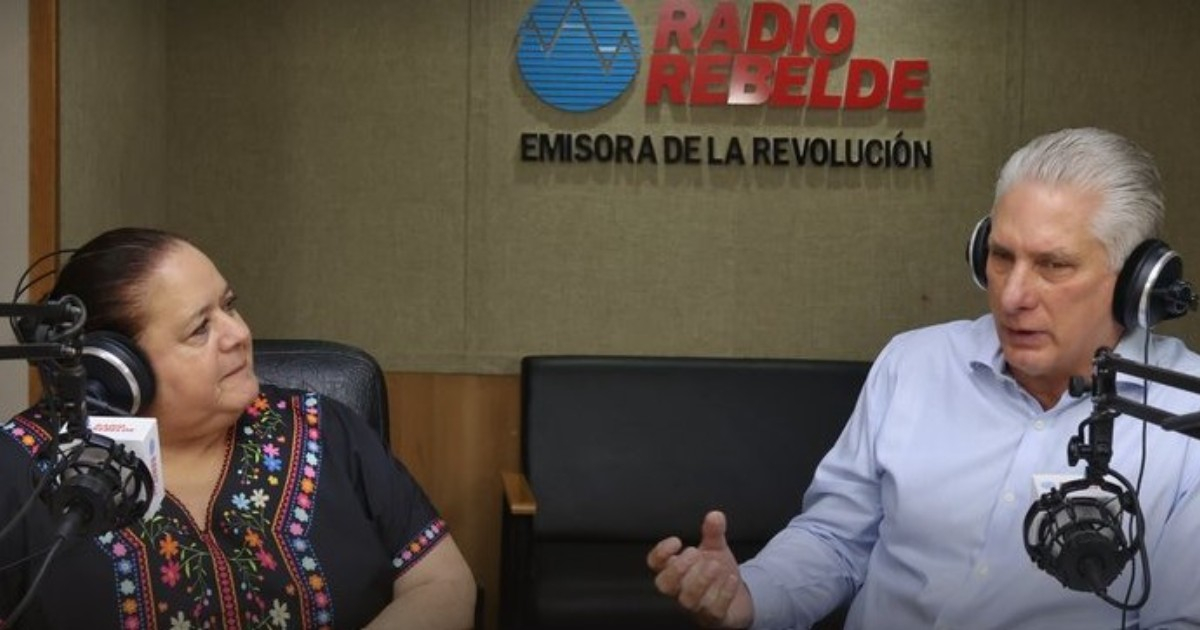
A Cuban mother turned to the radio program "Criterio Compartido" to request recognition and compensation for her role as a caregiver for her child with a disability, and she received a promise from Miguel Díaz-Canel: "You will be attended to in the coming days, and they will provide a solution."
The request was heard on Wednesday during the second installment of the biweekly show, broadcast from the studios of Radio Rebelde nationwide.
In response to the woman's plea, the leader replied with a rhetorical question: "How could we not ensure that a mother is a caregiver for her child and also receive all the support she needs...?", committing the involvement of the relevant institutions.
What is striking about the case is that Cuban legislation already provides for compensation for families caring for children with severe disabilities, as long as they meet certain requirements. However, Yudith reported that "in the municipality, they tell me that I cannot be my son's caregiver," without any known reasons for this refusal.
The , approved in February and published in the Official Gazette in April of the same year, recognizes the family care of children with severe, permanent, and irreversible disabilities as paid work.
The regulation allows mothers, fathers, grandparents, guardians, or other support persons to be hired by the Assurance and Support Unit of the Local Administration of People's Power, with labor rights and social security coverage funded by the State Budget.
However, practical application encounters bureaucratic obstacles: the disability must be certified by the municipal Public Health system, and the family caregiver must be authorized by the Municipal Directorate of Labor and Social Security, a process that, in practice, leaves many families without real access to the benefit.
That a mother had to call the radio program to demand a legally recognized right that has been in effect for over a year starkly illustrates the obstacles facing the implementation of that legislation.
The woman, identified as Yudith Monteagudo, explained that her son was born with an intellectual disability and that his situation has worsened due to health problems he has been experiencing for the past two years. She also mentioned that he had to have a leg amputated due to diabetes and a hematological condition.
Cuba is undergoing an unprecedented social and economic crisis. The CEPAL projects a GDP contraction of 10.3% in 2026, the worst decline in Latin America. Year-on-year inflation reached 25.19% in August, with food prices rising more than 36%.
In that same broadcast, Díaz-Canel also reported on the first delivery of the program, launched on September 23: of the 24 calls received, 16 people were visited by officials, five could not be located, and two remained pending attention.
"Out of the calls, eight were complaints. Of those, five were justified, and three were partially justified. In other words, the individuals were right in some way regarding the issues they raised," he acknowledged.
The second broadcast received over 50 calls regarding social vulnerability, medication shortages, inadequate basic services, pricing, banking issues, and bureaucracy, as reported by the program itself.
The ruler made a statement that sparked backlash: “The crisis also generates citizen creativity”, interpreted by the public as an attempt to shift the responsibility for the economic collapse onto the Cubans themselves.
The space has generated criticism on social media, where it was labeled as "the circus", and citizens are questioning the government's intention to eliminate bureaucratic obstacles that it has built over decades.
Related videos:
Filed under: