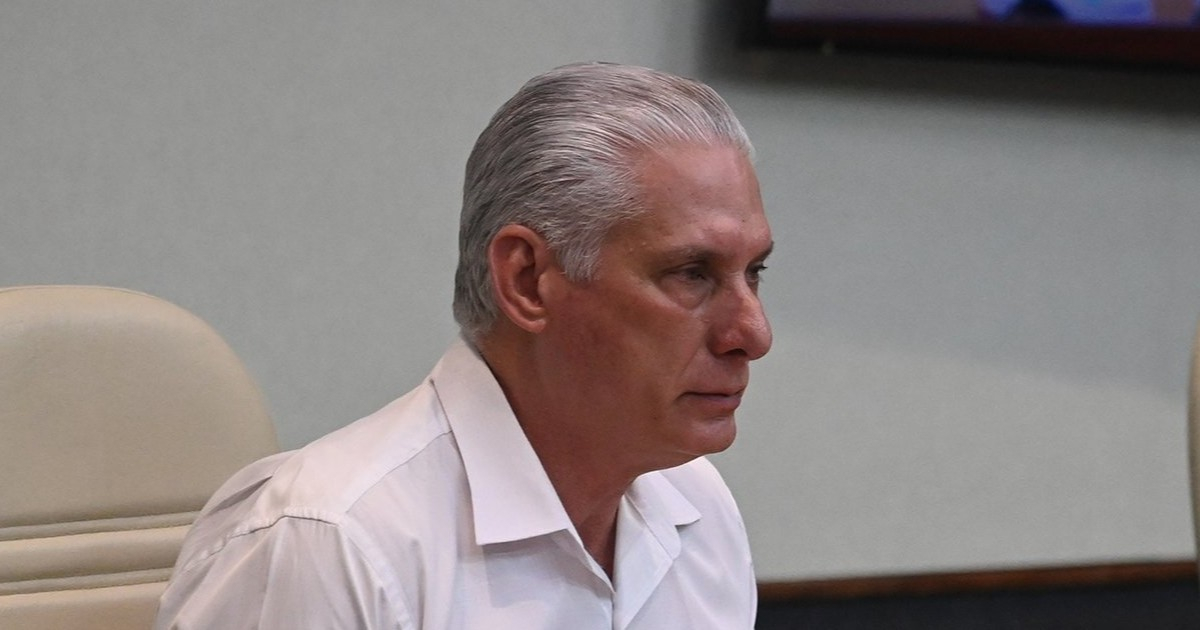
Miguel Díaz-Canel returned this Wednesday to the microphones of Radio Rebelde to host the second episode of his biweekly program “Criterio Compartido,” where he expressed a phrase that captures his approach to the collapse Cuba is experiencing: “The crisis also brings about citizen creativity”.
"That civic creativity linked to popular participation delivers results," he continued.
The expression is not new in the ruler's vocabulary. In February 2026, he had called for overcoming difficult times "with creative resilience, with the effort and talent" of the population, and in June, before the Extraordinary Plenary of the Central Committee of the Communist Party, he admitted that this approach had its limits: "To resistance, we owe our homeland, but today resistance alone is not enough."
The "citizen creativity" that is now being invoked is, in essence, a variant of the same discourse that shifts the burden of the crisis onto the Cubans themselves.
The program, broadcast nationwide alongside journalist Bárbara Betancourt, received 56 calls from citizens raising issues of social vulnerability, shortages of medicines, inadequate basic services, and bureaucracy.
Díaz-Canel acknowledged the shortage of medications on the island and attributed it to the lack of foreign currency and the "intensification of the U.S. blockade," without mentioning the regime's management as a determining factor.
The Basic Medicine List of Cuba for 2025 included 651 drugs, of which 250 were intended for import and 401 for domestic production, according to official data.
The ruler also reported on the first issuance, held on September 23. Of the 24 calls received at that time—from 23 different individuals—16 were subsequently visited by officials.
Of the eight complaints, five were recognized as valid and three as partially founded, according to the representative of the regime.
"Out of the calls, eight were complaints. Of these, five were justified, and three were partially justified. This means that the individuals had some valid points in their claims. There were nine that raised concerns," he argued.
The most recurring topics were water, electricity, sanitation, salaries, social equity, and food production.
In the public calls, concerns also emerged regarding the issue of prices. In this regard, Díaz-Canel was categorical: "The issue of prices is not only resolved by capping them," implicitly admitting that inflation — which reached 25.19% year-on-year in August 2026, with food prices rising over 36% — cannot be solved with administrative controls.
Díaz-Canel stated that the problems would be resolved by producing more: "And above all, we will solve this by producing and providing more goods and services for our population."
The program has sparked criticism from citizens who question the usefulness of a radio space in the face of structural problems that the regime has failed to resolve for decades.
CEPAL projects a GDP contraction of 10.3% for Cuba in 2026, while the National Electro-Energetic System has experienced eight complete outages since the beginning of the year, leaving millions of Cubans without electricity.
Related videos:
Filed under: