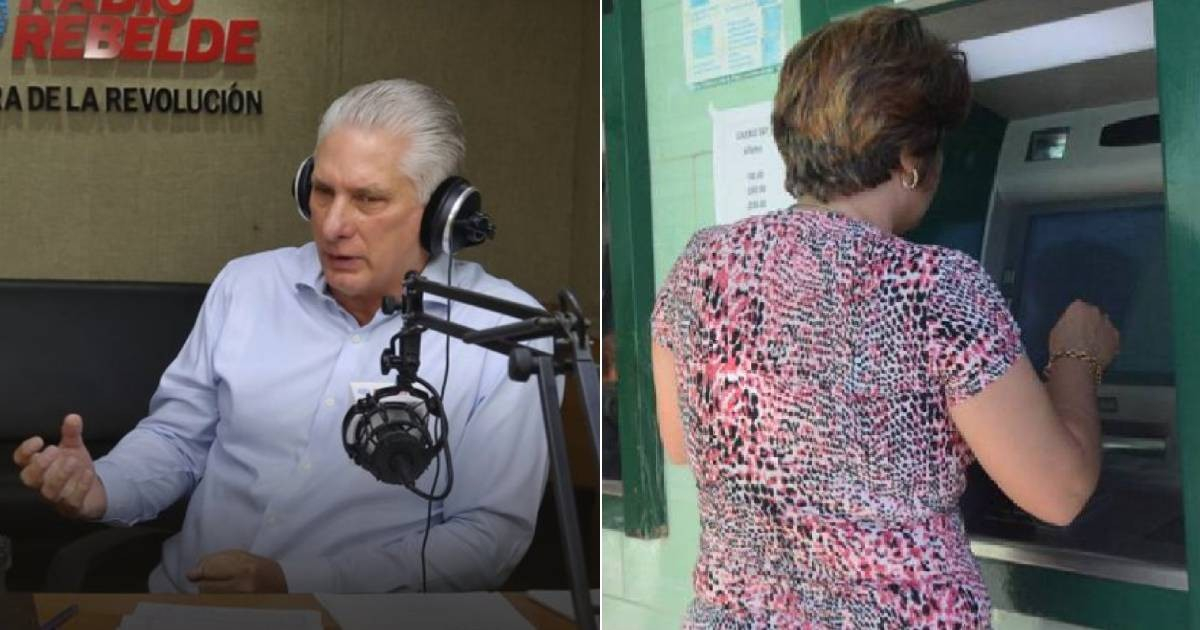
The president Miguel Díaz-Canel admitted this Wednesday that the banking policy promoted by his government since 2023 has insurmountable limitations: "banking cannot be imposed" on the entire population, as large sectors lack devices, connectivity, or access to digital payment platforms.
The statement was made during the second broadcast of his radio program "Criterio Compartido", transmitted from the studios of Radio Rebelde along with journalist Bárbara Betancourt.
The official directly linked the challenges of banking with the electrical crisis affecting the island, noting that frequent blackouts render ATMs, point-of-sale terminals, and online banking services inoperable.
In response, he announced a project to install photovoltaic panels at all bank branches across the country, with the aim of ensuring that a power outage does not lead to a collapse of financial services.
Despite the acknowledgment, Díaz-Canel defended the continuation of the policy by arguing that it provides traceability and transparency to economic operations. However, this admission contrasts with years of governmental insistence on expanding banking services and with the sanctions imposed on those who did not comply: up until July 2026, authorities had detected more than 26,500 deficiencies, imposed 15,240 fines, and ordered the closure of 269 establishments.
The available data illustrates the operational failure of the policy. Only 3.77% of transactions in Cuba were conducted through digital means in July 2026. In provinces like Sancti Spíritus, less than 10% of private businesses routinely accepted transfers, and more than half of the ATMs in Havana were out of service in May of that year.
In the informal market, the distortion has reached an extreme: intermediaries were only providing 600 pesos in cash for every 1,000 pesos transferred, a commission of 40% that reflects the desperation of those needing physical cash to operate.
This Wednesday's program focused on support for vulnerable individuals: the elderly, retirees, and people with disabilities. In this context, Díaz-Canel also acknowledged the shortage of medications in Cuba, attributing it to the lack of foreign currency and the U.S. embargo, and recognized the existence of an illegal drug market. The basic Cuban medicine list includes 651 medications, of which 250 are imported and 401 are produced nationally.
The president also took the opportunity to account for the follow-up to the first broadcast of the program, held on September 23, 2026. Of the 24 calls received at that time, "sixteen individuals were visited," he reported, while two participants were still awaiting a visit. "Of the calls, eight were complaints. Of these, five were justified, and three were partly justified," he detailed.
Regarding inflation, Díaz-Canel reiterated his stance that price control is not the solution: "I continue to insist that the issue of prices is not resolved simply by capping them," to which the host responded with a phrase that summarizes the structural problem: "What we need is production."
In June 2026, the government announced a reform to open the banking system to private and foreign institutions, with new credit mechanisms and payment services involving state, cooperative, and private participation, a sign that the current model is acknowledged as insufficient even from within the regime itself.
Related videos:
Filed under: