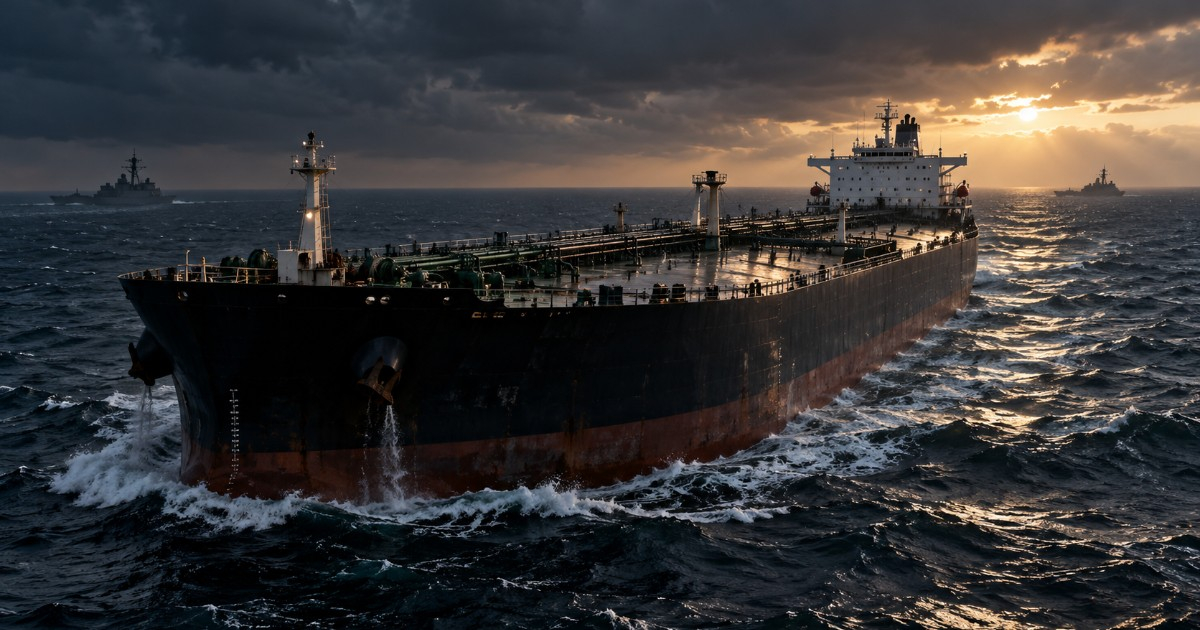
The United States announced new sanctions against 22 vessels linked to the trade of oil and petrochemical products from Iran, in an effort to cut the maritime routes that the Tehran regime uses to evade U.S. restrictions. The package, disclosed on Thursday, October 8, also targets 27 companies and six individuals associated with these operations.
The measure is divided between two agencies: the Department of the Treasury identified 17 vessels and the companies linked to them, while the Department of State sanctioned another five vessels, ten entities, and six individuals. The designations can be consulted in the updates from the Office of Foreign Assets Control (OFAC).
The new restrictions are part of Operation Economic Outcast, the economic offensive launched by the administration of Donald Trump in August to reduce the revenue that, according to Washington, allows Iran to finance its military activities and the Islamic Revolutionary Guard.
The oil tankers and companies pointed out by Washington
The Treasury claims that the 17 vessels identified in its action transported millions of barrels of Iranian crude oil and derivatives to markets in South and East Asia. Their records show a network of owners, managers, and companies registered in different countries, with ships operating under flags from various jurisdictions.
Among the examples cited by the organization is the STARWAY, flagged from Panama, which is responsible for the transport of over three million barrels of Iranian naphtha since 2025. The PARITOSH, flagged from Comoros, also appears, having reportedly mobilized more than 100,000 barrels of Iranian bitumen during 2026; and the BITU, with a Panamanian flag, to which over 170,000 barrels of the same product are attributed this year.
The statement also identifies the GAS LUCKY, flagged in the Bahamas, for transporting more than 500,000 barrels of Iranian ethylene since 2025. These amounts correspond to operations attributed to each vessel by U.S. authorities, not the total volume of oil exported by Iran.
On its part, the State Department targeted petrochemical trade operators and maritime services in various countries. Its action includes companies and executives linked to operations in Turkey, India, and the United Arab Emirates, as well as vessels such as YASHAR and ARGO MARIS, associated with maritime managers highlighted by Washington.
What is Iran's ghost fleet?
The so-called ghost fleet is a network of ships and intermediary companies that, according to U.S. authorities, facilitates the marketing of Iranian hydrocarbons despite sanctions. The scheme may employ opaque ownership structures, misleading documentation, and changes in identity or management of vessels to hinder the identification of the cargo's origin and its responsible parties.
The Treasury believes that this infrastructure has served for years to sustain Tehran's oil revenues. The various pavilions and registered countries mentioned in the documents highlight the complexity of the network, but they do not in themselves indicate that the governments of those territories have participated in a violation.
Scott Bessent, the Treasury Secretary, stated that his department will continue to pursue those who facilitate Iranian oil sales. The administration asserts that this package affects a significant portion of the maritime network still operating in service of Iran; this assessment comes from the U.S. government itself and does not equate to an independent confirmation that all vessels have ceased their operations.
What do the sanctions imply for the ships and their owners?
The inclusion on the sanctions lists generally implies the freezing of assets and financial interests under U.S. jurisdiction of the designated individuals and entities. It also prohibits U.S. persons from engaging in transactions with the affected parties, unless there is an applicable license or exception. The restrictions may also extend to companies that are 50% or more owned, directly or indirectly, by blocked individuals.
Sanctioning a vessel does not mean that the United States has captured, seized, or physically removed it from circulation. The immediate goal of these measures is to hinder the access of sanctioned operators to payments, services, and businesses subject to U.S. jurisdiction, as well as to raise the legal risks of facilitating prohibited operations.
In parallel, OFAC announced the removal of HAKUNA MATATA and PINOCCHIO from its sanctions list. According to the Treasury, both vessels had left the designated network and were sold to non-sanctioned operators. These exclusions are a separate decision from the inclusion of the 22 ships in the new package.
More economic pressure as Trump maintains the blockade on Iran
The offensive occurs amid heightened tensions over the Strait of Hormuz, a strategic passage for global oil trade, following months of confrontation between the United States and Iran and disruptions in hydrocarbon transport. Washington is thus combining financial and trade restrictions with the naval blockade it maintains on Iranian operations.
Hours before the announcement of the sanctions, Trump stated that the United States will not attack Iran again before the legislative elections on November 3, although he made it clear that the blockade will remain in effect. The president also discussed productive conversations with Tehran, without announcing a peace agreement.
The new action complements the measures that began in August when, as CiberCuba reported, the Trump administration launched a campaign to economically isolate Iran and decrease its energy export revenues.
The real impact of the designations will depend on their implementation and the ability of the sanctioned networks to find alternative routes and operators. For now, what is confirmed is the expansion of the U.S. lists: 22 ships, 27 companies, and six individuals are affected by this new round of measures, while military and diplomatic tensions in the region continue.
Related videos:
Filed under: