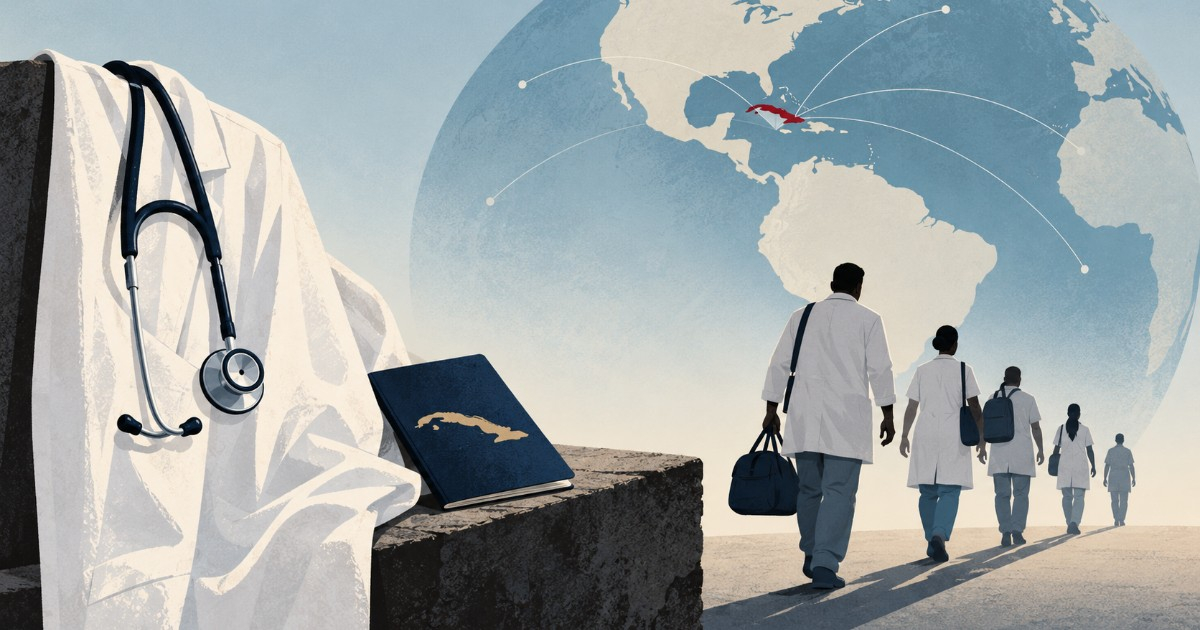
The Cuban government's program for the export of workers, which includes medical missions abroad, decreased from approximately 24,000 members at the beginning of 2025 to between 15,000 and 18,000 during 2026, according to the 2026 Trafficking in Persons Report by the U.S. Department of State.
The difference represents between 6,000 and 9,000 fewer workers, a reduction that Washington partly attributes to its diplomatic offensive against international agreements on the hiring of Cuban personnel and to the visa restrictions imposed on officials linked to that system.
The document, published on October 8, also indicates that four countries terminated their bilateral agreements with the Cuban government in 2025, although the special section regarding the labor export program does not specify which countries they were.
Despite the setback, the State Department estimates that in 2026 there were still workers linked to those missions in 53 countries.
Between 25% and 37.5% fewer workers
The comparison of U.S. figures indicates a decrease of approximately 25% to 37.5% from the 24,000 workers counted at the beginning of 2025.
It is important to distinguish that the report refers to the entire program for the export of civil workers from the Cuban state, and not just to the medical professionals. According to the Department of State, healthcare professionals make up 75% of that workforce.
The document does not include in its special section a list of the workers who left the program, a breakdown of the reductions by country, or sufficient information to determine how many returned to Cuba, transitioned to other jobs, or were directly hired by foreign institutions.
The U.S. administration maintains that its efforts with recipient countries have played a crucial role in reducing the number of workers subjected to the hiring mechanisms of Havana.
The report identifies diplomatic pressure, visa restrictions, and the promotion of hiring alternatives that eliminate the intermediary role of the Cuban state as tools of this strategy. However, the published figures do not allow for attributing the entire reduction solely to these measures.
The available statistics are also not fully aligned. In June 2025, the Cuban Minister of Public Health, José Ángel Portal Miranda, stated that more than 23,000 healthcare professionals were providing services in 56 countries. That statement corresponds to a different date and category of personnel than those used by Washington. Without a common methodology and detailed data, both series cannot be directly compared.
The pressure from the United States affects contracts and salaries
One of Washington's primary objectives is to modify the agreements through which foreign governments pay the Cuban state for the services of professionals sent to work in their territories.
The U.S. report states that the regime retains between 50% and 95% of the salaries owed to its workers abroad, while they receive allowances that are much lower than those of other professionals performing similar roles.
The document also denounces restrictions on freedom of movement, passport control, professional credentials, surveillance, and threats against workers or their families.
According to testimonies from former members gathered by the Department of State, some professionals have reportedly been forced to work excessive hours, accept precarious working conditions, and even alter records and medical procedures.
These are reports gathered by U.S. authorities, not individual court rulings against all members or those responsible for the missions.
The State Department maintains that the withholding of salaries allows the regime to maintain economic control over workers, even when recipient countries directly provide part of the payments to the professionals.
The report acknowledges that payment mechanisms vary by country, but warns that keeping the Cuban government as an intermediary complicates the effective protection of labor rights.
Uruguay changes payments without withdrawing Cuban professionals
The case of Uruguay illustrates how some governments are modifying their agreements without necessarily ending healthcare cooperation.
On October 7, CiberCuba reported that Uruguay had started to pay Cuban professionals directly linked to the José Martí Eye Hospital in Montevideo.
The change eliminates the previous mechanism for transferring funds to the structure of the Cuban brigade, although Uruguayan authorities assured that ophthalmological care would continue as normal.
This is a modification of the remuneration system and not a cancellation of the mission. It should also not be confused with the four agreements that, according to Washington, ended in 2025.
In July 2026, the Trump administration also announced sanctions against the Cuban Minister of Public Health and those responsible for the medical missions system, including leaders of the Central Unit for Medical Cooperation.
A blow to an important source of foreign currency for the regime
The reduction of workers and the review of agreements threaten an activity that has provided significant income to the Cuban government for years.
The State Department describes medical missions as a fundamental financial source for the regime, which obtains foreign currency through contracts with foreign governments and other entities.
However, the 2026 document does not provide a verifiable estimate of the money that Havana lost as a result of the reduction in personnel.
Therefore, it is not possible to calculate a specific economic loss based on the 6,000 to 9,000 fewer workers, as revenues also depend on the amounts of each agreement, the duration of the contracts, and the payment methods.
The Cuban government rejects U.S. accusations of forced labor and presents its medical missions as programs of solidarity and international cooperation. In its official statements, it has defended the continuation of health brigades and condemned U.S. pressure on countries that maintain agreements with Havana.
This position contrasts with the testimonies of former participants and with the reports of labor restrictions, wage withholding, and reprisals documented in U.S. reports.
The United States insists on direct hiring
The new balance is part of a broader policy through which Washington aims for recipient countries to review the conditions of Cuban workers and adopt transparent hiring mechanisms.
The State Department believes that eliminating the mandatory mediation by the Cuban government would better safeguard salaries, freedom of movement, and the rights of professionals.
The 2026 Trafficking in Persons Report also keeps Cuba at Level 3, the most unfavorable category in the U.S. assessment of government efforts to combat trafficking.
Related videos:
Filed under: