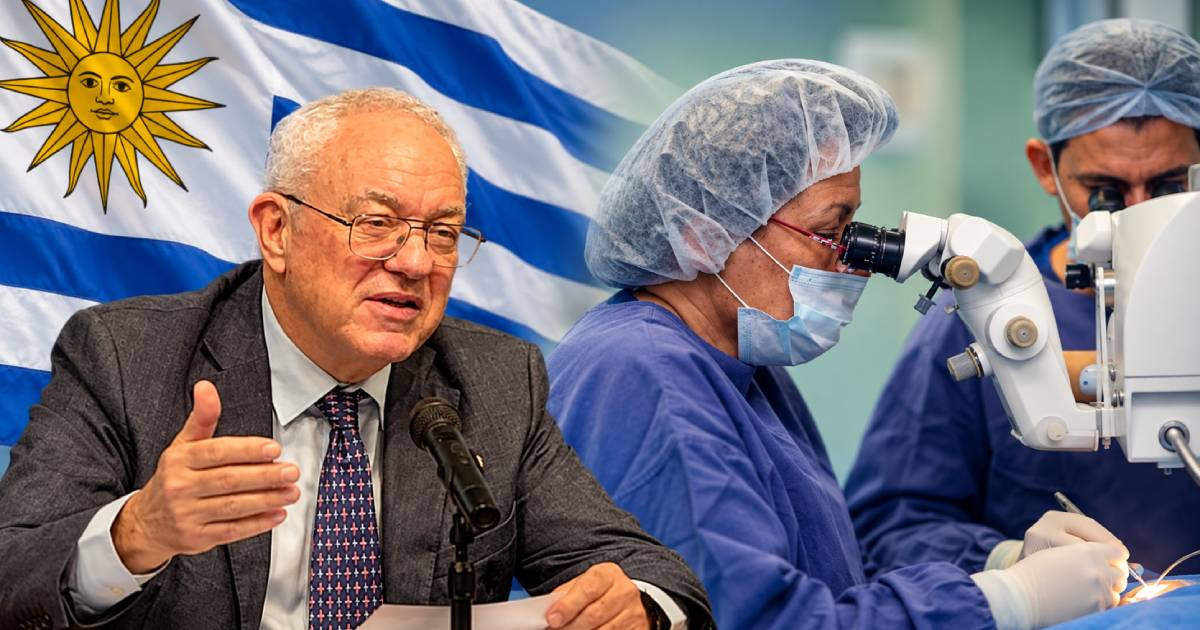
Uruguay will amend the agreement that currently involves 20 Cuban ophthalmologists at the Montevideo Eye Hospital and will begin to pay each professional directly, instead of channeling the funds through the Cuban brigade's structure.
Chancellor Mario Lubetkin confirmed the change in an interview with El Observador.
"We spoke with both the U.S. authorities and those in Cuba, and we achieved what we wanted: for the 20 Cuban doctors to continue performing eye surgeries in this country," stated the head of Uruguayan diplomacy.
So far, Uruguay allocated around 250,000 dollars annually for the operation of the Cuban medical mission. As explained in September by the president of the Social Security Bank (BPS), Jimena Pardo, these funds did not constitute the specialists' salaries directly, but rather a "reimbursement of expenses" that was transferred to an account of the brigade established by the Ministry of Public Health. The professionals' remuneration was managed by the Cuban side.
"The significant change now is that instead of paying this country, what we do is: social protection and payment of the stipend to the professional," Lubetkin explained.
The modification comes after the United States included Uruguay for the first time in a report on Cuban medical missions, which was sent to Congress at the end of August.
The document placed the South American country among 15 nations that made payments directly to the Cuban government for the services of these professionals. Washington claims that the worker export program from Havana exhibits a pattern of forced labor and labor exploitation.
The pressure on this type of agreement is part of a policy that Washington has been reinforcing since 2025. In March of that year, Secretary of State Marco Rubio called Cuba's medical missions a "ghastly practice" and denounced that, in many countries, professionals do not receive their salaries directly and suffer other restrictions. "In many other parts of the world, doctors are not paid. The Cuban government is paid," Rubio stated at that time, although he acknowledged that conditions vary by country and that each agreement should be evaluated individually.
The U.S. legislation passed this year stipulates that if a country appears in those reports for two consecutive years, the Secretary of State cannot provide certain international assistance to it. Uruguay would need to appear again in 2027 for that provision to take effect.
Uruguayan journalist Gabriel Pereyra reported that Washington warned about possible consequences for cooperation with Uruguay. However, Lubetkin stated that his government never received an official document announcing the suspension of aid.
"No official document has arrived," noted the chancellor, who presented the modification as an update to a mechanism that had been operating practically unchanged for years.
"The agreements made many years ago have been updated as they should have been," she stated.
The Uruguayan government had already announced in September that it sought to pay Cuban doctors directly, trying to preserve the ophthalmology program without continuing the transfer system to Havana.
Health cooperation between both countries dates back to 2007. According to official figures from BPS, by July 2025, the program had recorded a total of 916,787 eye consultations, 118,029 eye surgeries, and 217,885 screenings.
Lubetkin defended the continuity of the program and assured that the specialists will remain in Uruguay under the new mechanism.
"Cuban doctors will remain in this country, with absolutely logical and legal mechanisms in our actions, along with their social protection accounts at the BPS," he stated.
Related videos:
Filed under: