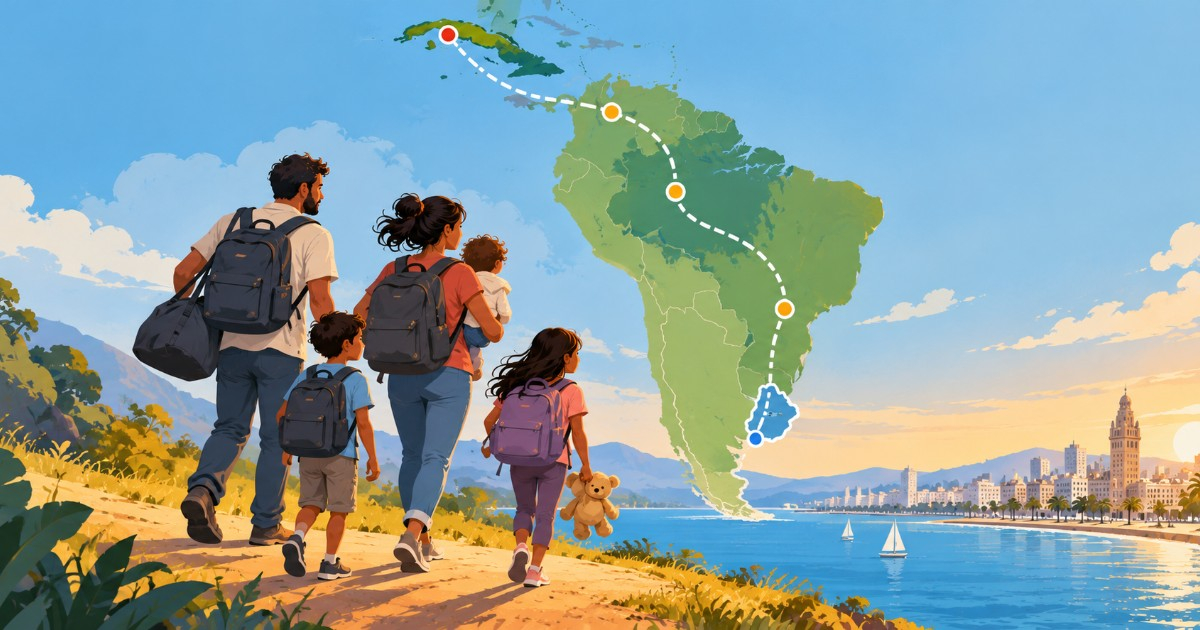
A vast route that starts in Cuba, crosses Guyana, and traverses Brazil from north to south until reaching the Uruguayan border has become an alternative migration option for thousands of Cubans, at a time when other routes used in recent years have become more challenging.
A report by BBC Mundo reconstructs this "journey" based on official data and the testimonies of several migrants, including Liudmila Medina, who traveled more than 7,000 kilometers with her husband and children to settle in Uruguay.
The family's initial destination was the United States. Medina recounted that they intended to travel to Nicaragua to continue their journey north from there, but the plan fell through when they were not allowed to board the plane due to the expiration of one of the passports.
It was then that they made another decision. “What do we do?” she recalls her husband asking. “We are going to Uruguay,” she replied.
Medina claims that he leveraged contacts and bribed individuals to quickly obtain the new passport. Afterwards, the family ended up paying nearly 13,000 dollars to a network of "coyotes" of various nationalities who helped them complete the journey.
The money, as he recounted, represented almost everything they had left and included the proceeds from the sale of his mother's home.
In April 2024, they arrived in Guyana on a commercial flight. From there, they traveled across the country for about 17 hours in a minibus along with dozens of other Cuban migrants.
"We were all packed in, one on top of the other," Medina recalled.
The journey was particularly challenging because he was traveling with Tristán, one of his sons, who has issues with the central nervous system and requires constant assistance. They were also accompanied by two other young children, while Medina was eight months pregnant.
"Since he didn't have head control, he would go to my side and fall on top of me: I had to hold Tristán. Gael was only 2 years old at that time and would also fall on top of me," he recounted.
After crossing Guyana, the family entered Brazil through Roraima, the northernmost state of the country, and continued their journey south using various land and air routes.
A week after leaving Cuba, he finally crossed through the Santana do Livramento-Rivera border crossing between Brazil and Uruguay, where he applied for asylum.
"They said to us, 'Welcome to Uruguay,'" Medina recalled.
The journey taken by this family is not an isolated case. An analysis by the Brazilian Intelligence Agency (ABIN) and the International Organization for Migration (IOM), cited by BBC Mundo, indicated a significant increase in the entry of Cubans into Uruguay from Brazil.
Between January and October 2025, the number exceeded 11,000 Cubans who went through the joint immigration control of Santana do Livramento-Rivera, averaging about 30 people per day.
Guyana occupies a strategic position on this route because, according to the cited analysis, it is the only country in South America that does not require a visa for Cuban citizens. From there, many continue on to Brazil and then to Uruguay.
The networks that organize these tours charge between $1,200 and $10,000 per person, depending on the departure point and the final destination. The analysis also documented cases of physical assaults and illegal detentions of migrants.
Among Cubans, this long journey across South America has come to be known as "the crossing".
The rise of this route coincides with a sustained increase in the Cuban presence in Uruguay.
Only in 2025, the number of Cuban citizens entering the country exceeded those leaving by 14,961 people, according to data from the National Migration Directorate cited by BBC Mundo. Between January and July 2026, the positive balance reached another 8,123 people.
The phenomenon is also putting significant pressure on the shelter system. By the end of June, there were 30,715 applications pending resolution and approximately 89% were from Cuban citizens, according to figures from the Refugee Commission (CORE).
During the first half of 2026, the agency received an average of approximately 1,300 monthly applications.
The Uruguayan Deputy Foreign Minister and president of the CORE, Valeria Csukasi, attributed the backlog of cases primarily to a "structural mismatch between the volume of requests and the institutional and operational capacity" of the agency to process them.
For many applicants, the delays in their cases mean remaining in an uncertain immigration situation for years, which can hinder access to bank loans, guarantees for renting homes, or certain family reunification processes.
At the same time, Cubans currently lead the granting of permanent residencies in Uruguay. In 2025, they obtained 6,185, over a third of all those granted in the country, and during the first seven months of 2026, they received another 4,665, according to immigration data cited by BBC Mundo.
Madelyn del Río, president of the organization Manos Cubanas, estimates that currently around 60,000 Cubans may be living in Uruguay, a figure significantly higher than the 11,826 born on the island recorded in the 2023 census.
Del Río argues that many continue to enter through the Brazilian border because the journey can be faster than waiting for certain visa processes, including those for family reunification.
The increasing Cuban presence is already visible in both Montevideo and smaller towns. In Santa Rosa, a city of about 7,000 inhabitants located approximately 50 kilometers north of the capital, around 1,100 Cuban immigrants have settled, many of whom are employed in nearby fields and at a poultry company.
Cubans are already part of various sectors of everyday life in Uruguay, from medicine and commerce to delivery, security, and services. While many claim to have been welcomed, there are also accounts of discrimination and xenophobia.
For Medina, the decision to emigrate was closely tied to the situation of her son Tristán. The young boy had undergone surgery for two brain tumors in Cuba in 2019, and according to his mother, he subsequently suffered nerve damage due to medical complications.
She then abandoned her career as a singer and actress, in which she was known as Mía Rosa, to dedicate herself to the child's rehabilitation. Over time, she claims, the lack of results, medication, and basic food eventually pushed the family to leave Cuba.
The arrival in Uruguay did not immediately solve all her problems. Medina had to borrow money, adapt to a new economic reality, and go alone to the public hospital Pereira Rossell to give birth to her son Kai.
Later, his children were able to access a preschool through a government scholarship, while the family received state housing assistance and financial support from a foundation for refugees.
"When we arrived in Uruguay, we received a hug," summarized Medina.
His main disappointment has been that Tristán's rehabilitation through the Teletón was deemed unfeasible. He even considered moving to Spain in search of other medical options, although he ultimately ruled that possibility out.
Currently, Tristán is receiving follow-up care from specialists at the Pereira Rossell hospital. Medina spends her time taking care of him in the subsidized apartment in Montevideo where she lives with her husband and their other children.
The family has also managed to reunite Medina's mother in Uruguay. Now they dream of buying a car and their own home.
"It’s incredible to see where we are now, with the assurance that nothing will be missing from us," he stated. "Back there, we are very limited and filled with fear; here, we have no fear of anything. Here, we have whatever we set our minds to."
The expansion of this migratory route had already been reflected months earlier. In June, an analysis of the Cuban exodus to South America documented that more than 11,000 citizens from the island had crossed from Brazil to Uruguay between January and October 2025, primarily through the Santana do Livramento-Rivera crossing.
The migration situation for those already in Uruguay, however, continues to be characterized by delays. Recently, a human rights advocate demanded answers from the authorities regarding the prolonged delays in thousands of asylum applications.
Formal recognitions as refugees remain very limited. Uruguay has officially recognized only 52 Cuban citizens as refugees, despite the large number of pending cases.
The increasing arrival of citizens from the island has also sparked discussions about integration and employment. In September, Cuban youths residing in Uruguay publicly responded to criticisms against immigrants and called for reflection on the circumstances that lead so many people to leave Cuba.
Related videos:
Filed under: