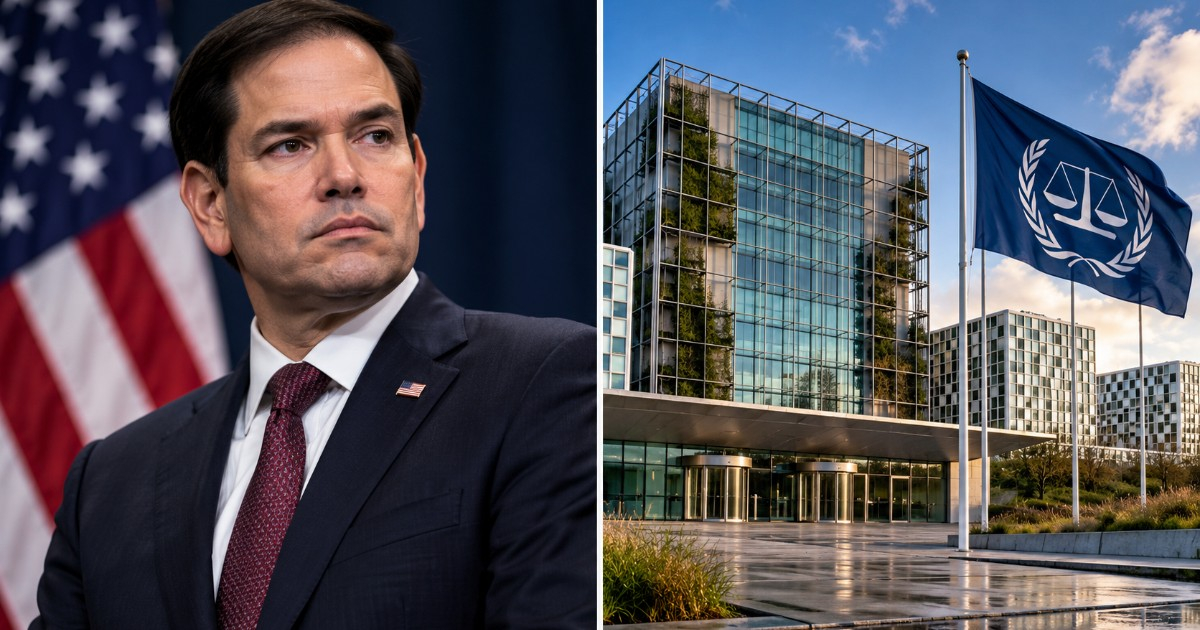
The government of President Donald Trump imposed sanctions on the International Criminal Court (ICC) as an institution and included it on the U.S. list of entities whose assets are frozen. The measure, announced on Friday, October 9, by Secretary of State Marco Rubio, expands Washington's offensive against the court based in The Hague, which it accuses of threatening the sovereignty of the United States.
Rubio stated in an official statement from the Department of State that the administration will prohibit transactions with the Court to restrict its resources and limit its operations. He also warned that if agreements are not reached regarding U.S. objections, his government will continue to push for the dismantling of the organization.
So far, Washington had sanctioned specific judges and prosecutors. The new designation includes the ICC as an institution. The Office of Foreign Assets Control (OFAC), part of the Department of the Treasury, confirmed the inclusion of the ICC in the list of Specially Designated Nationals and Blocked Persons (SDN) on October 9.
Which operations are prohibited and which are still authorized?
The designation implies, as a general rule, that the property and financial interests of the CPI located in the United States or under the possession or control of U.S. persons are blocked. It also restricts transactions subject to U.S. jurisdiction involving the court, except for the exceptions and licenses authorized by the Treasury. Blocking assets does not equate to confiscating them.
The restrictions, however, do not entail an immediate halt to all payments and services. The General License 13 from OFAC permits specific transactions necessary to maintain or conclude operations, contracts, and agreements with the CPI until April 7, 2027. Among the expressly mentioned examples are member state contributions, salaries, health insurance, rent, basic services, and certain payments to suppliers.
OFAC also issued three additional general licenses related to telecommunications and business software programs, pension payments, and specific operations associated with individuals detained under the Court's jurisdiction. The conditions can be found in the official ICC sanctions program.
Rubio warns that the campaign will continue
In his statement, Rubio insisted that the United States never joined the ICC and rejects the idea that it can prosecute military personnel, border agents, or U.S. leaders without Washington's consent. He asserted that his government had allowed room for a diplomatic solution but deemed the responses from the court and member countries insufficient.
"The ICC must either put an end to its threats, or we will put an end to the ICC," stated the Secretary of State. He also warned that if the allies do not intervene, the United States will continue its campaign to dismantle the court "brick by brick."
Washington invoked section 1(a)(ii)(A) of the Executive Order 14203, signed by Trump in February 2025. This decision is part of a strategy announced months earlier: in July, CiberCuba reported on the U.S. campaign to dismantle the International Criminal Court, which included diplomatic pressure, sanctions, and visa restrictions.
The court rejects the sanctions, and eight countries come to its defense
The ICC rejected the measures in a statement on October 9 and stated that they constitute an attack on the rule of law and an attempt to obstruct justice. The court affirmed that it will continue to carry out its functions, although it warned that it will need the support of the states that comprise it.
For their part, Canada, Denmark, Germany, France, Italy, Japan, the Netherlands, and the United Kingdom expressed their disagreement with the sanctions through a joint statement published by the British Government. The eight countries reiterated their support for the independence of the court and warned of the impact that the restrictions may have on its staff and investigations.
The ICC, established by the Rome Statute and operational since 2002, investigates and prosecutes serious international crimes, such as genocide, crimes against humanity, and war crimes, within the limits of its jurisdiction. The United States has not ratified its founding treaty, but the court maintains that, under certain conditions, it can investigate events that occur on the territory of a member state even if the suspect is a citizen of another country. This difference in interpretation is one of the central points of conflict between Washington and the Court, whose scope of jurisdiction is explained by the prosecutor's office of the organization.
Related videos:
Filed under: