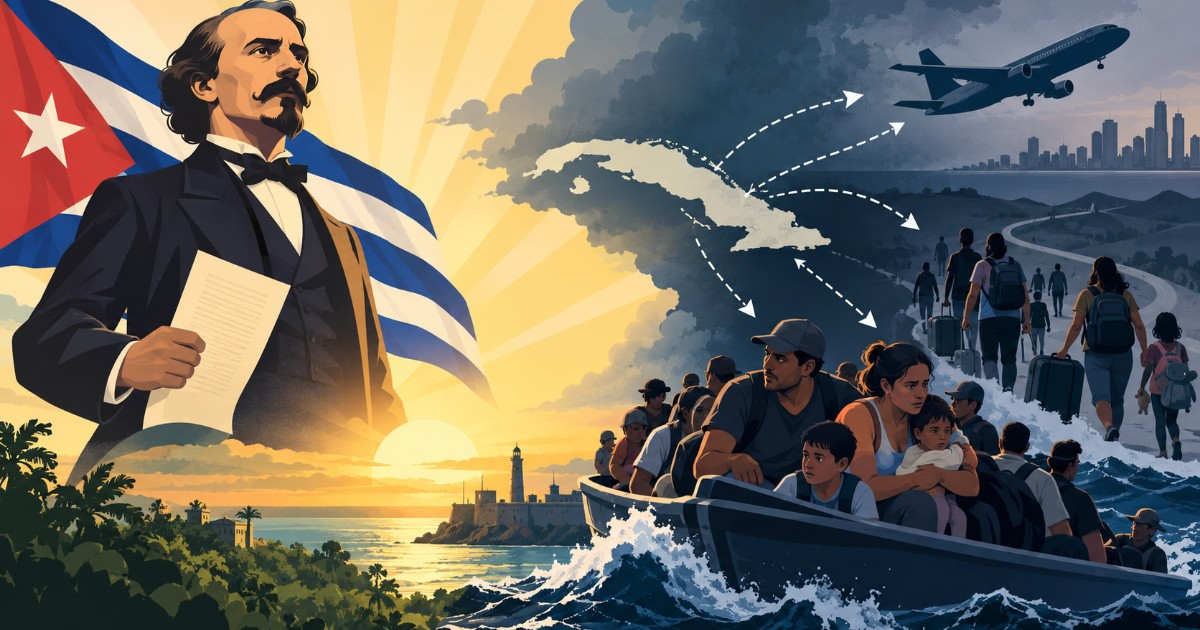
Cuba reaches this October 10th the 158th anniversary of the Grito de Yara with an officially calculated population of 9,434,593 inhabitants as of the end of 2025. However, this figure from the National Office of Statistics and Information (ONEI) is far from settling the debate on how many people actually live on the island: an independent demographic study estimated 8,025,624 residents at the end of 2024, nearly 1.72 million below the comparable official figure for that year.
The difference highlights a problem associated with the exodus: many Cubans have established their lives and permanent residences abroad, yet they maintain documentation, family connections, or residency processes in Cuba. Administrative residency and physical presence are not necessarily the same. However, it is also not enough to retain a Cuban address to demonstrate that a person remains counted in the effective population calculations of the ONEI, whose methodology states that those who spend most of the year outside the country are excluded.
How many people actually live in Cuba?
The balance from the ONEI for 2025 acknowledges a decrease of 313,414 people compared to the 9,748,007 inhabitants reported at the end of 2024. In that last complete year, there were 68,064 births and 136,214 deaths, resulting in a natural decrease of 68,150 people. The external migration balance was negative at 245,264: 317,320 emigrations and 72,056 immigrations were recorded. The balance reflects the difference between entries and exits, not the total number of those who left the country.
The demographer and economist Juan Carlos Albizu-Campos questions whether official calculations fully capture the extent of emigration and argues that the population base carries accumulated discrepancies. In his research Cuba: Demographic or Systemic Crisis?, he presented two scenarios for the end of 2024: one of 8,893,483 people and another of 8,025,624, depending on the corrections applied to the starting population and migratory balance. Compared to the approximately 9.75 million reported at that time by the ONEI, the difference would range from about 855,000 to 1.72 million inhabitants.
The lowest estimate is based, among other elements, on records of Cuban entries into the United States and on calculations of migration to other countries. Albizu-Campos argues that national statistics have underestimated departures to destinations other than the United States and have not sufficiently corrected their starting population. These are estimates from a researcher, not results from a census. It would also be incorrect to automatically subtract 1.72 million from the 9.43 million reported by the ONEI for 2025: these involve different years and procedures, and there is no equivalent independent measurement available to determine the actual population as of October 2026.
The last general population census in Cuba was conducted in 2012. Since then, annual estimates are based on records of births, deaths, and migration flows. The ONEI itself explained in August 2026 that for its "effective population" indicator, it considers those who have accumulated 180 days or more of residency within the last 365 days, and that this adjustment has been applied to the statistics since 2021. The existence of this rule does not settle the debate over the integrity of the records or how many emigrants have been effectively reflected in the figures.
What the new immigration laws change
The reform approved by the National Assembly in 2024 and introduced a new framework to distinguish effective migratory residence from other legal situations. Law 171 on Migration and Decree 136 establish that effective residence will be recognized automatically for those who accumulate more than 180 calendar days of presence in Cuba during the previous year; it also allows for applications under certain circumstances with more than 120 days and additional proof of ties to the country.
The new rules will come into effect on November 1, 2026, so they do not apply as of October 10. They will replace the old system tied to the 24-month residency requirement abroad, which had been suspended. The migratory category, the documentation that a citizen retains, and their statistical status as a resident are related issues, but not identical. The reform may enhance the administrative identification of who resides in Cuba and who is abroad; it does not, by itself, imply an immediate and demonstrated correction of one or two million in the population registry. CiberCuba detailed this week the anticipated changes for residents abroad.
The great Cuban exoduses since 1959
Cuban emigration existed before the victory of the Revolution led by Fidel Castro in January 1959. However, the establishment of the new regime and the subsequent consolidation of the socialist system marked the beginning of successive waves, driven by a changing combination of political persecution and disagreement, economic transformations, family separation, and the search for better living conditions. A study by the Migration Policy Institute and the historical synthesis from Florida International University (FIU) identify the main stages of the exodus to the United States.
1959-1962: the historic exile. Approximately 248,100 Cubans emigrated to the United States during the early years of Castro's government, including former officials of the Batista regime, businessmen, landowners, professionals, and families opposed to the political changes and nationalizations. During this period, the Pedro Pan Operation took place, through which around 14,000 minors arrived alone in the United States between 1960 and 1962. These children are part of that stage and should not be added back to the total as if they represented an independent wave.
1965-1973: Camarioca and the Freedom Flights. The maritime departure from Camarioca in 1965 preceded the airlift organized between Cuba and the United States. The so-called Freedom Flights transported approximately 260,600 people until April 1973. The reunification of families separated since the early years of the Revolution was a central reason for many travelers.
1980: the Mariel exodus. Following the crisis at the Peruvian embassy in Havana, the Cuban government opened the port of Mariel to vessels coming from Florida. In about five months, around 124,800 people left for the United States. The massive influx changed the social composition of the emigrant community, which no longer identified primarily with the first exile of the upper classes.
1994: the crisis of the rafters. During the height of the Special Period, following the collapse of the Soviet Union and amid a deep economic contraction, thousands of Cubans took to the Florida Straits in makeshift vessels. FIU estimates that around 30,900 individuals were involved in the events of August and September of that year. The crisis preceded immigration agreements between Havana and Washington that changed the handling of maritime arrivals.
1995-2017: sustained emigration after the Special Period. The exodus did not end with the rafters. Emigration continued through family reunification, visas, and irregular routes, under the U.S. policy of "wet foot, dry foot" until its elimination in January 2017. The historical count by FIU estimates around 649,700 emigrants to the United States between 1995 and 2015, within this longer phase. The Cuban migration reform of 2013, which removed the exit permit for most citizens, also changed travel conditions.
The new wave since 2021: by land, sea, and air
The economic crisis following the pandemic, the deterioration of basic services, and the intensification of repression after the protests on July 11, 2021, coincided with another large-scale wave of migration. The removal of the visa requirement for Nicaraguan entry for Cuban citizens at the end of 2021 facilitated an air route to Nicaragua and then overland through Central America and Mexico to the United States. Other Cubans left by boat heading for Florida or emigrated through regular flights and routes to countries like Spain, Mexico, and Brazil.
In September 2024, EL PAÍS documented an exceeding magnitude of 850,000 registrations related to the arrival of Cubans in the United States since 2022, considering data from the Customs and Border Protection (CBP) and admissions through humanitarian programs. This represents a scale larger than any of the specific exoduses of 1980 or 1994, although the statistics on border encounters, admissions, and residencies do not share the same methodology and should not be treated as an exact count of unique migrants.
Movements continued to change destinations in 2025 and 2026. The International Organization for Migration (IOM) documented new dynamics of Cuban mobility in Latin America between January and May 2026. Their regional report highlights flows to Brazil and a positive migratory balance of 5,946 Cubans in Uruguay in the first five months of the year. These figures do not correspond to the departures recorded by ONEI and cannot be mechanically added to their totals.
An island that grows old as its families scatter
Demographic loss has consequences that extend beyond border controls. By the end of 2025, 26.7% of the Cuban population will be 60 years old or older, according to the United Nations Population Fund (UNFPA). Official statistics also indicate that the working-age group lost about 1.26 million members in five years. The emigration of young adults, coupled with low birth rates, narrows the base of workers that sustain economic activity and care systems.
The effects are also visible in families whose members live spread across continents: grandparents aging without their children nearby, children growing up separated from parts of their family, and professionals no longer working on the island. The series of farewells recounted by a Cuban in August illustrates this human cost, which does not appear in population statistics.
On October 10, 1868, Carlos Manuel de Céspedes began the war for Cuba's independence in La Demajagua. The project of building a sovereign nation was then confronted with Spanish colonial rule. One hundred fifty-eight years later, that nation extends far beyond its borders: successive waves of exile and emigration have formed a vast diaspora, while the most fundamental demographic question about the island remains open: how many Cubans truly live on it.
Related videos:
Filed under: