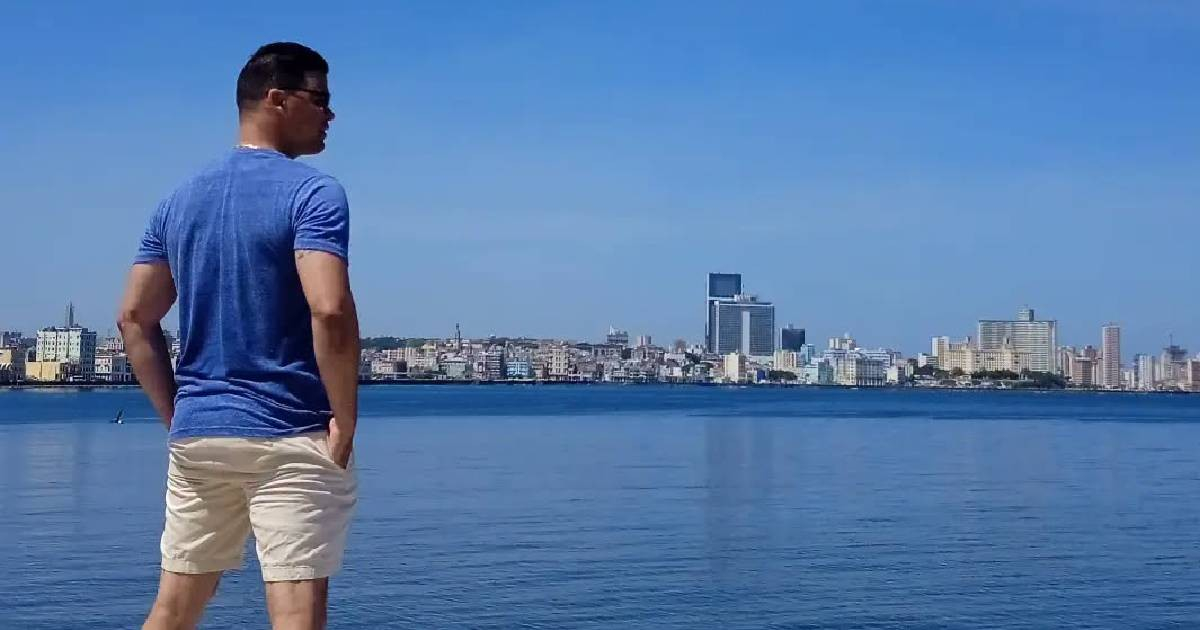
The Cuban journalist Alejandro Rodríguez Cuervo published a reflection on emigration and goodbyes that resonates with those who experience the daily toll of the exodus in Cuba: he has just said goodbye to another friend who decided to leave, and what he describes is not surprise, but an acquired resignation.
"Goodbye has become as commonplace as 'to resolve' or 'to struggle.' So common that you learn to live with it," he wrote on his Facebook wall, encapsulating in a single sentence what millions of Cubans experience daily as their close circle fragments.
Rodríguez Cuervo, who is a sports journalist for Cuban state television, does not solely attribute the cause of the exodus to material scarcity, although he acknowledges that it is also a factor.
"It's no longer just about the shortage of oil or milk (which are indeed lacking) but about how the future is tightening," he points out. What he describes is something deeper: an existential lack that turns each morning into a futile exercise in arithmetic, calculating how far the salary stretches, how long the electricity lasts, and how long it takes for a medication to arrive.
"Creativity (the kind that makes us so proud) has turned into a machine for filling gaps," he stated, in one of the most striking phrases of the text.
Regarding those who emigrate, Rodríguez Cuervo paints a picture that goes beyond mere luggage: "The one who leaves almost doesn’t take any suitcases with them. What they carry instead are rituals, customs, encounters; and upon arrival, they confront the harshest cold, that of nostalgia, of the unfamiliar, of starting almost from scratch."
But the reflection also points inward, towards those who remain. Every farewell, it says, opens a crack and forces an uncomfortable question: "Every departure confronts us with our own decision to stay, and we wonder if we are brave or insecure."
This type of testimony is part of an exodus that shows no signs of stopping. According to official data from the National Office of Statistics and Information (ONEI) published in July 2026, approximately 245,264 Cubans emigrated in 2025, leaving the island's population at 9,434,593 inhabitants.
The hardest-hit province was Havana, with 57,433 departures. In 2024, the figure had been 251,221 emigrants.
Since 2021, more than a million Cubans have left the island in what constitutes the largest exodus in the country's recent history.
The demographic crisis is further exacerbated by the decline in birth rates: in 2025, there were only 68,051 births compared to 134,354 deaths, resulting in a negative natural balance of over 66,000 people.
The average monthly salary in Cuba was 6,930 Cuban pesos in 2025, according to data published by the National Office of Statistics and Information (ONEI).
Since July 2026, however, the regime raised the minimum wage from 2,100 to 3,210 pesos per month and updated the salary scale for the budgeted sector. At the informal exchange rate in August 2026, the average salary for 2025 is equivalent to just over 10 dollars, while a recent estimate placed the monthly cost to meet basic needs in Cuba at 96,060 pesos per person, of which around 70,070 pesos is solely for food.
The phenomenon described by Rodríguez Cuervo has a name in psychology: migratory grief. Those who remain accumulate sadness, anxiety, and a sense of loss without having left the country themselves. In Cuba, this nostalgia is colloquially referred to as "el gorrión."
"Those of us who remain continue gazing at the sea, soaking in the salt and the hope, and tirelessly trying from here to build a future and a home. Until one day, if there's no other way out, we might decide to emigrate," he lamented at the end of his post.
Related videos:
Filed under: