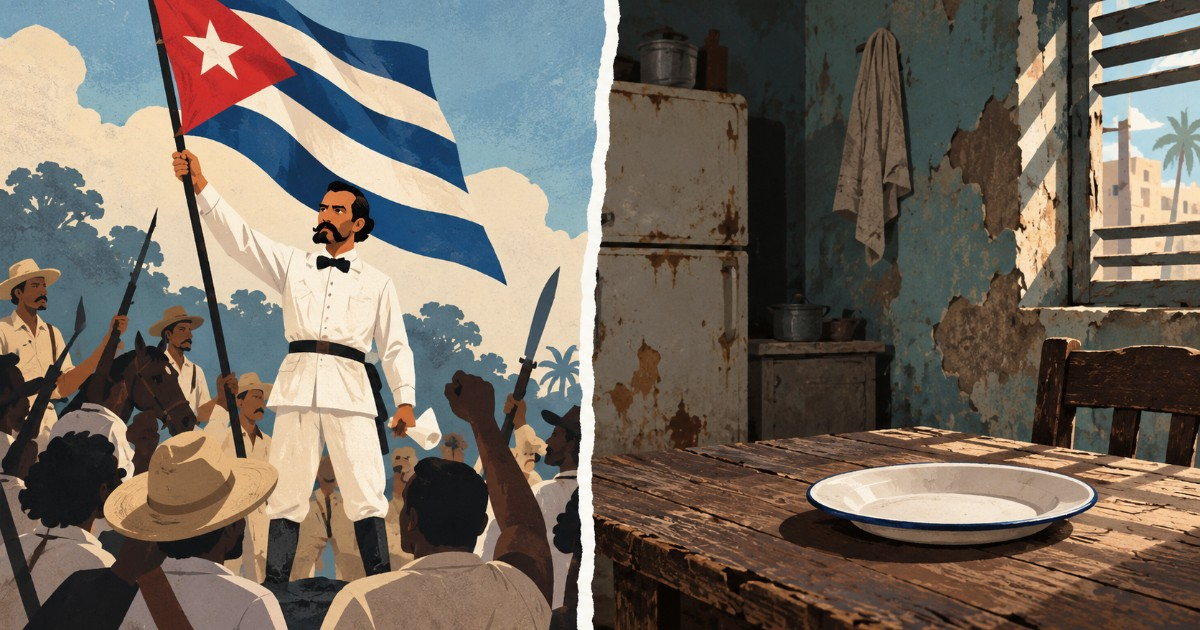
A carton of 30 eggs was sold for 4,500 Cuban pesos (CUP) in Trinidad, Sancti Spíritus, in mid-September. The , which was raised in July to 3,210 CUP per month, is not enough to buy it: there is a shortfall of 1,290 pesos, even before purchasing rice, beans, oil, or other food items. This disparity between income and prices accompanies Cuba on this October 10th, marking the 158th anniversary of the Grito de Yara.
The comparison is based on a documented price in a specific place and date, not on a national rate. In Holguín, a liter of oil was also reported to be sold for 2,200 CUP in September: nearly 69% of the minimum wage and around 72% of the minimum pension of 3,056 pesos. The location and seller may affect the price, but not the fact that common products consume a considerable portion of the lowest incomes.
Food drives inflation
The recorded an annual inflation rate of 25.19% in August 2026, along with a monthly increase of 4.92%. According to their data, food and non-alcoholic beverages accounted for 72.77% of the monthly variation in the consumer price index. Among the products with the highest impact were pork, eggs, and oil.
In the analysis by the Center for Cuban Economic Studies at the University of Havana, reported by CiberCuba, food and non-alcoholic beverages experienced a year-on-year increase of 36.01% in August. The increase in the minimum wage from 2,100 to 3,210 pesos approved in July raised nominal incomes, but it does not, by itself, address the loss of purchasing power against rising prices.
Another example comes from a video released in September: a Cuban woman totaled the prices of eggs, rice, beans, potatoes, bananas, and cassava, reaching a total of 7.150 CUP. This was a purchase of specific products, not a full monthly basket or a national price study. However, its amount more than doubled the minimum wage set by the government.
The notebook empties as neighborhood markets open up
The increase in prices coincides with the distribution difficulties of the regulated food basket. In a report by the state television broadcast at the beginning of October, a storekeeper from Havana explained that her establishment had received cigars in August, donated beans in September, and no merchandise in the early days of October. Her account describes that store, not necessarily all distribution points in the country.
In response to the deterioration of the state commerce network, the Ministry of Domestic Trade is promoting the so-called , regulated in August, where small and medium-sized enterprises and other economic actors can manage public establishments through contracts. An official from the agency announced in September that 30 of these locations were operational and promised prices between 15% and 30% lower than those of other stores.
The prices displayed in one of these establishments highlight the limited reach of that promise for those with low incomes. At La Predilecta, a neighborhood market inaugurated in Contramaestre, the sign released on September 28 announced eggs at 150 CUP each and powdered milk at 4,000 pesos. Several consumers questioned whether the prices were truly affordable. The Government defends these establishments as an alternative source of supply, although their opening does not, by itself, guarantee an increase in national food production.
In June, the authorities also eliminated the national price caps on various imported foods, including chopped chicken, oil, powdered milk, pasta, and sausages. This easing of restrictions coincided with supply constraints, rising fuel costs, and difficulties in accessing foreign currency. A report from the Center for Cuban Economic Studies further emphasized the impact of U.S. sanctions on trade, energy, and finances in 2026; internal production and distribution issues remain another part of the crisis.
A survey shows the extent of food scarcity
Food insecurity is not limited to just expensive food. According to the 2025 National Food Security Survey by Food Monitor Program and Cuido60, presented in May 2026 and conducted with 2,513 valid responses collected across 16 provinces, 33.9% of respondents reported that a member of their household had gone to bed hungry due to a lack of food in the past 30 days. Furthermore, 94.9% reported having lost some level of access to food purchases in the last year.
The same research found that 79.4% of the surveyed households devoted at least 80% of their income to purchasing food, with 40.6% spending all of their income on it. Power outages exacerbated the difficulties: 48.3% had lost food due to lack of refrigeration. These are the results of that survey, not an official measurement conducted on October 10.
In the manifesto that accompanied Carlos Manuel de Céspedes's uprising in 1868, the independence fighters criticized the obstacles to trade and the taxes imposed by the Spanish colonial regime, which they held responsible for preventing the island from prospering. That claim addressed very different historical circumstances, but it also placed economic well-being among the aspirations of an independent nation. On the 158th anniversary of the Grito de Yara, the everyday problem for many Cuban families is more immediate: securing food and having enough money to pay for it.
Related videos:
Filed under: