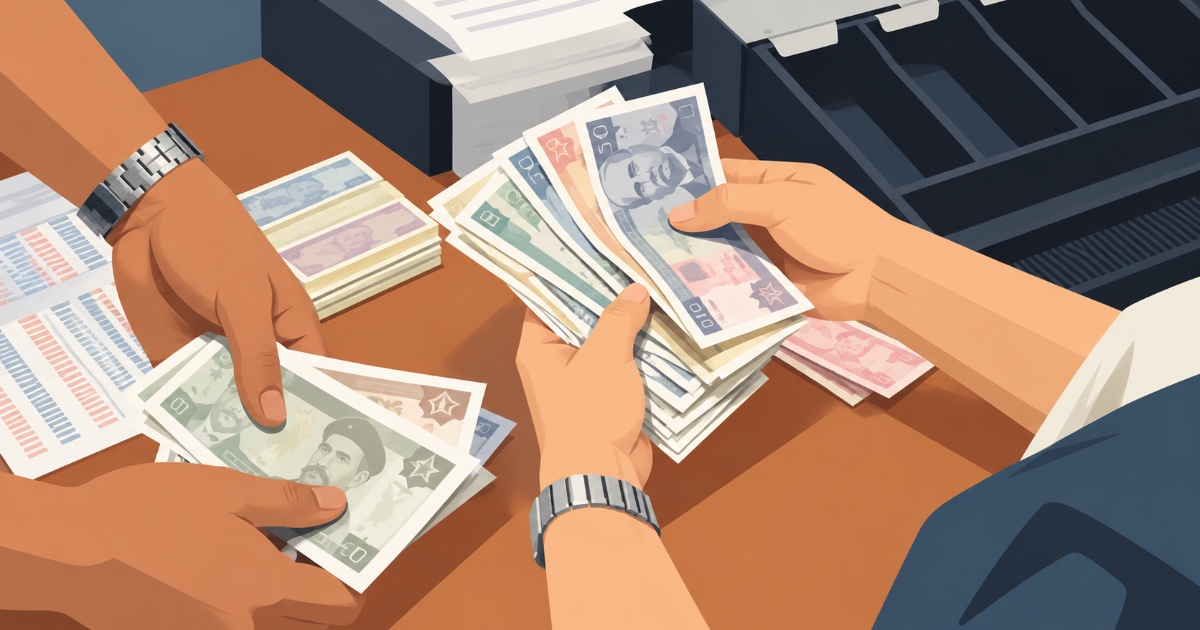
The Cuban government confirmed that this Saturday, October 10, 2026, a national day of commemoration for the start of the independence wars, work activities will pause with the exceptions provided by law. The break does not transfer to Monday, the 12th, and workers who are required to provide services are generally entitled to receive double pay for the hours worked.
The Ministry of Labor and Social Security (MTSS) explained the labor treatment of the date in a statement issued on Friday. The clarification comes in a country where salaries continue to lose purchasing power, and where even an extraordinary payment hardly compensates for the cost of food and other essential products.
Why is the break not moved to Monday, October 12th?
The , classifies October 10 as a national commemorative day in its article 232. Article 233.1 states that the day off is moved to the following Monday when May 1 or October 10 falls on a Sunday.
This year, October 10 falls on a Saturday, not a Sunday. Therefore, this rule does not grant an additional day off on Monday: October 12 remains a working day for those with regular hours that day. The announcement does not introduce a new benefit, but rather reminds us of how the current legislation applies.
Who should work and who gets paid double?
According to Article 236, activities that cannot be interrupted due to their relation with services to the population, continuous production, and urgent tasks must be maintained. The regulation also includes the preparation and sale of food, retail commerce, and other activities determined by local authorities, subject to authorized hours.
For those who must work for these reasons —or because the schedule has been exceptionally authorized according to the law—, article 237.2 establishes double the daily wage corresponding to all hours actually worked. This does not mean doubling the entire monthly salary, but rather compensating at double the rate for time worked under those conditions.
There is an alternative, but the employer cannot unilaterally impose it: Article 237.3 allows for the replacement of double payment with simple payment and one day of paid rest only if requested by the employee and agreed upon by both parties.
In the activities that indeed experience a recession, those who are paid based on performance receive the average salary, while those who are paid by time receive their basic daily wage. However, article 237.1 excludes this specific payment when the commemoration coincides with the employee's weekly rest or when certain situations occur, such as vacations, licenses, or social security benefits. Having Saturday as a regular day of rest does not, by itself, generate an additional payment.
Does this also apply to workers of micro, small, and medium enterprises (mipymes) and private businesses?
Yes, labor regulations apply to employment relationships in both the state and non-state sectors. Article 4 explicitly includes micro, small, and medium enterprises (mipymes), cooperatives, and self-employed workers when acting as employers. Therefore, a worker hired by a private business does not automatically lose the right to the appropriate salary treatment for working on this October 10th.
The case is different for those who operate independently without subordination to an employer: there is no salary paid by a patron that must be duplicated merely for the act of opening or working that day. What matters is the employment relationship and the applicable regulations, not just the type of business.
Salaries That Don't Make Ends Meet: The Background of the Cuban Crisis
The legal precision contrasts with the economic precariousness faced by wide sectors of the population. Since July, the . Meanwhile, the National Office of Statistics and Information (ONEI) recorded an average monthly salary of 6,930 pesos in 2025 for the civil state sector, which includes budgeted and business entities. This figure does not represent an average of all workers in the country, as it does not equally encompass the private sector. Although these figures correspond to different periods, they highlight the limited nominal value of income in relation to daily needs.
The rising cost of living continues to widen that gap. According to official data from the ONEI, in August 2026 consumer prices had accumulated an annual increase of 25.19%; food and non-alcoholic beverages accounted for 72.77% of the monthly index increase. Even the salary increases approved by the State are subject to inflation that erodes their real value.
The situation is even more dire in independent research. The Cuban Observatory of Human Rights (OCDH) estimated in August that 94% of Cubans live in extreme poverty, according to its own methodology based on 1,318 interviews conducted between June and July. The same study indicates that eight out of ten respondents had gone without a meal due to lack of money or food, and 68% of the surveyed households reported monthly incomes below 20,000 pesos. CiberCuba previously reported on these findings. These are estimates from an independent organization, not an official measurement from the State.
These figures call into question the economic management of Miguel Díaz-Canel's government: legally recognizing a double payment on a commemorative date is a labor obligation, not a solution to low wages, inflation, and impoverishment. The right to receive what is established must be respected, but for millions of Cuban families, the underlying issue remains that working does not guarantee meeting basic needs.
Related videos:
Filed under: