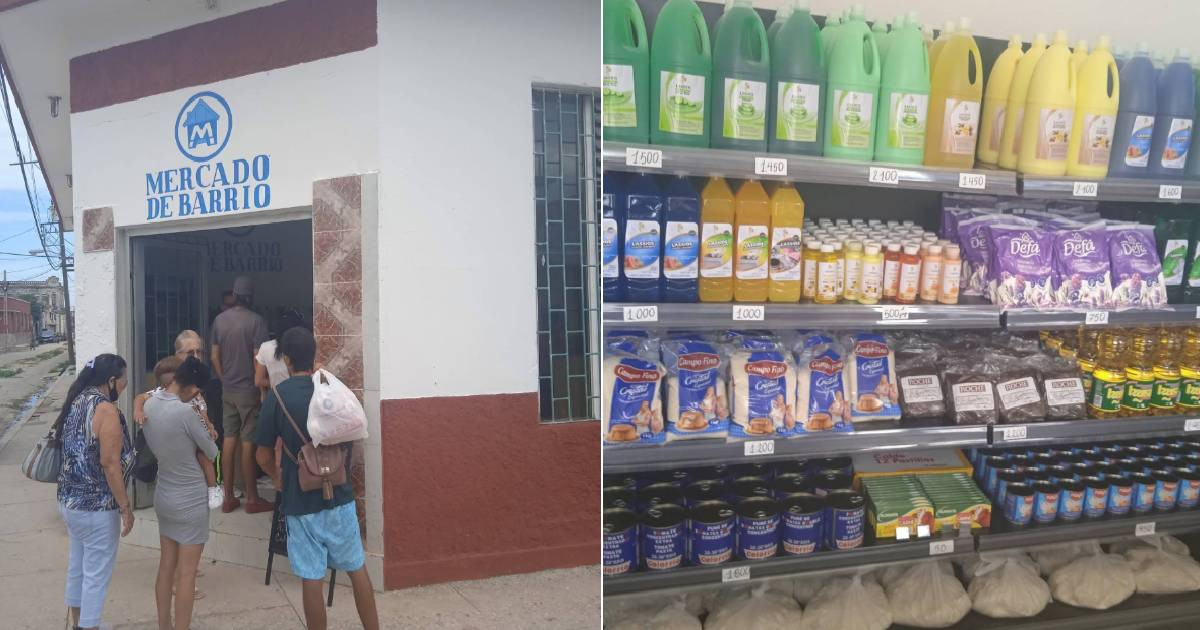
The first neighborhood market in Cárdenas, Matanzas, began operating amid a flurry of criticism on social media, where residents questioned why its prices are the same or even higher than those of private businesses, despite being a new government commercial initiative.
Located at the corner of Real and Industria streets, in the former premises known as El Cerdito, the establishment was announced this Friday by the digital creator Michel Matías on his Facebook profile.
The post garnered numerous comments, many of which were marked by skepticism about the advantages the market offers to consumers.
For his part, the content creator Christian Arbolaez shared on his Facebook profile the information board with the prices, which shows the pound of chicken at 600 pesos, the loin at 1,850, the breast at 900, and the rice at 390 pesos.
The oil costs 2,900 pesos, the tomato paste is 1,800, while sugar and coffee are sold for 1,200 pesos each. The pound of flour reaches 1,000 pesos.
"Either I can't see well, or the prices are the same as those of the small and medium enterprises," commented a neighbor. Another user was more blunt, stating that the prices were "the same or worse than the private sector."
The phrase "the same dog with a different collar" was repeated in the comments to express the disappointment of those who were hoping to find a more affordable alternative.
Other residents questioned the gap between the commercial offerings and the purchasing power of the population. "The Neighborhood Market is very nice, but now we need salaries that match the beautiful neighborhood markets," wrote a user, highlighting not only the prices but also the workers' ability to afford the cost of food.
The complaints also highlighted the lack of practical information in the initial announcement, which did not specify the address, the hours, or the payment methods.
Other users clarified those details in the comments, where a neighbor indicated that the establishment accepts electronic transfers without any additional percentage and without a limit on the number of products per transaction. A resident with reduced mobility also pointed out the difficulties faced by those who live alone and have trouble walking when trying to access the store.
In Guantánamo, a leader of the Business Group of Commerce defended the seven neighborhood markets that are now operational in that province, but consumers reported unreachable prices and empty shelves.
In Granma, residents estimated that acquiring one unit of each of the 22 products on the board would cost 12,740 pesos, nearly four times the monthly minimum wage of 3,210 pesos that has been in effect since July.
The Cuban government promotes these new neighborhood markets as an affordable option for the population, with initial promises of prices 15% to 30% lower than those of other stores.
In practice, some openings only offered discounts of between 10% and 15%, and the citizens' reaction has been predominantly negative.
A recent public consultation that the official portal Cubadebate opened about neighborhood markets ended up flooded with criticism, with one comment that summarized the popular sentiment: "I want to go to the neighborhood market where Díaz-Canel and Marrero shop."
The economist Javier Pérez Capdevila estimates that a person needs around 96,000 pesos per month to cover their basic needs, nearly 30 times the minimum wage.
Related videos:
Filed under: