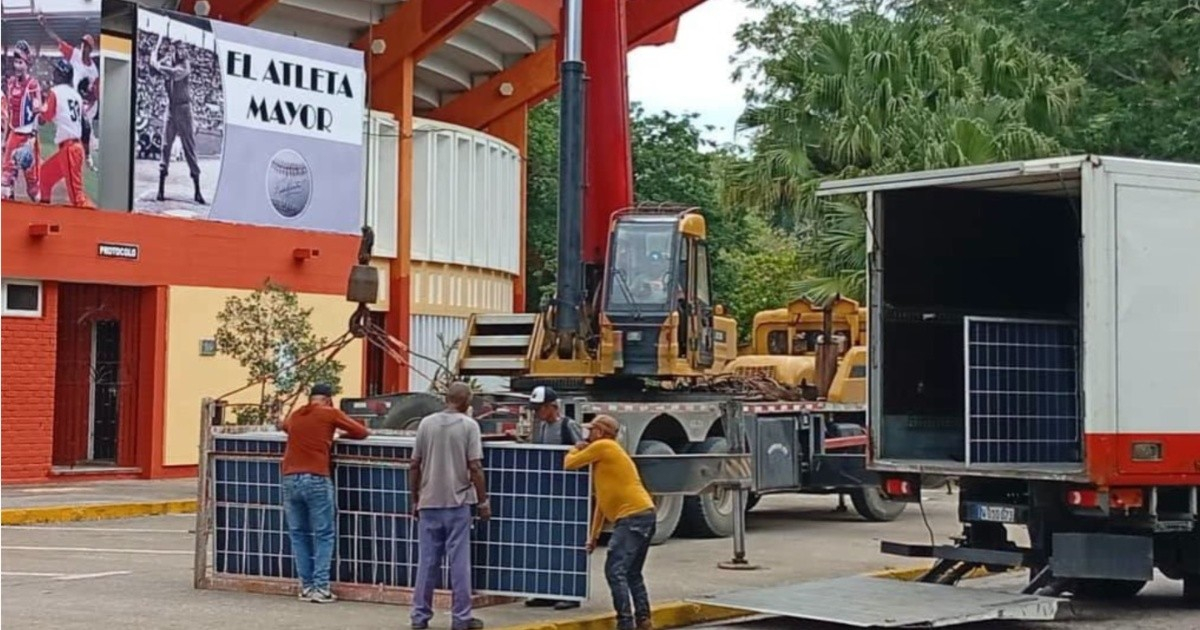
The Augusto César Sandino stadium in Santa Clara, home of the Leopardos de Villa Clara in the National Baseball Series, began this week the process of installing photovoltaic solar panels, marking what would be the first baseball facility in Cuba to feature this type of self-generation system.
The news was broadcast by sports commentator Dairon Pérez Urbano, from CMHW The Radio Queen of the Center, with photographs by Mariela Fonseca for Estereocentro Soy Villa Clara.
The images show dark blue photovoltaic panels with an aluminum structure being unloaded from trucks and lifted with mobile cranes in the vicinity of the facility.
The announcement comes at the worst energy moment in recent Cuban history. This Saturday, the National Electric System has only 1,250 MW available against a demand of 2,900 MW, with outages anticipated of up to 1,680 MW during peak hours, according to official data from the Ministry of Energy and Mines.
Lázaro Guerra Hernández, the general director of Electricity at MINEM, acknowledged that over 1,200 MW of installed capacity remains inactive due to a lack of imported fuel: "In order to significantly reduce the impact, it is essential to have fuel for those that we have on hold, more than 1,200 MW, which are technically available but for which we do not have imported fuel to generate electricity with these technologies."
The official himself admitted that the country has gone ten months without importing fuel for electricity generation, except for the donation from the Russian government that arrived on March 31 at the Matanzas supertanker base.
In that context, daytime solar energy has become virtually the only stable source of generation on the island, which explains the regime's interest in installing panels at sports facilities. The most recent example is La Polar Stadium in Havana—used for soccer—which incorporated 35 kW of photovoltaic capacity during its renovation in 2025.
The INDER declared in August 2026 that it has projects to equip the main provincial stadiums with solar panels, although it noted that funding was the main obstacle. The estimated cost for the Latinoamericano Stadium in Havana was 600,000 euros.
The energy crisis has already directly impacted Cuban baseball: the 65th National Series, starting on October 4, has altered its format to reduce travel and save fuel, dividing into two geographic zones.
The Sub-12, Sub-15, and Sub-18 youth championships were suspended in May for the same reason, and teams like the Cocodrilos de Matanzas were unable to travel to matches because the assigned bus did not receive fuel.
The Sandino Stadium, inaugurated on January 8, 1966, with a capacity for between 18,000 and 20,000 spectators, is one of the most iconic baseball venues in the country.
Its architectural design, created by architects Emilio Castro and Gustavo R. Arnavat with prefabricated concrete elements, served as a model for similar stadiums in Camagüey, Matanzas, and Pinar del Río.
If the installation takes place, Sandino would become the first baseball stadium in Cuba with its own photovoltaic system, a feat that the regime presents as progress while millions of Cubans endure blackouts of more than 16 hours a day with no solution in sight.
Related videos:
Filed under: