The Cuban government announced the opening of new neighborhood markets in Granma as part of its program to transform state commerce, but official publications triggered a wave of criticism from residents who question the high prices and claim that the establishments offer few advantages compared to private businesses.
The criticism arose following the announcements made by the authorities of Media Luna and Manzanillo, where the new businesses were presented as an alternative to bring basic necessity products closer to the population.
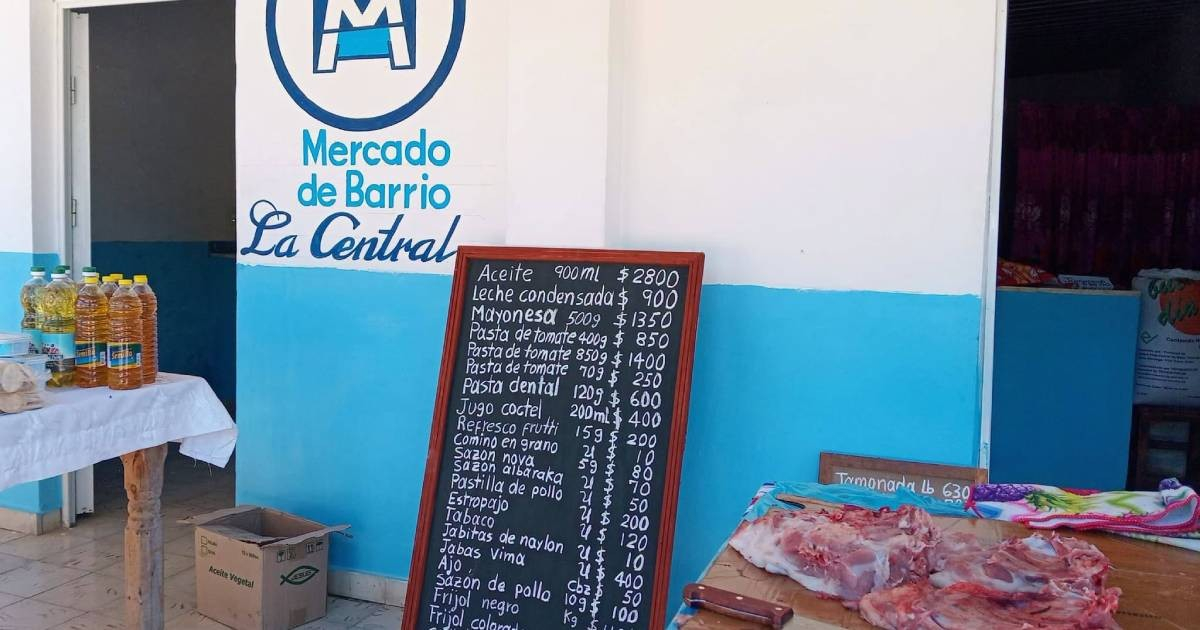
In Media Luna, the municipal government reported on Facebook about the opening of a market on Raúl Podio Saborit Avenue, in the Pueblo Nuevo neighborhood, as part of the economic and social transformations approved in June 2026.
However, what caught the users' attention the most was not the inauguration, but the prices displayed on the establishment's board.
Among the products offered are 900 milliliters of oil for 2,800 Cuban pesos (CUP), 500 grams of mayonnaise for 1,350 CUP, 850 grams of tomato paste for 1,400 CUP, and one kilogram of black beans for 1,100 CUP.
A user calculated that purchasing one unit of each of the 22 visible products would cost 12,740 pesos, an amount equivalent to almost four times the monthly minimum wage of 3,210 CUP, effective since July.
"I think it's a good idea, but still very far from the salary of a working Cuban," commented a resident.
Another questioned what really differentiates these establishments from private businesses.
"I see the same prices; you can even find cheaper products in the private sector," she stated, before noting that the main novelty appears to be the name and the official promotion.
Criticism also arose regarding the use of facilities that previously operated as warehouses for subsidized products.
"It is a disrespect to the very people: to take over a store that offered basic basket products and turn it into a market with exorbitant and inaccessible prices," denounced another neighbor.
In Manzanillo, the prices are also unconvincing
The situation repeated itself in Manzanillo, where local media announced that four neighborhood markets are now operational, including "Las Tres Puertas," located at the corner of León Street and Purísima.
Although the publication by Radio Granma journalist Baldo Alexy Blanco González highlighted the progress of this commercial modality, the comments reflected doubts about its benefits for consumers.
"It gains ground because there is no alternative, not because it is the ideal for those of us living on a salary," wrote a user.
Others reacted with shorter but equally critical phrases: "The same dog with a different collar" and "Dubai style," the latter referring to the high prices.
"The pocket is the great judge," stated another commentator, who urged to compare prices before presenting the initiative as a competitive alternative.
Concerns also extend to retirees, whose incomes are insufficient to afford a significant portion of the products available.
"I don't think my cousins can afford to buy any of these products with a retirement pension of 3,000 pesos," remarked a neighbor.
Closer markets, but not necessarily cheaper
The neighborhood markets program was regulated by the , which includes the participation of various economic actors in the management of state establishments.
The authorities initially promised prices that are 15% to 30% lower than those of other stores, although at some openings in Havana, only discounts ranging from just 10% to 15% were announced.
The expansion of the program also coincides with the reorganization of the traditional network of bodegas. The Ministry of Domestic Trade selected 1,913 establishments from a network of over 12,000 to serve vulnerable individuals, although it has not specified what will happen with the rest or how many will retain their traditional functions.
Concerns about access to food are intensifying amidst the loss of purchasing power. The Cuban economist Javier Pérez Capdevila has estimated that a person needs around 96,000 pesos per month to meet their basic needs, nearly 30 times the current minimum wage.
Related videos:
Filed under: