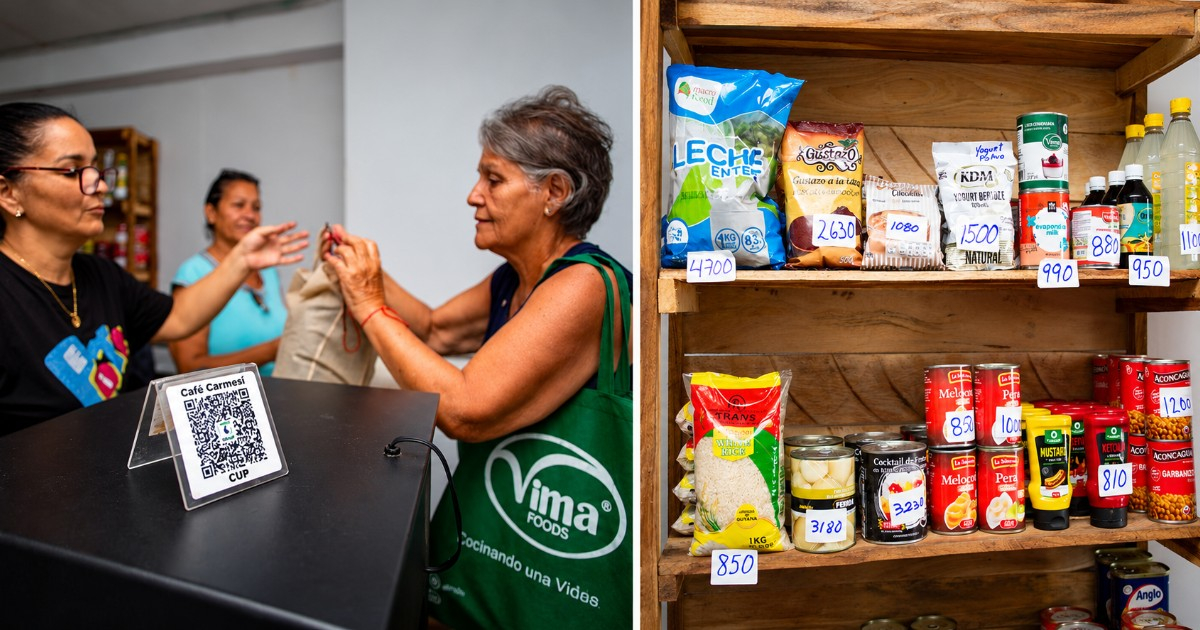
A question posed by the official portal Cubadebate regarding the operation of the new "neighborhood markets" sparked a wave of criticism, irony, and testimonials from Cubans who claim to lack access to these establishments or find prices there that are practically the same as those of the mipymes.
The post, , asked its readers: “Is there a neighborhood market in your area? How does it work? What products can you find there? Do the prices and offers meet your needs?”
The same announcement appeared on the media's website, which stated that it wanted to "hear your experience and open the debate" after a previous report on the Café Carmesí market sparked numerous comments and questions.
The response from many users was far from supporting the initiative.
One of the most shared comments summarized skepticism with a direct reference to the regime's leadership: “I want to go to the neighborhood market where Díaz-Canel and Marrero shop.”
Another user responded sarcastically: “Ask Canel, who claims he’s going around the neighborhoods”, while several people reacted with questions such as “Is that really the question you’re asking?” or “Is this true?”.
The most common criticisms were related to prices and the actual purchasing power of salaries and pensions.
"The elderly are already falling like flies, and you talk about markets that you know very well are beyond the reach of the vast poor population in this country," wrote an internet user.
Another person asserted that there is no market of that type in their area and described a very different reality: “Black market at a glance”, they said, before stating that the neighborhood store only occasionally provides a few pounds of rice and bread.
There were also testimonies from consumers who have visited these establishments and do not notice any substantial differences compared to other businesses.
"The corner microenterprise has the same price as the store on the other corner," a user stated.
Another one pointed out that they had seen the prices of one of these markets on television and reacted: “I was shocked to see them. Just like in other places.”
From different provinces, there were also comments asserting that these establishments simply do not yet exist in their communities. Users mentioned areas in Havana, Granma, and Holguín, among other regions, while some publicly asked where they could find one.
A resident of Santiago de Cuba reported that she visited one of these markets and asked if she could pay by transfer. According to her account, the establishment only accepted this method between 8:00 and 9:00 in the morning, a schedule she found incompatible with those who work.
Another comment described the model as “a small and medium enterprise by another name”, while several users used similar expressions: “small and medium enterprise store”, “just like any small and medium enterprise”, or “a place for resale”.
There were also questions raised about the very concept of the establishments. One reader argued that the issue is not just about bringing sales points closer to communities, but also about ensuring production and prices that the majority of the population can afford.
"What is needed is for all to respect the customer and for prices to be truly affordable," suggested another user, noting that the current economic situation makes it difficult to present these stores as a solution.
Among the more extensive responses, there was even a critique from positions favorable to the system itself, which described the idea as “nonfunctional and utopian” as long as food prices continue to rise and work incomes do not guarantee sustenance.
Other users openly resorted to sarcasm. One wrote that with his salary as a teacher, he could buy all the products of the month and still have money left over, immediately clarifying: “Notice the sarcasm and irony”.
Another summarized the perception that the initiative does not address the underlying problem with a question: “Neighborhood market? Or market for the wealthy?”.
The responses come after the regime presented these establishments as one of the alternatives to transform the deteriorating state retail network and bring essential products closer to the population.
In September, authorities ensured that the so-called "neighborhood markets" were to offer products at prices 15% to 30% lower than those of other businesses.
The promise included food items such as rice, sugar, oil, chicken, eggs, and powdered milk, as well as hygiene products.
The model allows state-owned establishments to be managed through bidding by small and medium-sized enterprises (mipymes), cooperatives, self-employed workers, and other economic actors.
Grocery stores and butcher shops are among the establishments that are being transformed under this scheme.
Practical experience has shown, however, significant differences between the officially promoted image and what some consumers encounter.
In Boyeros, Havana, authorities inaugurated a facility announcing discounts of between 10% and 15% on food and hygiene products.
In Contramaestre, Santiago de Cuba, another market displayed products such as rice for 350 pesos, chicken for 750, eggs at 150 each, oil for 2,000, and powdered milk for 4,000 pesos.
The reactions there were also mostly critical, and one of them summarized the new model by saying that they had simply “brought the small and medium enterprises closer to home”.
Few days later, a resident of Boyeros documented a neighborhood market with barely five products available: rice, sugar, beans, and salt, while a large part of the sales areas remained empty.
The lack of supplies coincides with the deterioration of the traditional warehouse network. At the beginning of October, a report showed a warehouse that had received cigars in August, beans in September, and no products in October, while neighborhood markets were officially presented as an alternative to the shortage.
Related videos:
Filed under: