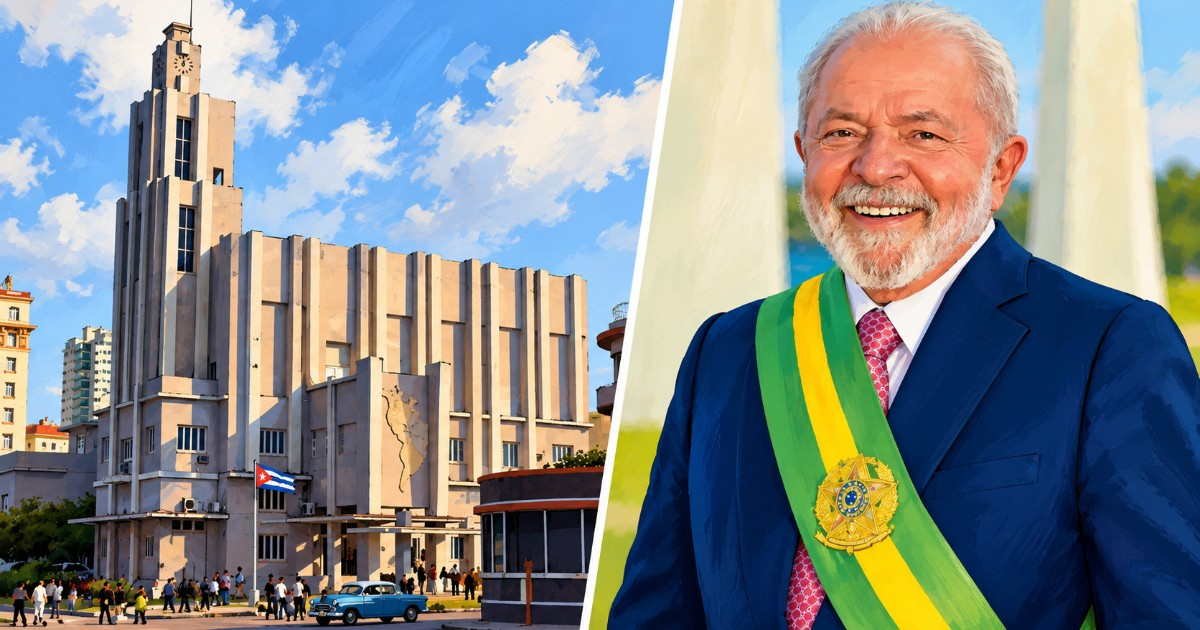
From Havana, three organizations linked to the Cuban regime have taken a stance in the second round of Brazil's presidential elections. The Casa de las Américas, the Cuban chapter of the Network in Defense of Humanity, and the International Committee for Peace, Justice, and Dignity of Peoples issued a joint statement in support of President Luiz Inácio Lula da Silva and called on social movements, artists, and intellectuals to mobilize in his favor for October 25.
The statement, dated Monday, October 5 in Havana and fully reproduced by La Jornada San Luis, is particularly striking for its central argument: while it accuses the United States and Israel of interfering in the Brazilian electoral process, an institution belonging to the Cuban state framework is openly participating in the political dispute of another country.
Accusations against the United States, Israel, and evangelical pastors
The signatories denounce an alleged "substantial financing from the American and Israeli lobby" to undermine Lula. They also point to media outlets and "evangelical preachers" as responsible for promoting the Brazilian right and label the opposition candidate, Flávio Bolsonaro, as fascist.
However, the text does not identify the alleged financiers, nor does it provide figures or include documents that substantiate the reported payments. Therefore, these are accusations from the signing organizations, not facts demonstrated by the statement. The Brazilian media outlet Brasil 247, which reported on the statement on October 9, also cautioned that no specific evidence was presented.
The statement came after Flávio Bolsonaro, senator and son of former president Jair Bolsonaro, surpassed Lula in the first round on October 4, with approximately 47.03% of valid votes compared to the incumbent's 45.16%. Neither candidate reached the necessary majority, and Brazilians will decide the presidency in the second round on October 25.
An institution of the Cuban state intervenes in the Brazilian electoral debate
The Casa de las Américas is not a civic organization independent of the political power in Havana. Its own , defines it as an institution affiliated with the Ministry of Culture and establishes that its president is appointed by the head of Government, upon the proposal of the corresponding minister.
That a state entity expresses an international political preference does not, by itself, constitute illegal electoral intervention. Nor is publishing a manifesto the same as secretly funding a campaign. However, it does reveal a political contradiction: from an institution subordinate to a regime that systematically denounces foreign interference, an international mobilization is called for in support of a candidate for the presidency of Brazil, while unsubstantiated accusations of external funding are presented as certainties in the manifesto.
The appeal to sovereignty is thus conditioned by ideological affinity: the signatories deem the international political pressure in favor of Lula to be legitimate, but attribute the advancement of his opponents to a foreign conspiracy. This interpretation, lacking evidence of the alleged funding, also undermines the significance of the millions of Brazilians who voted for an alternative to the current president.
What Havana has at stake in Brazil's elections
The Cuban regime's interest in Lula's continuity has political, diplomatic, and economic precedents. During various administrations of the Workers' Party, Brazil has been an important interlocutor for Havana. Among the most significant cooperation projects was the financing of the Mariel port, linked to the Cuban military conglomerate GAESA, through the Brazilian development bank BNDES.
This link has also left an outstanding bill. In May 2026, CiberCuba reported, based on data from the Brazilian government and CNN Brasil, that Cuba had accumulated an unpaid debt of approximately 676 million dollars with Brazil, with no official forecast for resolution. Brazilian legislation restricts new credits of this nature to delinquent countries.
Another precedent is the Mais Médicos program, which since 2013 has incorporated Cuban health professionals in Brazil through cooperation agreements. In 2018, the Government of Havana decided to withdraw around 8,300 doctors following the conflict with Jair Bolsonaro, then the elected president, as reported by the Pan American Health Organization. The episode demonstrated how much the bilateral relationship can change with a political shift in Brasília, although it does not alone allow for anticipating the decisions of a potential government under Flávio Bolsonaro.
Brazil has also diplomatically backed Havana in international forums. A change in government could alter those positions, but the extent of that change would depend on the future decisions of Brazilian authorities, not on the warnings from the signing organizations.
The manifesto circulated from Cuba ultimately illustrates the political interest the regime has in the Brazilian outcome. While accusing foreign powers of attempting to influence the election, one of its own state institutions publicly supports Lula's campaign. The decision rests with the voters of Brazil on October 25th.
Related videos:
Filed under: