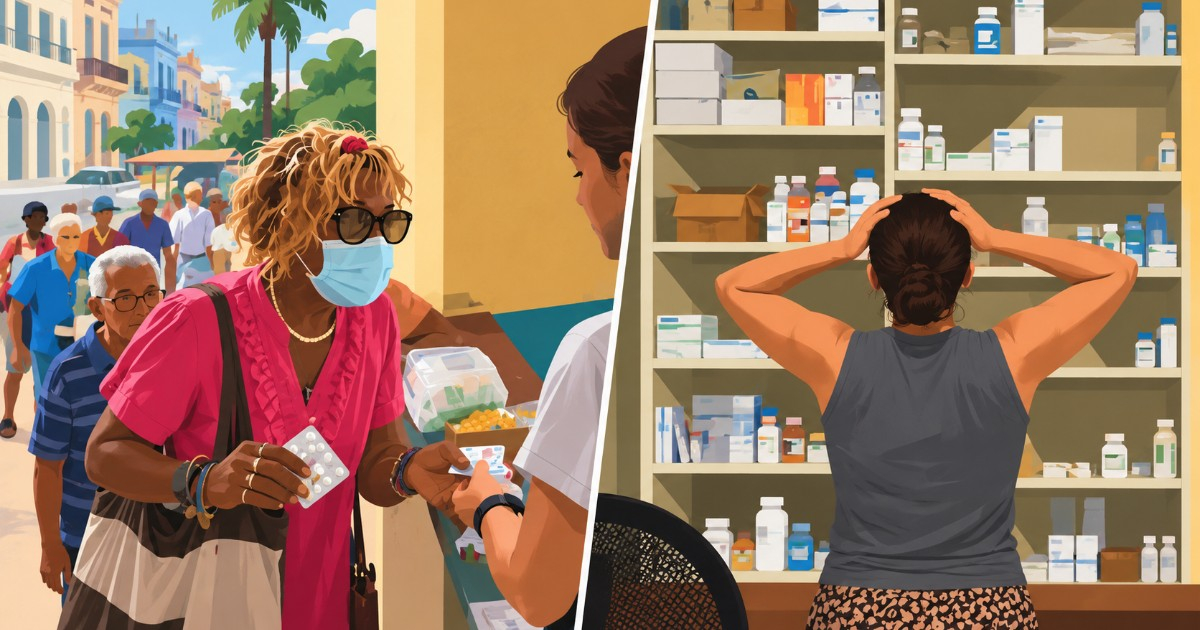
In the Havanese Vedado neighborhood, residents who cannot find their medications in state pharmacies receive assistance from a solidarity network that distributes them for free. The initiative, known as "Medicine is not for sale," organizes requests via WhatsApp and operates on donations and volunteer work, amid a shortage that continues to affect Cuban patients.
The project is coordinated by Laura Mendoza, according to a report by journalist Andrea Rodríguez for the Associated Press (AP), published this Sunday, October 11. The agency documented how, on Thursdays and Sundays at noon, Mendoza delivers the medications that beneficiaries have previously requested. Among the available products are antihistamines, diuretics, eye drops, and antibiotics.
Donations, WhatsApp groups, and deliveries to those who cannot go out
Mendoza explained to AP that the project coordinates five WhatsApp groups in Havana and has added another one in Guanabo. He also estimated that there are about a hundred similar community initiatives in the capital, a figure that reflects his perception rather than an official record.
The network operates with the support of Cáritas and receives medications from humanitarian organizations in Canada and the United States, as well as from travelers and neighbors who contribute what they can. According to its coordinator, the donations received by the initiative exceed 13 kilograms weekly. This volume refers to the weight of the products received, not the number of patients treated or the complete treatments available.
The collaboration also includes deliveries to individuals who cannot move on their own. However, solidarity has its limits: medications that require refrigeration, certain cancer treatments, and materials such as syringes, gauze, or anesthetics are among the most difficult needs to meet, according to testimonies gathered by AP.
The shortage that forces the search for alternatives
The existence of these networks reflects the diminishing ability of state pharmacies to guarantee routine treatments. The leader Miguel Díaz-Canel acknowledged the seriousness of the medication shortage in statements released on October 7. In August, he had already admitted that only about 30% of the basic medication list was available.
The shortage also extends to domestic manufacturing. AP recalled that the president of BioCubaFarma, Mayda Mauri Pérez, reported in June that nearly 300 of the 395 medications that the company was responsible for supplying had not been produced due to issues with imported raw materials. In Ciego de Ávila, health authorities also acknowledged that only 10% of the basic medicine supply was available in state pharmacies, affected by both shortages and distribution problems.
The difficulty lies not only in finding the product but also in being able to afford it when it appears outside of state channels. A retiree interviewed by AP reported that informal sellers had asked for as much as 1,000 pesos for a quantity of medication that she used to buy at a significantly lower subsidized price. According to her account, that amount exceeds 30% of her monthly pension. This reflects her specific experience, rather than a uniform price for all patients.
Private pharmacies continue to fail to meet the immediate need
Amid the crisis, the Cuban regime enabled the private management of pharmacies through Decree 160/2026, which came into effect in August. However, allowing the activity does not mean that authorized and stocked establishments are already available to the public. According to data from the Ministry of Public Health released in September, 36 proposals were under review and 14 had received approval to proceed, yet no pharmacy under the new model had opened to the public at that time. The AP report from October 11 also indicates that its opening was still pending.
The new model maintains state controls over imports, which must go through Medicuba or Farmacuba, and requires health authorizations to sell medications. Even when the establishments begin to operate, price will still be a concern for people with very low incomes.
Meanwhile, solidarity deliveries help to address specific needs, but they rely on irregular donations and cannot replace a network of pharmacies with a continuous supply and affordable medications. The assistance from volunteers exposes a reality that directly affects thousands of families: obtaining basic treatment has become an uncertain pursuit.
Related videos:
Filed under: