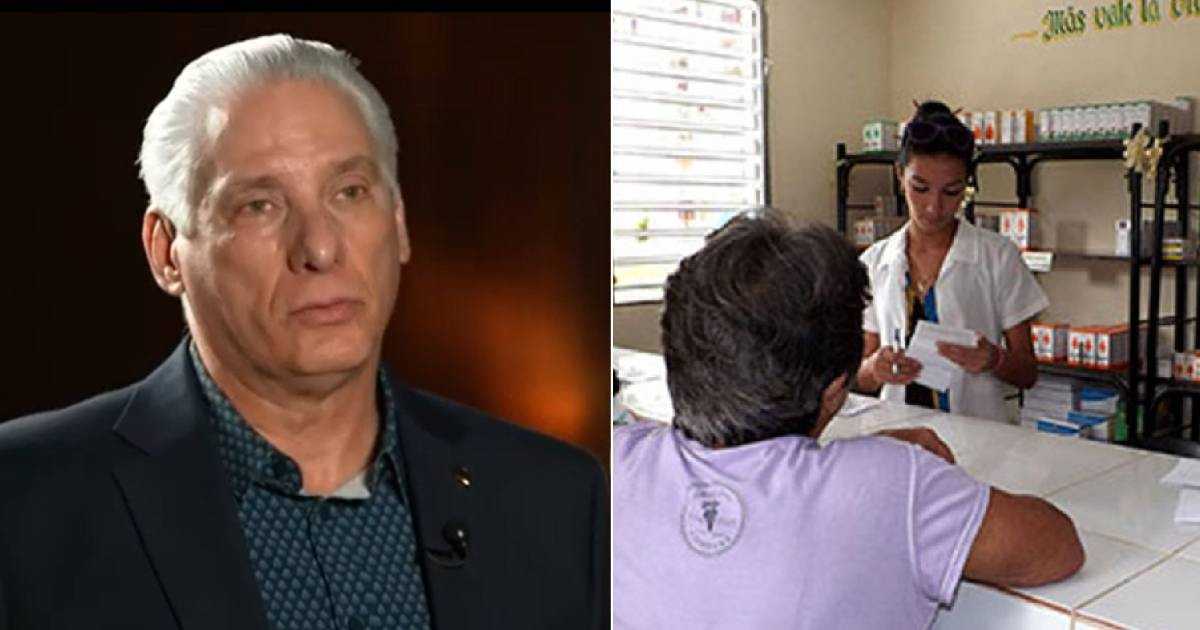
The leader Miguel Díaz-Canel acknowledged this Wednesday the severe shortage of medications that Cuba is experiencing and attributed the crisis primarily to the lack of foreign currency caused by what the regime refers to as the "intensification of the blockade" by the United States, in a new public admission that contrasts with the official propaganda of Cuba as a "medical powerhouse."
The ruler made the statements during the second broadcast of his radio program Criterio Compartido, on Radio Rebelde, in response to a question from a citizen regarding the shortage of medications.
Díaz-Canel stated that "the biopharmaceutical sector in Cuba has been one of the hardest hit by the intensification of the blockade" and asserted that the island has "a robust and capable biotechnology and pharmaceutical industry" that, with access to foreign currency, could "purchase raw materials to produce most of the medications needed by the country."
The Cuban basic medicine list includes 651 entries —250 imported and 401 produced nationally— but the regime acknowledges that the embargo prevents it from acquiring 70% of what is necessary, according to unverified official figures.
What Díaz-Canel omitted is that the U.S. embargo exempts food and medications since the Torricelli Act of 1992 and the Trade Sanctions Reform Act of 2000, although these operations require licenses and export controls. The State Department reiterated in August that these exceptions remain in effect.
He also did not mention that last August he had already admitted that only 30% of the essential medicine stock was available —seven out of ten essential medications were missing— along with devastating figures: 98,500 patients on the surgical waiting list, including 12,000 children; 117,000 adults and 1,200 minors with cancer without first-line treatments; and an infant mortality rate that nearly doubled to 9.8 per 1,000 live births.
The contradiction with the regime's priorities is hard to ignore. In 2024, the State allocated more than 36.8 billion pesos to tourism activities compared to only 1.977 billion for public health. According to financial documents obtained by The Miami Herald, the military tourism company Gaviota held about 4.3 billion dollars in accounts—almost 13 times the 339 million that the Government itself estimated would be needed to supply pharmacies with essential medications.
Additionally, Cuba generates between 6,000 and 8,000 million dollars annually in medical service exports, with around 24,000 professionals deployed in 56 countries, while the State retains approximately 85% of those payments.
In Ciego de Ávila, the health system operated in August with only 60 medications —10% of the basic list—, and 151 drugs did not reach the warehouses due to internal logistical issues and lack of fuel, not because of the embargo.
As a partial response to the crisis, the regime authorized private companies to manage pharmacies in July, an activity that had been reserved for the State for decades. In early September, the Ministry of Public Health reported that 36 private pharmacy projects were being evaluated, of which 14 had been approved to move forward. However, none have officially begun operations, and all medication imports must be channeled exclusively through the state importers Medicuba and Farmacuba.
Díaz-Canel also acknowledged that there are individuals who "illegally market, even speculatively and abusively, the prices" of medications, a reality that has been fueled by the very collapse of the state system.
The new customs regulations published on Monday (Resolution 340/2026) will take effect on October 12 and will govern personal imports — including shipments of medications from abroad, allowed since February up to 200 dollars or 20 kilograms per person.
Related videos:
Filed under: